
Last Watched

"Future"  Sort by

Fix Our Climate

   2021    Nature
The climate is changing faster than ever, which is why 'fix our climate' is one of the five goals of the Earthshot Prize. Prince William, Sir David Attenborough and Christiana Figueres highlight inspiring and often unexpected solutions to the challenge. In this film, we'll explain the scale of the problem posed by climate change and will introduce you to some amazing people already working on climate crisis. One of these three finalists will win the Earthshot Prize and get the platform and resources they need to scale their ground-breaking work. Nine more solutions for fixing our climate will receive the same support over the course of this decade.
Series: The Earthshot Prize: Repairing Our Planet
Living Together

   2006    Nature
The documentary deals with the future of conservation. It begins by looking at previous efforts. The 'Save The Whales' campaign, which started in the 1960s, is seen to have had a limited effect, as whaling continues and fish stocks also decline. In the 1990s, as head of the Kenya Wildlife Service, Richard Leakey took on the poachers by employing armed units. Although it was successful in saving elephants, the policy was detrimental to the Maasai people, who were forced from their land. The need for "fortress" areas is questioned, and the recently highlighted Raja Ampat coral reef in Indonesia is an example. The more tourism it generates, the greater the potential for damage — and inevitable coastal construction. Sustainable development is viewed as controversial, and one contributor perceives it to currently be a "contradiction in terms". Trophy hunting is also contentious. Those that support it argue that it generates wealth for local economies, while its opponents point to the reducing numbers of species such as the markhor. Ecotourism is shown to be beneficial, as it is in the interests of its providers to protect their environments. However, in some areas, such as the Borneo rainforests, the great diversity of species is being replaced by monocultures. The role of both religion and the media in conservation is argued to be extremely important. Contributors to the programme admit a degree of worry about the future, but also optimism.

What is the Universe Made of

   2018    Science    HD
This series takes viewers on a journey to the frontiers of science, where researchers are tackling some of the biggest questions about life and the cosmos. The universe is hiding something. In fact, it is hiding a lot. Everything we experience on Earth, the stars and galaxies we see in the cosmos—all the 'normal' matter and energy that we understand—make up only 5% of the known universe. The other 95% is made up of two mysterious components: 'dark matter' and 'dark energy.' We can’t see them, but we know they’re there. And what’s more —these two shadowy ingredients are locked in an epic battle to control the very fate of the universe.
Now, scientists are trying to shed light on the so-called 'dark sector' as the latest generation of detectors rev up, and powerful telescopes peer deeper into space than ever before to observe how it behaves. Will the discoveries help reveal how galaxies formed? In the series finale, Nova Wonders journeys to the stars and back to investigate what we know —and don’t know. Find out how scientists are discovering new secrets about the history of the universe, and why they’re predicting a shocking future.
Series: Nova Wonders

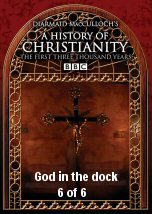
God in the Dock

   2011    Culture
Diarmaid MacCulloch's own life story makes him a symbol of a distinctive feature about Western Christianity - scepticism, a tendency to doubt which has transformed both Western culture and Christianity. In the final programme in the series, he asks where that change came from. He challenges the simplistic notion that faith in Christianity has steadily ebbed away before the relentless advance of science, reason and progress, and shows instead how the tide of faith perversely flows back in. Despite the attacks of Newton, Voltaire, the French Revolutionaries and Darwin, Christianity has shown a remarkable resilience. The greatest damage to Christianity was actually inflicted to its moral credibility by the two great wars of the 20th century and by its entanglement with Fascism and Nazism. And yet it is during crisis that the Church has rediscovered deep and enduring truths about itself, which may even be a clue to its future.
Series: A History of Christianity

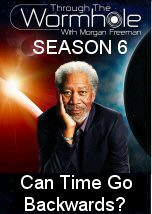
Can Time Go Backwards

   2015    Science
We move around in space, but we are stuck in a prison of time moving ever forwards. Einstein said, 'The distinction between past, present and future is only a stubbornly persistent illusion.' Is our experience of the ticking clock merely a trick of the mind? Could science ever make the clock move backwards? Experiments in quantum physics are showing that the future influences the present: what happens later limits the choices we think we have now. The laws of physics say visiting or talking to ourselves in the past is possible – but changing history once we get there is not.
Series: Through the Wormhole Season 6

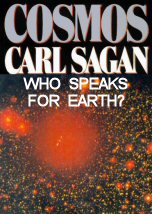
Who Speaks for Earth

   1980    Culture
Sagan reflects on the future of humanity and the question of 'who speaks for Earth?' when meeting extraterrestrials. He discusses the very different meetings of the Tlingit people and explorer Jean-François de La Perouse with the destruction of the Aztecs by Spanish conquistadors, the looming threat of nuclear warfare, and the threats shown by destruction of the Library of Alexandria and the murder of Hypatia. The episode ends with an overview of the beginning of the universe, the evolution of life, and the accomplishments of humanity and makes a plea to mankind to cherish life and continue its journey in the cosmos. The Cosmos Update notes the preliminary reconnaissance of planets with spacecraft, the fall of the Berlin Wall and the end of apartheid in South Africa, and measures towards the reduction of nuclear weapons.
Series: Cosmos