Last Watched

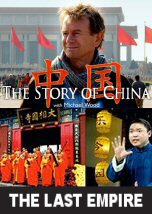
The Last Empire

   2016    History
China's last empire, the Qing, lasted from 1644 to 1912. It began in violence and war as the Manchus swept down from the north, but invaders became emperors, with three generations of one family ruling the country. Among them, Michael Wood argues, was China's greatest emperor - Kangxi. Under the Qing, China doubled in size to include Xinjiang in the far west, as well as Mongolia and Tibet, creating the essential shape of China today. The new dynasty tolerated a diversity of cultures and religions, including Islam. In Kaifeng, Michael visits a women's mosque with a female imam, a delightful scene that ends with laughter and selfies! The Qing also undertook huge cultural enterprises. At a traditional printing house where the wood blocks are hand-carved, we see how the Complete Tang Poems were reproduced - all 48,000 of them. We travel through the wintry countryside to a remote village where a hardy audience watch open-air opera in the snow and visit a painter's studio, and 'storytelling' houses in Yangzhou. In the 18th century, China was arguably the greatest economy in the world, and we get a fabulous sense of the rich culture that came with prosperity. But then came the clash with the British, in the first Opium War, when a British expedition destroyed the Qing navy and extracted territory and trading rights. We leave with a glimpse of the future. 'Every dynasty has risen and declined,' says Michael, 'and has needed new life to regenerate, and this time the catalyst was the British.' Among the ports China ceded was an almost uninhabited island, Hong Kong, one of today's greatest financial centres, and Shanghai, a small town then but now one of the greatest cities in world.
Series: The Story of China
Absolute Zero Conquest of Cold

   2007    Technology
This scientific detective tale tells the story of a remarkable group of pioneers who wanted to reach the ultimate extreme: absolute zero, a place so cold that the physical world as we know it doesn't exist, electricity flows without resistance, fluids defy gravity and the speed of light can be reduced to 38 miles per hour. Absolute zero became the Holy Grail of temperature physicists and is considered the gateway to many new technologies, such as nano-construction, neurological networks and quantum computing. The possibilities, it seems, are limitless. The first episode Chronicles the major discoveries leading towards the mastery of cold, beginning with King James I's court magician, Cornelius Drebbel, who managed to air condition the largest interior space in the British Isles in 1620. Other stories will include the first "natural philosopher," Robert Boyle, a founder of the Royal Society in Great Britain; the Grand Duke Ferdinand II de Medici's involvement in the creation of the first thermometer; the establishment of the laws of thermodynamics by three young scientists, Sadi Carnot, James Joule and William Thomson; and Michael Faraday's critical achievement in liquefying several other gases which set the stage for the commercial application of cold to refrigeration and air conditioning.
Series: Absolute Zero

Revive Our Oceans

   2021    Nature
Seafood is a substantial part of the daily diet of over three billion people and oceans absorbs almost a third of all the greenhouse gases we emits. Buy the ocean it is not what it once was. Scenes of extraordinary ocean abundance now only exist in far-off places or in tales from the past. We urgently need to mend our relationship with our oceans and allow them to thrive once again.
Prince William, David Attenborough and Shakira find out about inspiring people and projects across the world that can help us stop damaging the oceans and enable their revival.
Series: The Earthshot Prize: Repairing Our Planet

Wilding

   2021    Nature
Jeremy Clarkson decides to become a naturalist. 'In just 30 years, insect numbers have dropped by 25% and they're still falling. Without insects, all life on Earth ends. Everywhere where insects like to live is disappearing and I've decided to do something about that. My plan is to make my hedgerows, my valleys, my woods, and my streams more attractive to creepy crawlies. In essence, I am going to leave chunks of the farm completely alone. I'm going to put Mother Nature in the driving seat. It's a process called wilding.'
Series: Clarkson Farm

Earthflight South America

   2012    Nature
The documentary series gives a bird's-eye view of South America, as condors soar along the Andes, scarlet macaws explore the heart of the Amazon and hummingbirds and vultures see the continent's greatest sights. It is a journey that includes Machu Picchu, the Nasca Lines and the cities of Rio de Janeiro and Santiago. In Patagonia, giant petrels shadow killer whales as they hunt seals by stranding their huge bodies on the beach. At Iguassu Falls, dusky swifts dive through the cascades to huddle in communal roosts while hummingbirds bathe below. In a secret Andean location, condors soar in flocks over 40-strong and scavenge on casualties from herds of fighting guanacos. Elsewhere, a mother condor gently pushes her youngster to the edge of a 200-metre cliff, as flight school begins. Deep in the Amazon, macaws seek medicinal clay. They are joined by a host of secretive jungle animals, including spider monkeys and tapirs, all after the same remedy. In Peru, condors soar over fighting sea lions waiting for causalities and on a mass exodus north, birds converge on the Panama Canal. In Costa Rica, black vultures descend on turtles as they lay their eggs in the sand and pick off the eggs that ping-pong through the air.
Series: Earthflight

Ghosts of the Crusades

       History
The series Warrior Graveyard uncovers some extraordinary warrior skeletons from history. Archaeologists and forensic scientists use remains to tell the story of famous warriors of the past and unleash the full force of modern forensics upon them: battle scars, bone deformations and recoverable scraps of DNA will all be tested and explored. CGI and drama will then bring them dramatically to life, revealing a revolutionary new picture of how these warriors lived - and died.
An archaeological and forensic examination of six crusaders' bones brings to life the 1179 Battle of Jacob's Ford, revealing the wounds that killed the warriors in the Holy Land. With every sword slash comes an insight into an historic day. Excavations along the Israel/ Jordan border are unearthing skeletons and rewriting the history of the First Crusade. The site at Jacob's Ford is the only known Crusader battle site with complete skeletons. To secure the road between Akkon and Damascus, King Baldwin IV of Jerusalem had a mighty castle built at the Jacob's Ford of the Jordan River in October 1178. The fortress was a thorn in the side of Sultan Saladin, so he had it stormed a year later, before it was completed.
Excavations have been taking place on the site of the legendary crusader castle since the early 1990s. Archaeologists and forensic experts have examined the remains of six fallen crusaders and uncovered fascinating details about the Battle of Chastellet. The programme has secured access to the excavation and remains of some of the 80 Crusader Knights and 750 foot soldiers stationed at the fort when it was attacked and its Crusaders massacred by Saladin's army in 1179, in the battle that changed the course of history in the Middle East.
Series: Warrior Graveyard
Top Gear

Top Gear

2012  Technology
Clarkson Farm

Clarkson Farm

2021  Nature
The Human Body

The Human Body

1998  Medicine
Magic Numbers

Magic Numbers

2018  Science
The Hunt

The Hunt

2015  Nature