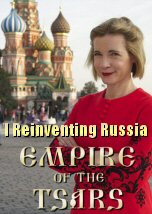









Lucy Worsley continues her journey through Russia in the footsteps of the Romanovs, the most powerful royal dynasty in modern European history. In this episode she examines the extraordinary reign of Catherine the Great, and the traumatic conflict with napoleonic France that provides the setting for the novel War and Peace. At the magnificent palace of Peterhof near St Petersburg, Lucy charts the meteoric rise of Catherine the Great, who seized the Russian throne from her husband Peter III in 1762 and became the most powerful woman in the world. Catherine was a woman of huge passions - for art, for her adopted country (she was German by birth) and for her many lovers. Catherine expanded her empire through military victories overseas, while at home she encouraged education and introduced smallpox inoculation to Russia. But Catherine struggled to introduce deeper reforms, and the institution of serfdom remained largely unchanged. Lucy explains how this injustice fuelled a violent rebellion. Nevertheless, Catherine left Russia more powerful on the world stage than ever. But all she had achieved looked set to be undone when Napoleon invaded Russia in 1812. Lucy relives the pivotal battle of Borodino, when the Russian army finally confronted the French forces; the traumatic destruction of Moscow; and, under Catherine's grandson Alexander, the eventual victory over the French that provided the Romanov dynasty with its most glorious hour.
They are the most powerful objects in the universe. Nothing, not even light, can escape the gravitational pull of a black hole. Astronomers now think there are billions of them out in the cosmos, swallowing up planets, even entire stars in violent feeding frenzies. New theoretical research into the twisted reality of black holes suggests that three-dimensional space could be an illusion. That reality actually takes place on a two-dimensional hologram at the edge of the universe.
In this second episode, a woman recounts her journey to becoming a mouthpiece for white nationalist hate speech, work that culminates in high-profile violence and murder. Samantha confesses how she became a spokesperson on the Internet for the hate speech of one of the many white nationalist groups that swarm the United States. And this fact ended in racist violence and death during an event. 'I had to start to realize what I was supporting. Was I the victim or was I also a villain?' says Samantha, looking into the camera. Hand in hand with xenophobia, digital true crime seems to have no respite, and so it will be shown how those supremacists work with good Wi-Fi.
In 1983 Hasbro bought the license of the Diaclone and Micro Change toys from Takara, then commissioned Marvel Comics to come up with a story-line and character names for the toys. The result: Transformers. Despite Tonka releasing the cheaper Gobots line six months earlier, Hasbro's Transformers took the toy market by storm in 1984, raking in US$150 million that year. At the peak of the toy line's popularity, The Transformers: The Movie hit theaters to further capitalize on its success, but the film polarized fans and collectors with the death of Optimus Prime and majority of the original characters. As Hasbro took full control of Transformers from Takara by the late 1980s, sales declined until the toy line was discontinued in 1991. After the failed Generation 2 reboot, Beast Wars rejuvenated the franchise in 1995. In 2007, the live-action Transformers film solidified Transformers' position as Hasbro's flagship toy line.
Caesar pursued Pompey to Greece but the tide has turned and it's Caesar who is on the run. He contacts Mark Antony, who he left in charge in Rome, to come and join him with the 13th Legion but Antony seems to be in no hurry. Vorenus has re-enlisted in Antony's Legion and he and Niobe have begun to renew their marital relationship. The presence of Niobe's sister is the only sour note in their house. Pullo meanwhile continues to train young Octavian in the use of arms and the boy's mother Atia is so pleased with his development that she decides he should take another.
The U.S. authorities granted Bhagwan's visa as a religious teacher and leader. But local officials try to build a case against the Rajneeshees with the largest immigration fraud in the history of the United States. When Sheela's thirst for power, even with murder attempts, is revealed, the Bhagwan finally breaks his silence.
Catherine expanded her empire through military victories overseas, while at home she encouraged education and introduced smallpox inoculation to Russia. But Catherine struggled to introduce deeper reforms, and the institution of serfdom remained largely unchanged. Lucy explains how this injustice fuelled a violent rebellion. Nevertheless, Catherine left Russia more powerful on the world stage than ever. But all she had achieved looked set to be undone when Napoleon invaded Russia in 1812. Lucy relives the pivotal battle of Borodino, when the Russian army finally confronted the French forces; the traumatic destruction of Moscow; and, under Catherine's grandson Alexander, the eventual victory over the French that provided the Romanov dynasty with its most glorious hour.