




Last Watched

"Modern"  Sort by

The Empire of Reason

   2017    History
Al-Khalili travels to northern Syria to discover how, a thousand years ago, the great astronomer and mathematician Al-Biruni estimated the size of the earth to within a few hundred miles of the correct figure. He discovers how medieval Islamic scholars helped turn the magical and occult practice of alchemy into modern chemistry. In Cairo, he tells the story of the extraordinary physicist Ibn al-Haytham, who helped establish the modern science of optics and proved one of the most fundamental principles in physics - that light travels in straight lines. Prof Al-Khalili argues that these scholars are among the first people to insist that all scientific theories are backed up by careful experimental observation, bringing a rigour to science that didn't really exist before.
Series: Science and Islam
Big Bang Machine

   2015    Technology
On July 4, 2012, scientists at the giant atom smashing facility at CERN announced the discovery of a subatomic particle that seems like a tantalizingly close match to the elusive Higgs Boson, thought to be responsible for giving all the stuff in the universe its mass. Since it was first proposed nearly fifty years ago, the Higgs has been the holy grail of particle physicists: finding it completes the 'standard model" that underlies all of modern particle physics. Now CERN's scientists are preparing for the Large Hadron Collider's second act, when they restart the history-making collider, running at higher energy--hoping to find the next great discovery that will change what we know about the particles and forces that make up our universe.

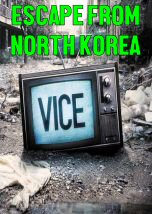
Escape from North Korea

   2013    Culture
North Koreans cross the border into China illegally every year, some via a modern-day underground railroad to freedom and eventual citizenship in South Korea. VICE visits the most dangerous place in the world: Kashmir's line of control, which partially occupies the Indian state and separates India from Pakistan.
Series: Vice

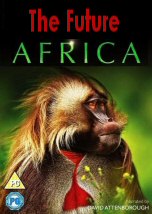
The Future

   2013    Nature
David Attenborough comes face-to-face with a baby rhino and asks what the future holds for this little one. He meets the local people who are standing side-by-side with the wildlife at this pivotal moment in their history. We discover what it takes to save a species, hold back a desert and even resurrect an entire wilderness - revealing what the world was like before modern man.
Series: Africa with David Attenborough

Comets: Frozen Wanderers

   2012    Science
We think of comets as beautiful glowing balls of light streaking across our skies with their long sweeping tails, yet comets are so much more than just a cosmic firework display. Comets have a uniquely important place in modern science. As time machines from the early universe, they could hold the key to unlock the secrets of the cosmos. Comets could even be the origin of life itself. We follow the incredible odyssey of a comet as it sails through the solar system, watching it's every move as it evolves from a dormant chunk of ice and rock into a tumbling, violently active nucleus engulfed in a gaseous haze. What we learn is a revelation; comets are even more mysterious and fascinating than we had ever imagined.
Series: How the Universe Works

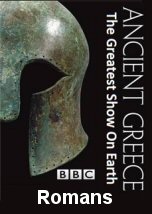
Romans

   2013    History
Dr Michael Scott examines the vital role played by the Romans in the preservation of Greek drama and in the history of theatre. He explores how the Romans absorbed Greek theatre and adapted it to their own, very Roman, ends and looks at how this famous empire provides one of the crucial connections between our modern drama and the great plays of the ancient Greeks.
Series: Ancient Greece