








Last Watched

Traceroute

   2016    Culture
A Personal Journey Into The Uncharted Depths Of Nerd Culture, A Realm Full Of Dangers, Creatures And More Or Less Precarious Working Conditions.
Artist and life-long nerd Johannes Grenzfurthner is taking us on a personal road trip from the West Coast to the East Coast of the USA, to introduce us to places and people that shaped and inspired his art and politics. Traceroute wants to chase and question the ghosts of nerddom's past, present and future. An exhilarating tour de farce into the guts of trauma, obsession and cognitive capitalism.

Willy and Sal

   2021    History
A Six-part Saga on the South Florida traffickers indicted in one of the largest drug cases in U.S. history. Alleged to be the chief U.S. distributors for two of Colombia's biggest cartels, Cuban exiles Augusto 'Willy' Falcon and Salvador 'Sal' Magluta were accused of smuggling over 75 tons of cocaine into the U.S. in the 1980s. The high school friends built a reputed $2 billion empire that made Willy and Sal two of Miami's biggest celebrities. Featuring colourful interviews with those closest to them, their defence team, and the Feds tasked with taking them down, the series paints a vivid portrait of the last of Miami's 'cocaine cowboys.'
The first episode shows how in the 1970s and '80s, friends Willy Falcon and Sal Magluta leave humble beginnings behind as they allegedly ascend to the top of Miami's drug trade.
Series: Cocaine Cowboys: The Kings of Miami

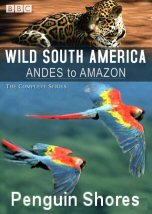
Penguin Shores

   2005    Nature
A dramatic journey along the coasts of South America, from the Falklands to the tropical Galapagos. The cold currents create rich fisheries, and support such diverse marine life as dolphins, killer whales, sea lions and albatross. But the most biquitous creatures are the penguins, which inhabit surprising locations - lush forest, arid desert and even equatorial areas.
Series: Wild South America

Life Rocky Start

   2016    Science
Four and a half billion years ago, the young Earth was a hellish place, a seething chaos of meteorite impacts, volcanoes belching noxious gases, and lightning flashing through a thin, torrid atmosphere. Then, in a process that has puzzled scientists for decades, life emerged. But how? Join mineralogist Robert Hazen as he journeys around the globe. From an ancient Moroccan market to the Australian Outback, he advances a startling and counterintuitive idea—that the rocks beneath our feet were not only essential to jump-starting life, but that microbial life helped give birth to hundreds of minerals we know and depend on today. It's a theory of the co-evolution of Earth and life that is reshaping the grand-narrative of our planet’s story.

The Cities

   2011    Culture
Humans are so clever they’ve built their own habitat, designed to keep wild nature out. Yet as we discover the urban environment is totally dependant on the natural world. Over the three years of filming for Human Planet, the teams have spent time with over seventy different communities in countries across the planet. Despite seeing many different ways of living, there are some aspects of family life that remain the same whether you live in a tree house in West Papua, or a brick house in Bolton. These similarities became very clear when the urban team went to film on a rubbish dump in Kenya. Here on the Kibarani dump on the outskirts of Mombasa, Ali, Ashe and their family live and survive amongst the rubbish, and even here, just like anywhere on the planet, everything stops for a nice cup of tea!
Series: Human Planet

Escaping ISIS

   2015    Culture
In August 2014, ISIS militants raided a Yazidi village in Syria, kidnapping thousands of men, women and children. Hundreds of the kidnapped men were killed or forced to convert to Islam; the women and children were sold as sex slaves or to marry ISIS fighters. Many were raped or became victims of other forms of sexual violence. Escaping ISIS depicts 34 of those captured by militants last year — mostly women and young children — reuniting with their families as they escape to freedom". Some victims were brought to freedom through underground networks, guides inside ISIS and resistance fighters. Women contacted the resistance fighters, begging for rescue; some said the alternative is committing suicide. Many escapees walk for several days with little food and water, often barefoot, risking getting recaptured and killed. One resistance fighter was shot in the back of the head in ISIS territory after they found out that he was working against them. The documentary shows parts of this treacherous journey to freedom.