



Last Watched

Easy Listening

   2013    Art
Series concludes with the focus shifting to the United States in the post-war years of the 1950s and beyond. Beginning with arguably the most notorious work of 20th century classical music, John Cage's 'silent' composition 4'33", it looks at how a series of maverick Americans re-invented the sound of classical music into a more simple form, bringing back harmonies and rhythms that made it increasingly popular with audiences across the world. It also examines how this music found its way into a spiritual realm, with the strain of pared-down religious composition that came to be known as 'holy minimalism'. From the Maverick concert hall in Woodstock, New York to an Orthodox cathedral in Estonia to a car park in Peckham, south London, the story is told by a stellar line-up of contributors including Philip Glass, Steve Reich, John Adams, Arvo Pärt and John Tavener.
Series: The Sound and the Fury
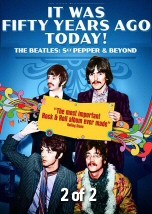
It Was Fifty Years Ago Today 2of2

   2017    Art
Featuring interviews with former employees, fellow musicians, family members and journalists, and supported by original and exclusive never-seen-before footage, this star-studded rockumentary offers a fascinating insight into the creation and recording of one of the most ground-breaking and influential albums in pop history. A documentation of the influences that went on to help create the seminal album Sgt. Pepper's Lonely Hearts Club Band.
Series: It Was Fifty Years Ago Today

Who Speaks for Earth

   1980    Culture
Sagan reflects on the future of humanity and the question of 'who speaks for Earth?' when meeting extraterrestrials. He discusses the very different meetings of the Tlingit people and explorer Jean-François de La Perouse with the destruction of the Aztecs by Spanish conquistadors, the looming threat of nuclear warfare, and the threats shown by destruction of the Library of Alexandria and the murder of Hypatia. The episode ends with an overview of the beginning of the universe, the evolution of life, and the accomplishments of humanity and makes a plea to mankind to cherish life and continue its journey in the cosmos. The Cosmos Update notes the preliminary reconnaissance of planets with spacecraft, the fall of the Berlin Wall and the end of apartheid in South Africa, and measures towards the reduction of nuclear weapons.
Series: Cosmos

Dancing in the Dark

   2015    Science
Scientists genuinely don't know what most of our universe is made of. The atoms we're made from only make up four per cent. The rest is dark matter and dark energy (for 'dark', read 'don't know'). The Large Hadron Collider at CERN has been upgraded. When it's switched on in March 2015, its collisions will have twice the energy they did before. The hope is that scientists will discover the identity of dark matter in the debris. The stakes are high - because if dark matter fails to show itself, it might mean that physics itself needs a rethink.

The Lost Gardens of Babylon

   2014    History
Of the Seven Wonders of the Ancient World, the Hanging Garden of Babylon is the most elusive of these constructions of classical antiquity. While traces have been found of the Great Pyramid of Gaza, the Temple of Artemis at Ephesus, the Statue of Zeus at Olympia, the Mausoleum of Halicarnassus, the Colossus of Rhodes and the Lighthouse of Alexandria, centuries of digging have turned up nothing about the lost gardens of Babylon – until now.
Why, in the nearly 3,000 years since the gardens were presumably built, has no archeological evidence ever been found to support their existence? Is the Hanging Garden of Babylon a myth or a mystery to be solved?
Travel with Dr. Stephanie Dalley of Oxford University’s Oriental Institute and author of The Mystery of the Hanging Garden of Babylon, to one of the most dangerous places on earth, as she sets out to answer these questions and prove not only that the gardens did exist, but also identify where they most likely were located, describe what they looked like and explain how they were constructed.
Series: Secrets of the Dead

The Cognitive Tradeoff Hypothesis

   2019    Science
Join us on a journey into the mysterious depths of the human psyche as we investigate the strange and surprising terrain of the Mind Field.
Chimps and Humans can be traced biologically back to a common ancestor. The Cognitive Tradeoff Hypothesis theorizes about the two different paths of development - particularly cognitive development - that occurred in these two species after the split. Chimps stayed in the trees and developed some extraordinary cognitive capabilities which are shown by the research work of Japanese scientists, while humans came down into the savanna and developed social capabilities and language.
The hypothesis is that humans 'traded' some aspects of cognitive capabilities by re-purposing areas of the brain that had evolved in the context of other uses. Those capabilities are kept in chimps and are far surpassing that of normal humans. This is shown by the research work of scientists at the Primate Research Center connected with Kyoto University.
Series: Mind Field