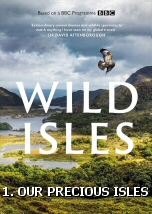
In the first episode, Sir David Attenborough reveals the unexpected wildlife riches of the British Isles, showcasing the dramatic and spectacular habitats that rival any across the globe. This journey uncovers the diversity of life in the UK's unique landscapes, from the intricate world of bumblebees to the swift lives of kingfishers. The episode captures extraordinary scenes of nature, including killer whales preying on seals, golden eagles in the Scottish mountains, the cunning tactics of woodland plants, and the perilous life of puffins evading gulls. It highlights Britain's geological diversity as a cornerstone of its natural wealth, contributing to an array of habitats and supporting a wide range of life. Britain's importance extends to being a haven for migratory birds, with our seas feeding 65% of the world's gannets and supporting the largest colony of northern gannets on Scotland's Bass Rock. The west coast of Scotland offers sanctuary to barnacle geese due to its abundant food and mild climate, though they remain vigilant against hunting sea eagles. Despite these natural treasures, Britain faces challenges as one of the most nature-depleted countries globally. Sir David Attenborough emphasizes the need to conserve and restore these wild isles for the enjoyment and benefit of future generations.
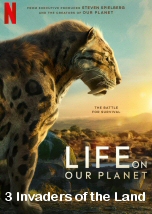
The third episode of the series is a visually stunning journey, from the earliest lichens and microplants to the imposing dinosaurs and the diversity of life forms we know today. Key moments in Earth's history are highlighted, such as the appearance of arthropods, the development of terrestrial flora and fauna, and the mass extinctions that have reshaped ecosystems. The documentary not only shows the resilience and adaptability of life on our planet but also highlights the fragility of our ecosystem and the crucial importance of preserving biodiversity for the future of Earth. This documentary is a celebration of life in all its forms and a powerful reminder of our role in protecting this incredibly diverse and dynamic world.
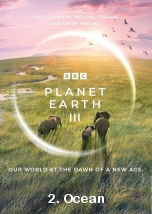
This second episode is a captivating exploration of the ocean's wonders and mysteries. It reveals how a significant part of our planet remains unexplored, primarily due to its vast water coverage. The film emphasizes the extraordinary discoveries awaiting every journey below the water's surface, with over a thousand new species identified annually. Home to 80% of all animal life on Earth, the ocean's diverse habitats host a range of surprising behaviors and life-and-death struggles, often hidden beneath a serene exterior. The shallow tropical seas, appearing as paradises, are actually arenas of intense survival battles. Predatory lionfish, with their patient hunting tactics, and clown frogfish, using a unique fishing rod-like dorsal fin as a lure, demonstrate the ocean's complex food web. The documentary also explores the kelp forests off the North American coast, revealing their role as nurseries for young horn sharks. Amidst these underwater forests lurk giant sea bass, wolf-eels, and various sharks like houndsharks and broadnose sevengills, posing significant threats to the smaller inhabitants. The episode takes viewers to the twilight and midnight zones of the ocean, unveiling alien-like creatures such as the siphonophore, glass squid, and gulper eel, adapted to the extreme conditions of deep waters. The journey concludes with the moving story of the pearl octopus, whose devotion to her eggs in the challenging deep-sea environment is both heartwarming and heartbreaking. This episode is not only a showcase of the ocean's diverse inhabitants but also a reminder of the urgent need to understand and protect this vast, mysterious, and vital part of our planet.
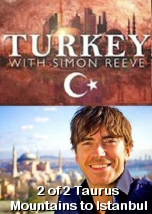
In the Taurus Mountains Simon stays with descendants of the original Turks, nomads known as Yoruks, whose lifestyle is under threat from the modern world and an increasingly religious government. They're not the only minority at odds with the authorities in Turkey; Simon sees first-hand the devastating effects of fighting in the country's Kurdish region. In an area where the government has detained foreign journalists, Simon gathers unique footage in the aftermath of a crackdown on Kurdish militants - the wholesale destruction of the historic centre of one of Turkey's oldest cities. Away from the conflict in the south, Simon heads towards the Black Sea coast. He meets a wildlife conservationist protecting Turkey's population of brown bears, and villagers who still communicate over long distances using an ancient bird language. In the country's capital he meets a victim of President Erdogan's authoritarian purge of people accused of complicity in the failed coup against him. Finally Simon's journey comes full circle when he returns to Istanbul - home to the new craze of 'Ottomania', a celebration of the vast empire that preceded modern Turkey. Simon visits the set of one of the world's most popular TV dramas - even getting a speaking role - based in the court of an Ottoman sultan
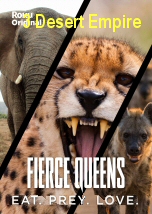
There is one miniature fierce queen, hardly bigger than a grain of rice. Enter the fascinating, and sometimes brutal world of honey ants, struggling not just for survival, but power - all in service of their fearless leader, the queen. Her story has it all-- ambition, murder, and a great army of female warriors on the rampage.
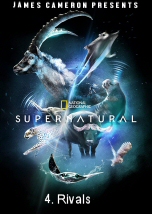
We may be smart, but we're still discovering animals have countless skills, every bit as impressive. In a world full of unexpected foes, competition is evolution's ultimate driving force. Is the secret behind the incredible diversity of life on earth, and the most extraordinary animal powers.
















Britain's importance extends to being a haven for migratory birds, with our seas feeding 65% of the world's gannets and supporting the largest colony of northern gannets on Scotland's Bass Rock. The west coast of Scotland offers sanctuary to barnacle geese due to its abundant food and mild climate, though they remain vigilant against hunting sea eagles. Despite these natural treasures, Britain faces challenges as one of the most nature-depleted countries globally. Sir David Attenborough emphasizes the need to conserve and restore these wild isles for the enjoyment and benefit of future generations.