
Last Watched

Lost Horizons: The Big Bang

   2008    Science
Professor Jim Al Khalili from the University of Surrey delves into over 50 years of the BBC science archive to tell the story behind the emergence of one of the greatest theories of modern science, the Big Bang. The remarkable idea that our universe simply began from nothing has not always been accepted with the conviction it is today and, from fiercely disputed leftfield beginnings, took the best part of the 20th century to emerge as the triumphant explanation of how the universe began. Using curious horn-shaped antennas, U-2 spy planes, satellites and particle accelerators, scientists have slowly pieced together the cosmological jigsaw, and this documentary charts the overwhelming evidence for a universe created by a Big Bang.
Ancient Greece: Democrats

   2013    History
Dr Michael Scott journeys to Athens to discover that from the very start the theatre was about more than just entertainment - it was a reaction to real events, it was a driving force in history and it was deeply connected to Athenian democracy. In fact, the story of theatre is the story of Athens.
Series: Ancient Greece

Living Together

   2006    Nature
The documentary deals with the future of conservation. It begins by looking at previous efforts. The 'Save The Whales' campaign, which started in the 1960s, is seen to have had a limited effect, as whaling continues and fish stocks also decline. In the 1990s, as head of the Kenya Wildlife Service, Richard Leakey took on the poachers by employing armed units. Although it was successful in saving elephants, the policy was detrimental to the Maasai people, who were forced from their land. The need for "fortress" areas is questioned, and the recently highlighted Raja Ampat coral reef in Indonesia is an example. The more tourism it generates, the greater the potential for damage — and inevitable coastal construction. Sustainable development is viewed as controversial, and one contributor perceives it to currently be a "contradiction in terms". Trophy hunting is also contentious. Those that support it argue that it generates wealth for local economies, while its opponents point to the reducing numbers of species such as the markhor. Ecotourism is shown to be beneficial, as it is in the interests of its providers to protect their environments. However, in some areas, such as the Borneo rainforests, the great diversity of species is being replaced by monocultures. The role of both religion and the media in conservation is argued to be extremely important. Contributors to the programme admit a degree of worry about the future, but also optimism.

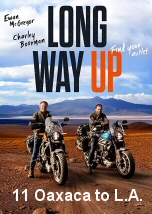
Oaxaca to LA

   2020    Culture
Ewan McGregor and Charley Bormann are very close to finishing their journey. Discussions on security are still on the agenda; they cannot travel at night due to dangerous cartels. They will need to do many miles on a bus with space for the bikes inside. The team manage to get the bikes on after concerns they wouldn’t fit. Repairing and conditioning the bus is an achievement considering they did it in a few days.
Ewan and Charley get back on their bikes, and they head to their last border cross to enter the United States. After 12 hours in the border, the crew, Ewan and Charley make it to America. It’s an easy stretch to L.A. on their bikes. Ewan, the crew and family, finish the last leg. It’s done, they’ve managed to finish Long Way Up. It’s such an achievement. Episode 11 is a heartfelt finale, showcasing the end of an incredible journey from both Ewan, Charley, and the team that supported them.
Series: Long Way Up

An Endless War

   2011    History
The turmoil of 1968 helps Nixon win the presidency. Troop strength in Vietnam peaks and the draft accelerates. Karl Marlantes endures bitter jungle fighting on Hill 484, and draftee Arthur Wiknik gets a grim introduction to combat on 'Hamburger Hill'. But shortly after winning both hills, US troops abandon them.
Series: Vietnam in HD

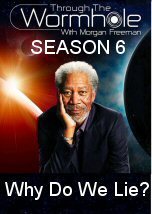
Why Do We Lie

   2015    Culture
We all agree lying is shameful. Yet we still deliberately deceive each other constantly. Are our brains wired for lying from a young age? The brains of pathological liars may provide insights. Will technology make it easier for us to be dishonest, or could it someday instantly reveal someone is lying? Perhaps we are deceitful because our limited senses prevent us from seeing the real truth. Scientists say our own memories deceive us, and have managed to implant false memories. Other scientists look for ultimate truth in the subatomic world … only to end up turning reality on its head.
Series: Through the Wormhole Season 6