Albert Einstein, the most famous scientist of all time, was a world-renowned celebrity, greeted like a rock star when he appeared in public. An anti-war firebrand, Einstein also spoke out on issues ranging from women's rights and racism to immigration and nuclear arms control. But today, his image has been neutered into that of a charmingly absent-minded genius. He was, in fact, a powerful force for social change and a model for political activism. Using a wealth of rarely-seen archival footage, correspondence, and new and illuminating interviews, filmmaker Julia Newman makes the case that Albert Einstein's example of social and political activism is as important today as are his brilliant, groundbreaking theories.
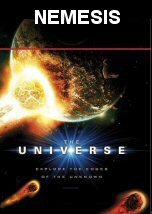
The theory of Némesis, a star that orbits the Sun and causes catastrophic events is explored. Nemesis is a hypothetical red dwarf or brown dwarf, originally postulated in 1984 to be orbiting the Sun at a distance of about 95,000 AU (1.5 light-years) somewhat beyond the Oort cloud, to explain a perceived cycle of mass extinctions in the geological record, which seem to occur more often at intervals of 26 million years.
Diarmaid MacCulloch's own life story makes him a symbol of a distinctive feature about Western Christianity - scepticism, a tendency to doubt which has transformed both Western culture and Christianity. In the final programme in the series, he asks where that change came from. He challenges the simplistic notion that faith in Christianity has steadily ebbed away before the relentless advance of science, reason and progress, and shows instead how the tide of faith perversely flows back in. Despite the attacks of Newton, Voltaire, the French Revolutionaries and Darwin, Christianity has shown a remarkable resilience. The greatest damage to Christianity was actually inflicted to its moral credibility by the two great wars of the 20th century and by its entanglement with Fascism and Nazism. And yet it is during crisis that the Church has rediscovered deep and enduring truths about itself, which may even be a clue to its future.
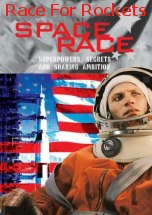
Space Race is a docu-drama chronicling the major events and characters in the American/Soviet space race. It focusses on Sergei Korolev, the Soviets' chief rocket designer, and Wernher von Braun, his American counterpart. The series was a joint effort between British, German, American and Russian production teams." In the first episode, 1944-1949, we see Wernher von Braun's work on the V-2 for the Nazis during the last years of the Second World War, his surrender to American troops and his move to the USA. We see Sergei Korolev's release from the Gulag, and how he is set to work on Soviet rockets, first attempting to copy the V-2, then building a more efficient rocket of his own.
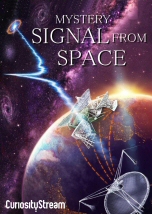
Deep in the mountains of West Virginia, the Green Bank Observatory has been receiving a mysterious signal from deep space. A team of astronomers has been detecting high-energy bursts erupting from unknown sources far off in space since years ago. But one of them is different from the rest. They call it FRB 121102. What is actually giving rise to this very powerful flash? Could this be a message from an advanced civilization, or is it a much stranger and violent occurrence? Visit the largest steerable radio telescope on the planet for answers.
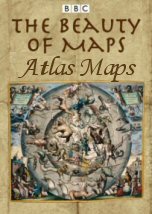
The Dutch Golden Age saw map-making reach a fever pitch of creative and commercial ambition. This was the era of the first ever Atlases - elaborate, lavish and beautiful. This was the great age of discovery and marked an unprecedented opportunity for mapmakers who sought to record and categorise the newly acquired knowledge of the world. Rising above the many mapmakers in this period was Gerard Mercator, inventor of the Mercator projection, who changed mapmaking forever when he published his collection of world maps in 1598 and coined the term 'Atlas'. The programme looks at some of the largest and most elaborate maps ever produced, from the vast maps on the floor of the Royal Palace in Amsterdam, to the 24 volume atlas covering just the Netherlands, to the largest Atlas in the world, The Klencke Atlas. It was made for Charles II to mark his restoration in 1660. But whilst being one of the British Libraries most important items, it is also one of its most fragile so hardly ever opened. This is a unique opportunity to see inside this enormous and lavish work, and see the world through the eyes of a King.






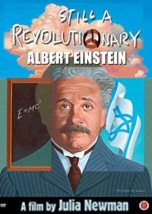





Using a wealth of rarely-seen archival footage, correspondence, and new and illuminating interviews, filmmaker Julia Newman makes the case that Albert Einstein's example of social and political activism is as important today as are his brilliant, groundbreaking theories.