
Last Watched

"Asia"  Sort by

Lord of Asia

   1997    History
Michael crosses Iran towards the Caspian Sea. He meets nomads who tell of Alexander's tryst with an Amazon queen, and the living descendants of Alexander's Persian enemies, who have their own tales of `Alexander the Accursed'.
Series: In the Footsteps of Alexander the Great
Meat-Eaters

   1998    Nature
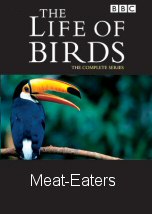
This episode examines those birds whose sustenance comes from flesh and their methods of hunting. In New Zealand, Sir Attenborough observes Keas, parrots that do not eat meat exclusively, raiding a shearwater's burrow for a chick. However, it is the dedicated birds of prey, such as owls, buzzards, eagles, falcons and vultures, to which much of the programme is devoted. In order to spot and pursue their victims, senses of sight and hearing are very acute. Vultures are the exception, in that they eat what others have left, and once a carcass is found, so many birds descend on it that the carrion seems submerged beneath them. The Turkey Vulture is an anomaly within its group, as it also has a keen sense of smell. Eagles defend their territory vigorously, and a pair of sea eagles are shown engaging in an aerial battle. The Galápagos Hawk hunts Marine Iguanas, but can only do so when its quarry is vulnerable, during the breeding season. The African Harrier Hawk has adapted to extracting burrowing animals by virtue of an especially long, double-jointed pair of legs. By contrast, a shrike is not equipped with the requisite sharp beak and talons needed for butchery, and so dismembers its kill by impaling it on the thorns of acacias. The Lammergeier eats bones, and will drop them on to rocks from a great height in order to break them down to a digestible size. Also featured are the Eurasian Sparrowhawk, Goshawk and Peregrine Falcon.
Series: The Life of Birds

Planet Earth II Grasslands

   2016    Nature    HD
Grasslands cover one quarter of all land and support the vast gatherings of wildlife, but to survive here animals must endure the most hostile seasonal changes on the planet. From Asia's bizarre-looking Saiga antelope to the giant anteaters of Brazil, grassland animals have adapted in extraordinary ways to cope with these extremes. In the flooded Okavango, lions take on formidable buffalo in epic battles, on the savannah bee-eaters take advantage of elephants to help catch insects and, on the freezing northern tundra, caribou embark on great migrations shadowed by hungry Arctic wolves.
Series: Planet Earth II

Words on a Page

   2020    History
Writing itself is 5,000 years old, and for most of that time words were written by hand using a variety of tools. The Romans were able to run an empire thanks to documents written on papyrus. Scroll books could be made quite cheaply and, as a result, ancient Rome had a thriving written culture. With the fall of the Roman Empire, papyrus became more difficult to obtain. Europeans were forced to turn to a much more expensive surface on which to write: Parchment. Medieval handwritten books could cost as much as a house, they also represent a limitation on literacy and scholarship.
No such limitations were felt in China, where paper had been invented in the second century. Paper was the foundation of Chinese culture and power, and for centuries how to make it was kept secret. When the secret was out, paper mills soon sprang up across central Asia. The result was an intellectual flourishing known as the Islamic Golden Age. Muslim scholars made discoveries in biology, geology, astronomy and mathematics. By contrast, Europe was an intellectual backwater.
That changed with Gutenberg’s development of movable type printing. The letters of the Latin alphabet have very simple block-like shapes, which made it relatively simple to turn them into type pieces. When printers tried to use movable type to print Arabic texts, they found themselves hampered by the cursive nature of Arabic writing. The success of movable type printing in Europe led to a thousand-fold increase in the availability of information, which produced an explosion of ideas that led directly to the European Scientific Revolution and the Industrial Revolution that followed.
Series: The Secret History of Writing

The Incredible Human Journey: Asia

   2009    History
The journey continues into Asia, the world's greatest land mass, in a quest to discover how early hunter-gatherers managed to survive in one of the most inhospitable places on earth - the Arctic region of Northern Siberia. Alice also explores what may have occurred during human migration to produce Chinese physical characteristics, and considers a controversial claim about Chinese evolution: that the Chinese do not share the same African ancestry as other peoples.
Series: The Incredible Human Journey

Be Water

   2020    History
In 1971, after being rejected by Hollywood, Bruce Lee returned to his parents' homeland, Hong Kong. Over the next two years, he'd complete four iconic films that would define his legacy, a legacy cut short when he died, stunningly, in the summer of 1973. He was 32 years old. Directed by Bao Nguyen, 'Be Water' is a gripping, fascinating, intimate look at not just those final, defining years of Lee's life, but the complex, often difficult, and seismic journey that led to Lee's ultimate emergence as a singular icon in the histories of film, martial arts, and even the connection between the eastern and western worlds.
The film chronicles Lee's earliest days, as the son of a Chinese opera star born while his father was on tour in San Francisco, and then raised in Hong Kong over what became an at times troubled childhood. Sent to live in America at the age of 18, he began teaching Kung Fu in Seattle, and established a following that included his future wife, Linda. His ambition ever rising, Lee eventually made his way to Los Angeles, where he strove to break into American film and television. There, despite some success as a fight choreographer and actor, it was clear Hollywood wasn't ready for an Asian leading man - and so he returned to Hong Kong to make the films that would in fact make him a legend, his international star skyrocketing just as his life was cut short.
'Be Water' is told by the family, friends, and collaborators who knew Bruce Lee best, with an extraordinary trove of archive film providing an evocative, immersive visual tapestry that captures Lee's charisma, his passion, his philosophy, and the eternal beauty and wonder of his art.