

Last Watched

"Gravity"  Sort by

Inside Einstein Mind

   2015    Science
On November 25th, 1915, Einstein published his greatest work: General Relativity. The theory transformed our understanding of nature’s laws and the entire history of the cosmos, reaching back to the origin of time itself. Now, in celebration of the 100th anniversary of Einstein’s achievement, discover the inside story of Einstein’s masterpiece". The story begins with the intuitive thought experiments that set Einstein off on his quest and traces the revolution in cosmology that is still playing out in today’s labs and observatories. Discover the simple but powerful ideas at the heart of relativity, illuminating the theory—and Einstein’s brilliance—as never before. From the first spark of an idea to the discovery of the expanding universe, the Big Bang, black holes, and dark energy, NOVA uncovers the inspired insights and brilliant breakthroughs of “the perfect theory.”
Numbers as God

   2018    Science
Mathematician Dr Hannah Fry explores the mystery of maths. It underpins so much of our modern world that it's hard to imagine life without its technological advances, but where exactly does maths come from? Is it invented like a language or is it something discovered and part of the fabric of the universe? It's a question that some of the most eminent mathematical minds have been wrestling with. To investigate this question, Hannah goes head first down the fastest zip wire in the world to learn more about Newton's law of gravity, she paraglides to understand where the theory of maths and its practice application collide, and she travels to infinity and beyond to discover that some infinities are bigger than others.
In this episode, Hannah goes back to the time of the ancient Greeks to find out why they were so fascinated by the connection between beautiful music and maths. The patterns our ancestors found in music are all around us, from the way a sunflower stores its seeds to the number of petals in a flower. Even the shapes of some of the smallest structures in nature, such as viruses, seem to follow the rules of maths. All strong evidence for maths being discovered. But there are those who claim maths is all in our heads and something we invented. To find out if this is true, Hannah has her brain scanned. It turns out there is a place in all our brains where we do maths, but that doesn't prove its invented.
Experiments with infants, who have never had a maths lesson in their lives, suggests we all come hardwired to do maths. Far from being a creation of the human mind, this is evidence for maths being something we discover. Then along comes the invention of zero to help make counting more convenient and the creation of imaginary numbers, and the balance is tilted in the direction of maths being something we invented. The question of whether maths is invented or discovered just got a whole lot more difficult to answer
Series: Magic Numbers

Absolute Zero Conquest of Cold

   2007    Technology
This scientific detective tale tells the story of a remarkable group of pioneers who wanted to reach the ultimate extreme: absolute zero, a place so cold that the physical world as we know it doesn't exist, electricity flows without resistance, fluids defy gravity and the speed of light can be reduced to 38 miles per hour. Absolute zero became the Holy Grail of temperature physicists and is considered the gateway to many new technologies, such as nano-construction, neurological networks and quantum computing. The possibilities, it seems, are limitless. The first episode Chronicles the major discoveries leading towards the mastery of cold, beginning with King James I's court magician, Cornelius Drebbel, who managed to air condition the largest interior space in the British Isles in 1620. Other stories will include the first "natural philosopher," Robert Boyle, a founder of the Royal Society in Great Britain; the Grand Duke Ferdinand II de Medici's involvement in the creation of the first thermometer; the establishment of the laws of thermodynamics by three young scientists, Sadi Carnot, James Joule and William Thomson; and Michael Faraday's critical achievement in liquefying several other gases which set the stage for the commercial application of cold to refrigeration and air conditioning.
Series: Absolute Zero

Falling

   2011    Science
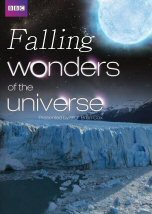
Professor Brian Cox takes on the story of the force that sculpts the entire universe - gravity. Gravity seems so familiar, and yet it is one of the strangest and most surprising forces in the universe. Starting with a zero gravity flight, Brian experiences the feeling of total weightlessness, and considers how much of an effect gravity has had on the world around us. But gravity also acts over much greater distances. It is the great orchestrator of the cosmos. It dictates our orbit around the sun, our relationship with the other planets in our solar system, and even the way in which our solar system orbits our galaxy. Yet the paradox of gravity is that it is actually a relatively weak force. Brian takes a face distorting trip in a centrifuge to explain how it is that gravity achieves its great power, before looking at the role it plays in one of the most extraordinary phenomena in the universe - a neutron star. Although it is just a few kilometres across, it is so dense that its gravity is 100, 000 million times as strong as on Earth. Over the centuries our quest to understand gravity has allowed us to understand some of the true wonders of the universe, and Brian reveals that it is scientists' continuing search for answers that inspires his own sense of wonder.
Series: Wonders of the Universe

Extreme Orbits - Clockwork and Creation

   2012    Science
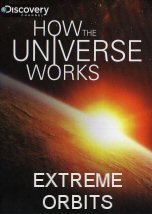
Orbits are the dynamics that drive the universe. From the smallest asteroid to the largest super-cluster, everything in the universe is in orbit. We owe our very existence to the stability of earth's orbit — it gave us life and keeps us safe. But we are the freaks. Everywhere else we look we find orbits are chaotic, unstable, and violent. Beyond our solar system we find planets that are blow-torched, stars that eat each other, and black holes that destroy everything in their path. Yet on the very largest scale, orbits are also a creative force. clashing galaxies give birth to new stars and new worlds. on the galactic scale orbits even construct the fabric of the universe itself.
Series: How the Universe Works

The Lives of the Stars

   1980    Science
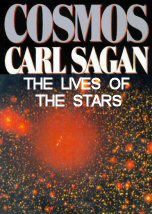
The simple act of making an apple pie is extrapolated into the atoms and subatomic particles (electrons, protons, and neutrons) necessary. Many of the ingredients necessary are formed of chemical elements formed in the life and deaths of stars (such as our own Sun), resulting in massive red giants and supernovae or collapsing into white dwarfs, neutron stars, pulsars, and even black holes. These produce all sorts of phenomena, such as radioactivity, cosmic rays, and even the curving of spacetime by gravity. Cosmos Update mentions the supernova SN 1987A and neutrino astronomy.
Series: Cosmos
Sex Explained

Sex Explained

2020  Medicine
Racism: A History

Racism: A History

2007  Culture
The Jinx

The Jinx

2015  History
Space

Space

2001  Science
The Cell

The Cell

  Science