Professor Brian Cox continues his epic exploration of the cosmos by looking at the faint band of light that sweeps across the night sky - our own galaxy, the Milky Way. The Sun is just one of almost 400 billion stars that form this vast, majestic disk of light, our own home in the universe. Thanks to a cutting-edge space we’re finally able to reveal the Milky Way’s dramatic history and predict its cataclysmic future. Our galaxy started out a fraction of the size it is today, and Gaia telescope has revealed how it grew over the eons. Beautifully rendered VFX based on the very latest Gaia data has uncovered the remarkable story of our galaxy’s evolution. As our young galaxy encountered rival galaxies, it experienced a series of violent growth spurts and intense periods of cataclysmic change while battling to survive. Each time our galaxy feeds, a new era of star formation begins, fuelled by incoming torrents of fresh gas and energy. And there is another collision to come. Another, larger galaxy is coming our way. Andromeda is heading straight for us at a quarter of a million miles per hour. The Milky Way’s long-term fate is in the balance.
Following engineers and scientists on a groundbreaking mission as they build, test and launch the James Webb Space Telescope, the most powerful observatory ever constructed, and discovers the astonishing cosmological enigmas it will investigate. Using the latest CGI animation technology, the film will follow the journey and share the incredible cosmological images and mysteries that scientists believe the telescope will capture. This super-telescope is the next generation successor to the Hubble Space Telescope, with a mirror 6 times bigger. It will also be able to peer back in time. For the first time in space exploration, scientists will be able to explore the formation of the first stars and galaxies and search for planets that can support life.
An informative and ambitious journey exploring how the evolution of scientific understanding is intimately interwoven with society's historical path. The Story Of Science tells the forces that came together to create scientific knowledge; the practical business of making instruments and machines; the great forces of history – revolutions, voyages of discovery and artistic movements – and the dogged determination of scientists and experimenters. This is the story of how scientific ideas shaped the modern world and how science made history. Michael Mosley begins the first episode with the story of one of the great upheavals in human history - how we came to understand that our planet was not at the centre of everything in the cosmos, but just one of billions of bodies in a vast and expanding universe. He reveals the critical role of medieval astrologers in changing our view of the heavens, and the surprising connections to the upheavals of the Renaissance, the growth of coffee shops and Californian oil and railway barons. Michael shows how important the practical skills of craftsmen have been to this story and finds out how Galileo made his telescope to peer at the heavens and by doing so helped change our view of the universe forever.
Is there anyone out there? Astronomers have been pointing their radio telescopes at the skies for decades trying to pick up alien signals, so far without success. But now there's a new way of looking for aliens. Hitch a ride with Dr Graham Philips as he joins astronomers trawling through the galaxy looking for signs of extra-terrestrial intelligence.
Questions are raised about the search for intelligent life beyond the Earth, with UFOs and other close encounters refuted in favor of communications through SETI and radio telescope such as the Arecibo Observatory. The probability of technically advanced civilizations existing elsewhere in the Milky Way is interpreted using the Drake equation and a future hypothetical Encyclopedia Galactica is discussed as a repository of information about other worlds in the galaxy. The Cosmos Update notes that there have been fewer sightings of UFOs and more stories of abductions, while mentioning the META scanning the skies for signals.
In August 1977, the Big Ear Radio-telescope in Ohio received a strange signal from the Sagittarius constellation while searching for intelligent extra-terrestrial life. It had a duration of 72 seconds and an intensity 30 times higher than usual. Named the Wow signal, it is still being considered as one of the best examples of having being sent by intelligent extraterrestrial life. But, nothing has revolutionised the search of extra-terrestrial intelligent life as much as the recent discovery by the Kepler Satellite, of thousands of Earth-like planets where life could be possible. Join the debate with this stunning documentary, as we ask Is Anybody Out There?












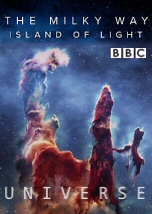






Our galaxy started out a fraction of the size it is today, and Gaia telescope has revealed how it grew over the eons. Beautifully rendered VFX based on the very latest Gaia data has uncovered the remarkable story of our galaxy’s evolution. As our young galaxy encountered rival galaxies, it experienced a series of violent growth spurts and intense periods of cataclysmic change while battling to survive. Each time our galaxy feeds, a new era of star formation begins, fuelled by incoming torrents of fresh gas and energy. And there is another collision to come. Another, larger galaxy is coming our way. Andromeda is heading straight for us at a quarter of a million miles per hour. The Milky Way’s long-term fate is in the balance.