









Last Watched

"Nim"  Sort by

Planet Earth II Grasslands

   2016    Nature    HD
Grasslands cover one quarter of all land and support the vast gatherings of wildlife, but to survive here animals must endure the most hostile seasonal changes on the planet. From Asia's bizarre-looking Saiga antelope to the giant anteaters of Brazil, grassland animals have adapted in extraordinary ways to cope with these extremes. In the flooded Okavango, lions take on formidable buffalo in epic battles, on the savannah bee-eaters take advantage of elephants to help catch insects and, on the freezing northern tundra, caribou embark on great migrations shadowed by hungry Arctic wolves.
Series: Planet Earth II

For the Love of Spock

   2016    History
Last year, just before Thanksgiving, I approached my dad, Leonard Nimoy, about the possibility of working together on a film about Mr. Spock. I had skimmed through some of the books on the making of Star Trek and felt there was so much more to explore about the creation and development of Mr. Spock. And the timing seemed right, as the 50th anniversary of Star Trek the original series was not that far away. Dad agreed that now was the right time, and that he was 100% committed to collaborating with me on this project. He also reminded me that we were (then) just days away from the 50th anniversary of the start of production on 'The Cage,' the original pilot for Star Trek in which dad first appeared as Mr. Spock.

Planet Earth II Jungles

   2016    Nature    HD
Jungles provide the richest habitats on the planet - mysterious worlds of high drama where extraordinary animals attempt to survive in the most competitive place on earth. Flooded forests are home to caiman-hunting jaguars and strange dolphins that swim amongst the tree tops, while in the dense underworld, ninja frogs fight off wasps and flying dragons soar between trees. Acrobatic indri leap through the forests of Madagascar, while the jungle night conceals strange fungi and glow-in-the-dark creatures never filmed before.
Series: Planet Earth II

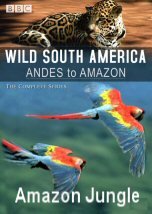
Amazon Jungle

   2005    Nature
A visit to the Amazon jungle - the world's largest rainforest and home to the widest variety of plants and animals on Earth. he diversity of life in the jungle is so great that in just two square miles scientists have counted 3,000 varieties of ants, 530 types of birds and 11 species of monkey. But despite the huge range of life that flourishes here, survival is never easy.
Series: Wild South America

Can We Make Life

   2018    Medicine
'It's alive!' Since Dr. Frankenstein spoke those famous words, we've been alternately enthralled and terrified by the idea of creating life in the lab. Now, a revolution in genetic engineering and thrilling innovations in synthetic biology are bringing that dream—or nightmare, as the case may be—closer to reality. New tools allow researchers to use cells to create their own DNA and edit it into existing genomes with more ease and less cost than ever before.
Along with renewed hopes for treating some genetic diseases, there's serious talk of using the newest technologies to bring long-extinct animals back from the dead – like the team hoping to resurrect the woolly mammoth. Science fiction is quickly becoming science fact. Another daring genetic experiment to bioengineer animals could prevent Lyme disease. But the power to make life comes with deep ethical questions. What are the potential rewards—and dangers—of tinkering with nature? This films explores the benefits and the burden of risk surrounding the controversial new technology.
Series: Nova Wonders

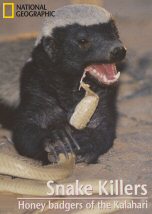
Snake Killers Honey Badgers of The Kalahari

   2007    Nature
The honey badger looks like something you might buy in pet shop and give to children, but turns out to be one of the most violent and determined creatures ever to scuttle across the face of the earth. Nothing in the badger’s world-not even the badgers themselves-are safe from its remarkable ability to create havoc and cause harm. Like a meter long skunk with the brain of a shark the Honey Badger’s metabolism compels it to eat constantly and live on the run. Its diet is admirably inclusive ranging from insects to its own young. If an animal is too big to eat then the badger will fight it anyway, indeed it is this almost supernatural tenacity that compels you respect it, as well as yielding some of the most spectacular sequences in the film. Five foot long cobra sleeping in the top of tree? No problem, the badger scoots up and bites its head off. When an ailing badger is attacked by a full size leopard it takes the leopard over an hour to finish it off. When one is bitten in the face by a snake that can kill a man, it just lies down for a while and sleeps it off.
Top Gear

Top Gear

2012  Technology
Neanderthal

Neanderthal

  History
How to Stay Young

How to Stay Young

2016  Medicine
Minimalism

Minimalism

2015  Culture
The Last Dance

The Last Dance

2020  Culture
The Art Mysteries

The Art Mysteries

2020  Art