






Last Watched

Travellers Tales

   1980    Science
The journeys of the Voyager probes is put in the context of the Netherlands in the seventeenth century, with a centuries-long tradition of sailing ship explorers, and its contemporary thinkers (such as Constantijn Huygens and his son Christian). Their discoveries are compared to the Voyager probes' discoveries among the Jovian and Saturn systems. In Cosmos Update, image processing reconstructs Voyager’s worlds and Voyager’s last portrait of the Solar System as it leaves is shown.
Series: Cosmos

Is a Zombie Apocalypse Possible

   2014    Medicine
It is a nightmare that has stalked us for centuries: hordes of human beings transformed into mindless, cannibalistic monsters. Could this civilization-ending nightmare become reality? Scientists have discovered pathogens that turn insects into the walking dead. New strains of viruses are attacking humans every day. Mathematicians have calculated the likelihood of surviving a zombie virus outbreak: they’re not hopeful. Now neuroscientists are discovering how easy it is for us to lose conscious control of our bodies. Are we at risk of becoming puppets? If we were in the middle of a zombie apocalypse, would we even know it?
Series: Through the Wormhole Season 5

Return

   2013    History
With optional Hebrew subtitles. Simon Schama's history of the Jewish experience ends with an examination of how the Holocaust and the creation of Israel have fundamentally changed what it means to be Jewish. Mixing personal recollection with epic history, Simon tells the story of the remarkable personalities and unprecedented events which turned the Zionist dream of creating a modern state of Israel into reality - and the consequences for the world. With contributions from writer David Grossman, photographer Micha Bar-Am, kibbutz founder Freddie Kahan, West Bank settler Zvi Cooper and Palestinian villager Yacoub Odeh. This film explores the tension between the high ideals and dire necessities that led to the creation of a Jewish homeland and the realities of conflict, dispossession and occupation that have followed in its wake.
Series: The Story of the Jews

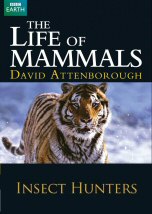
Insect Hunters

   2002    Nature
Mammals from tiny shrews, giant anteaters, armoured armadillo to bats have specialised in eating insects. Some have evolved into complex and effective hunters, even pursued their prey into the skies
Series: The Life of Mammals

Edge of the Universe

   2019    Science
Does the universe, have a limit? Does the universe have an edge? Looking out to the edge of the universe is tremendously important to understand our place in the cosmos and to understand the universe itself.
Inflation was a formative moment for our universe. By the time it stopped, the universe's basic characteristics were set. There could be regions of the greater universe where inflation didn't stop then. Occasionally a little region will stop inflating and just expand at the normal rate. We could imagine a super large-scale structure where there's different regions of the universe, domains, and each domain has different local constants and laws of physics.
Series: How the Universe Works Series 8

The Great Tide

   2009    Nature
A mighty army of dolphins, sharks, whales, seals and gannets hunt down the billions of sardines along South Africa's east coast each winter. This is the Sardine Run: an underwater Armageddon, the greatest gathering of predators anywhere on the planet, and the most spectacular event in the world's oceans. From intimate moments of the creatures caught up in the run, to the dramatic finale of this spectacular event, The Great Tide is an action-packed feeding-frenzy, filmed underwater, on the ocean's surface, and in the air.
However, in recent years the sardine run has become less predictable, perhaps due to the warming effects of climate change. If the sardine run does not happen, the lives of the animals caught up in the drama hang in the balance. Pioneering a unique boat stabilised camera mount for surface filming, Nature's Great Events crew capture all the high octane action as the predators compete for sardines, filmed with aerial, underwater and above water cameras. Super slow motion cameras also capture the very moment gannets plunge into the water, hitting it at sixty miles an hour.
A violent winter storm is the trigger for the sardines to begin their desperate dash. They are followed by a super-pod of 5,000 dolphins and further up the coast more predators gather. A shoal of sardines 15 miles long is pushed into the shallows and aerial shots show thousands of sharks gathering to feed on them. The climax to the sardine run is a spectacular feeding frenzy as the dolphins round the sardines up into balls on which all the predators feast. Gannets rain down in their thousands, sharks pile in scattering the fish and a Bryde's whale lunges in taking great mouthfuls of sardines.
Series: Nature Great Events