





Last Watched

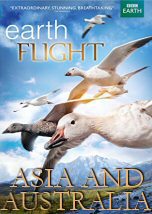
Asia and Australia

   2012    Nature
In this bird's-eye view of two continents, demoiselle cranes negotiate a dangerous Himalayan pass on their way to India while high-flying bar-headed geese take the fast track five miles above. In Rajasthan, vultures watch hunting tigers hoping for a meal and pigeons visit a temple dedicated solely to sacred rats. Pigeons are also our guide to the greatest gatherings of camels on Earth and learn to dodge buzzards around the battlements of Jodhpur Fort. 9,000 cranes overwinter in the most unlikely of spots - a barbed wire compound in the centre of a desert town. In Australia, rainbow lorikeets drop in on Sydney and patrol Australia's Gold Coast. In the outback, white cockatoos swirl in thousands and budgerigars pass Uluru (Ayers Rock) and gather in the biggest flocks ever recorded. In China, swallows and swifts visit the Great Wall and the Forbidden City of Beijing. In Japan, the country's most revered birds - Japanese cranes are fed fish by appreciative locals and are joined in strange, momentary harmony by hungry red foxes, white-tailed eagles and Steller's eagles. As peace descends, Japanese cranes dance beautifully in the snow.
Series: Earthflight
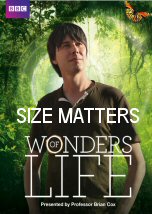
Size Matters

   2013    Science
Brian explores the physics of the size of life through some close encounters with Australia's wildlife. From swimming with great white sharks to tracking red kangaroos, he discovers that the size you are profoundly affects the life you lead and, ultimately, how long you have to enjoy it.
Series: Wonders of Life

Exploring The Universe

   2020    Science
This remarkable science-history series investigates the blistering pace of human endeavour in space exploration, computing, energy, resources, Earth science and our understanding of the evolution of life itself. Across the last 50 years, humans have set a blistering pace and scientific discovery. We've crossed the boundaries of our solar system, made machines that can learn harnessed the power of the sun and built life from scratch. It's a period like no other in history, where human endeavour is changing everything: this is The Great Acceleration. As we race toward the future, we must examine the journey.
In the first episode, Dr Shalin Naik explores the ambitious space shuttle mission that began in the '70s plus the future colonization of Mars. Over the past 50 years, space has become central to everything, from communications to entertainment to climate modelling. And as private enterprise enters space exploration, our understanding of the universe will only continue to expand. We will know if we can survive on other objects - the moon, maybe Mars, maybe even some of the moons of Jupiter and Saturn. Deep space is the last and infinite frontier. That's what we do as human beings. We explore, we learn, we make discoveries, from the moment we're born to the moment we die.
Series: The Great Acceleration

Last Man Standing

   2016    History
Tony Accardo receives a phone call from Joseph P. Kennedy, asking the mob kingpins to use their pull with the Illinois union vote to help his son, John F. Kennedy, win the upcoming presidential election. In return, he offers to put an end to his son Robert F. Kennedy's investigation into Giancana and the Outfit. As election day nears, Kennedy's fight against Richard Nixon tightens, turning Illinois into a key battleground. Giancana delivers the union votes. After a close race, Kennedy is declared the victor. Just weeks after Kennedy takes office, his brother Robert is named Attorney General. To the Chicago mob's surprise, when Robert takes office as the new U.S. Attorney General in 1961, he makes his top priority going after organized crime รณ and one of his primary targets is the Outfit. Weeks after, John F. Kennedy is shot and killed in Dallas. After his brother is assassinated, Robert steps down from his post as Attorney General and the investigation into organized crime is virtually dropped. The government begins an investigation into the assassination, with rumors already circulating that the mafia could have been involved.
Series: The Making of the Mob

Blues for a Red Planet

   1980    Science
The episode, devoted to the planet Mars, begins with scientific and fictional speculation about the Red Planet during the late nineteenth and early twentieth centuries (H. G. Wells' The War of the Worlds, Edgar Rice Burroughs' science fiction books, and Percival Lowell's false vision of canals on Mars). It then moves to Robert Goddard's early experiments in rocket-building, inspired by reading science fiction, and the work by Mars probes, including the Viking, searching for life on Mars. The episode ends with the possibility of the terraforming and colonization of Mars and a Cosmos Update on the relevance of Mars' environment to Earth's and the possibility of a manned mission to Mars.
Series: Cosmos

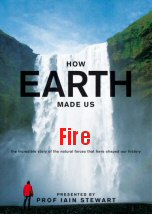
Fire

   2010    Culture
Iain explores man's relationship with fire. He begins by embarking on an extraordinary encounter with this terrifying force of nature - a walk right through the heart of a raging fire. Fire has long been our main source of energy and Iain shows how this meant that the planet played a crucial role in Britain's industrial revolution, whilst holding China's development back. Along the way he dives in a mysterious lake in Oregon, climbs a glacier of salt, crawls through an extraordinary cave in Iran and takes a therapeutic bath in crude oil.
Series: How Earth Made Us
Capitalism A Love Story

Capitalism A Love Story

2009  Culture
How Earth Made Us

How Earth Made Us

2010  Culture
Leaving Neverland

Leaving Neverland

2019  Culture
Top Gear

Top Gear

2012  Technology
The Cell

The Cell

  Science