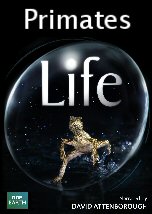
A rain forest is the richest habitat on Earth. Exactly how many species rain forests contain is unknown, but it runs into millions. And new ones are discovered every week. There are some, like the clouded leopard, we still know virtually nothing about. Although they cover just seven percent of the world's land area, jungles play a vital role in the health of the planet . Jungles and rainforests are home to an incredible variety of species like preening birds, intelligent orangutans and remarkably ambitious ants.
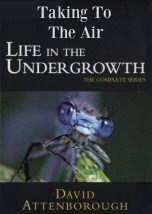
As the early June sun begins to set over a calm river in Central Hungary, masses of ghostly shapes emerge from their larval cases to take to the air for the first time. They are mayflies and in a spectacular display, thousands of them demonstrate how the very first wings were used.
From the stunning aerobatics of hoverflies in an English garden to the mass migration of purple crow butterflies in the valleys of Taiwan, this episode tells the tale of the first animals ever to take to the air. Unique footage reveals the lightning fast reactions of bluebottles and hoverflies, filmed with one of the world's fastest cameras, and Sir David Attenborough handles the world's largest (and perhaps most ferocious) insect - the Titan beetle.
Dr Adam Rutherford shows how decoding the genome has led us to begin to understand the very process by which our DNA makes us different; how it makes each one of us on earth unique and influences who we are and the traits we have. He reveals how, as we try and understand the relationship between who we are and our genes, we stand at the beginning of the most exciting scientific journey of all time.
Documentary which tells the story of the theory of evolution by natural selection which is now scientific orthodoxy, but when it was unveiled it caused a storm of controversy. Many people criticised it for being short on evidence and long on assertion and Darwin, being the honest scientist that he was, agreed with them. He entrusted future generations to complete his work and prove the essential truth of his vision. Evolutionary biologist Professor Armand Marie Leroi argues that, with the new science of evolutionary developmental biology (evo devo), it may be possible to take that theory to a new level - to do more than explain what has evolved in the past, and start to predict what might evolve in the future.
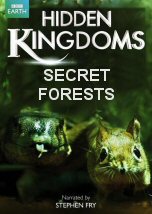
This is the story of two tiny animals coming of age. In the wild woods of North America, a young chipmunk is gathering a vital store of nuts ahead of his first winter - in his way are ruthless rivals and giant predators. In the steaming rainforest, a young tree-shrew is forced deep into the jungle to find food. She must draw on all her intelligence and agility if she is to escape the ultimate jungle predator - a reticulated python!
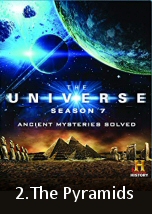
The Great Pyramids of Giza remain one of the enduring wonders of the ancient world. This mesmerizing monument have eluded astronomers and archeologists for centuries. Why and how the ancient pyramids of the pharaohs were built? Were they merely burial tombs, or a cosmic vehicle to the celestial world? What were the motives and methods behind the orientation of the pyramids to face the four cardinal directions with extreme accuracy? The world's renowned Egyptologists, astronomers and engineers join forces to solve some of the long-held mysteries about the pyramids.












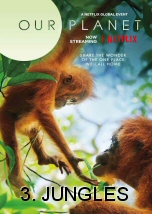




Jungles and rainforests are home to an incredible variety of species like preening birds, intelligent orangutans and remarkably ambitious ants.