For most of our history, we humans considered ourselves unique. But now, a new, artificial species might challenge our superiority. Mechanical beings have the potential to change everything. How we got them is a story of astonishing twists and amazing turns to achieve us the machine that may turn out to be the most revolutionary technology ever conceived--the robot. Learn how robots were first conceptualized in ancient Rome and see how their use has evolved over the centuries, from the calculator to the Mars Lander. Then, take a sneak peek at what future robots will be able to do. Narrated by Patrick Stewart.
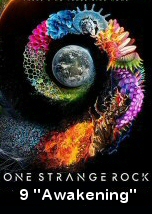
We all come from the same place, a moment when a dead rock came to life. Discover the story of how and why life began on Earth, and what makes our planet different from the others.
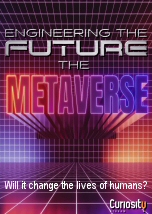
The metaverse is an environment where humans interact socially and economically through a software in cyberspace, which acts as a metaphor for the real world, but without its limitations. The metaverse is generally composed of multiple three-dimensional, shared and persistent virtual spaces linked to a perceived virtual universe. This virtual world is often facilitated by the use of virtual reality (VR) or augmented reality (AR) headsets and avatars. The Metaverse is the successor to the internet. It will change the lives of almost every human on the planet.
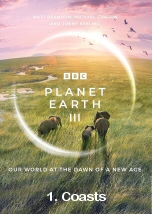
Discover amazing landscapes, the most amazing fights of animals on our planet, from the highest mountains to the deepest oceans, from the darkest caves to the hottest deserts with new technology. In the first episode, Sir David Attenborough explores the dangerous frontiers created by the world's coasts, where animals fight for survival amidst constant change. Cape fur seals, sea angels, lions, archer fish, flamingos and green turtles feature.
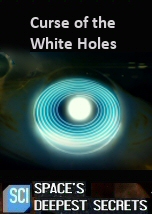
The white hole is a region of spacetime and that cannot be entered from the outside, although energy-matter, light and information can escape from it. In this sense, it is the reverse of a black hole. Einstein predicted strange cosmic phenomena known as white holes, but scientists have yet to prove they exist. Today, astronomers race to find the clues that can unlock the secrets of white holes. They investigate the tiny black holes that hide in the most ancient parts of the universe to finally find the smoking gun.
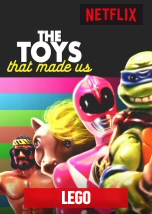
In 1949, after decades of making wooden furniture and toys, Ole Kirk Christiansen's small factory in Billund, Denmark, moved to plastic and created the 'Automatic Binding Bricks', which would later be known as LEGO. When the company patented the tube system in 1958, LEGO became the dominant toy line worldwide throughout the 1960s and 1970s. When other competitors capitalized on the expiration of the company's patents in the 1980s, LEGO faced stiff competition until they reported their first loss in 1998. Poor business decisions with film licenses and the failure of the Jack Stone and Galidor lines brought LEGO to near-bankruptcy until Jørgen Vig Knudstorp took over the company and, by bringing it back to its roots, rejuvenated LEGO's profits. By the time The Lego Movie hit theaters in 2014, LEGO became the largest toy franchise in the world.













Learn how robots were first conceptualized in ancient Rome and see how their use has evolved over the centuries, from the calculator to the Mars Lander. Then, take a sneak peek at what future robots will be able to do. Narrated by Patrick Stewart.