







Last Watched

"Light"  Sort by

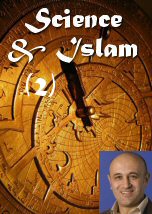
The Empire of Reason

   2017    History
Al-Khalili travels to northern Syria to discover how, a thousand years ago, the great astronomer and mathematician Al-Biruni estimated the size of the earth to within a few hundred miles of the correct figure. He discovers how medieval Islamic scholars helped turn the magical and occult practice of alchemy into modern chemistry. In Cairo, he tells the story of the extraordinary physicist Ibn al-Haytham, who helped establish the modern science of optics and proved one of the most fundamental principles in physics - that light travels in straight lines. Prof Al-Khalili argues that these scholars are among the first people to insist that all scientific theories are backed up by careful experimental observation, bringing a rigour to science that didn't really exist before.
Series: Science and Islam
Shield

   2018    Science
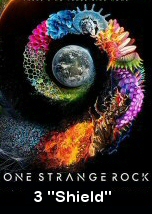
The sun gives us warmth and light. It is the fuel of life. Without the energy of the sun almost nothing grows, thrives or lives. But the sun was not put there for our benefit. It is not this big jolly ball of nice smiling down on us, wishing us all a good day. It is not our friend. The sun is a monster. A planet killer. And we don't see that side of the sun down here.
But eight astronauts, with over 1,000 days in space between them, can show us how being up there helped them understand the suns bright fury.
Series: One Strange Rock

Secrets of the Seven Earths

   2018    Science    HD
We are living in a new golden age of exploration. Planet hunters are searching far beyond our solar system and they are actually finding new worlds orbiting other suns. Thousands of these alien worlds have already been found, but this is the story of perhaps the greatest discovery yet, a star 40 light-years away with seven Earth-sized planets: Trappist-1.
This new discovery of seven alien Earth-like planets in a faraway solar system is a major milestone in our hunt for extraterrestrial life, and experts investigate the secrets of Trappist -1's mysterious worlds to reveal if we're truly alone in the universe.
Series: Space Deepest Secrets

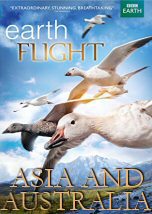
Asia and Australia

   2012    Nature
In this bird's-eye view of two continents, demoiselle cranes negotiate a dangerous Himalayan pass on their way to India while high-flying bar-headed geese take the fast track five miles above. In Rajasthan, vultures watch hunting tigers hoping for a meal and pigeons visit a temple dedicated solely to sacred rats. Pigeons are also our guide to the greatest gatherings of camels on Earth and learn to dodge buzzards around the battlements of Jodhpur Fort. 9,000 cranes overwinter in the most unlikely of spots - a barbed wire compound in the centre of a desert town. In Australia, rainbow lorikeets drop in on Sydney and patrol Australia's Gold Coast. In the outback, white cockatoos swirl in thousands and budgerigars pass Uluru (Ayers Rock) and gather in the biggest flocks ever recorded. In China, swallows and swifts visit the Great Wall and the Forbidden City of Beijing. In Japan, the country's most revered birds - Japanese cranes are fed fish by appreciative locals and are joined in strange, momentary harmony by hungry red foxes, white-tailed eagles and Steller's eagles. As peace descends, Japanese cranes dance beautifully in the snow.
Series: Earthflight

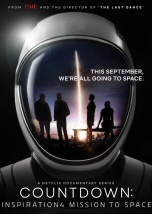
Countdown: Inspiration4 Mission to Space Episode I

   2021    Technology
Follow the four civilians as they launch into space on a three-day trip orbiting Earth and reaching an altitude higher than that of the International Space Station. The SpaceX Dragon mission, dubbed Inspiration4, is making history as the first all-civilian mission to orbit.
In the first episode, preparations begin for the mission. The commander is Jared Isaacman, a billionaire entrepreneur who purchased the flight for all four passengers, and the second crew member is a 29-year-old cancer survivor, Hayley Arceneaux.
Series: Countdown: Inspiration4 Mission to Space

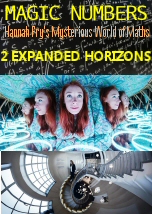
Expanded Horizons

   2018    Science
Dr Hannah Fry travels down the fastest zip wire in the world to learn more about Newton's ideas on gravity. His discoveries revealed the movement of the planets was regular and predictable. James Clerk Maxwell unified the ideas of electricity and magnetism, and explained what light was. As if that wasn't enough, he also predicted the existence of radio waves. His tools of the trade were nothing more than pure mathematics. All strong evidence for maths being discovered.
But in the 19th century, maths is turned on its head when new types of geometry are invented. No longer is the kind of geometry we learned in school the final say on the subject. If maths is more like a game, albeit a complicated one, where we can change the rules, surely this points to maths being something we invent - a product of the human mind. To try and answer this question, Hannah travels to Halle in Germany on the trail of perhaps one of the greatest mathematicians of the 20th century, Georg Cantor. He showed that infinity, far from being infinitely big, actually comes in different sizes, some bigger than others. This increasingly weird world is feeling more and more like something we've invented. But if that's the case, why is maths so uncannily good at predicting the world around us? Invented or discovered, this question just got a lot harder to answer.
Series: Magic Numbers
The Human Body

The Human Body

1998  Medicine
Conquistadors

Conquistadors

2002  History
Life

Life

2009  Nature
Wild South America

Wild South America

2005  Nature
Leaving Neverland

Leaving Neverland

2019  Culture
Natural World

Natural World

2009  Nature
Shine a Light

Shine a Light

2008  Art
Chased by Sea Monsters

Chased by Sea Monsters

2003  Nature