










Last Watched

"Astronomy"  Sort by

The Search for a New Earth

   2017    Technology
Planet Earth has been home to humankind for over 200,000 years, but with a population of 7.3 billion and counting and limited resources, this planet might not support us forever. Professor Stephen Hawking thinks the human species will have to populate a new planet within 100 years if it is to survive. With climate change, pollution, deforestation, pandemics and population growth, our own planet is becoming increasingly precarious. In this landmark film Professor Hawking, alongside engineer and radio astronomy expert Professor Danielle George and a former student, Christophe Galfard, join forces to find out if, and how, humans can reach for the stars and relocate to different planets. Travelling the globe, they meet top scientists, technologists and engineers who are working to answer our biggest questions: is there another planet out there that we could call home? How will we travel across the vast distances of space to get there? How will we survive the journey? And how will we set up a new human civilization on an alien world? Travelling the globe, they meet top scientists, technologists and engineers who are working to answer our biggest questions: is there another planet out there that we could call home? How will we travel across the vast distances of space to get there? How will we survive the journey? And how will we set up a new human civilization on an alien world? Taking in the latest advances in astronomy, biology and rocket technology from the Atacama Desert to the wilds of the Arctic, viewers will discover a whole world of cutting edge research. This programme shows that Professor Hawking’s ambition isn’t as fantastical as it sounds - and that science fiction is closer to science fact than we ever thought.
The Hawking Paradox

   2005    Science
Stephen Hawking is the most famous scientist on the planet. But behind the public face lies an argument that has been raging for almost 30 years. Has he been wrong for the last 30 years? Hawking shot to fame in the world of physics when he provided a mathematical proof for the Big Bang theory. This theory showed that the entire universe exploded from a singularity, an infinitely small point with infinite density and infinite gravity. Hawking was able to come to his proof using mathematical techniques that had been developed by Roger Penrose. These techniques were however developed to deal not with the beginning of the Universe but with black holes". Science had long predicted that if a sufficiently large star collapsed at the end of its life, all the matter left in the star would be crushed into an infinitely small point with infinite gravity and infinite density – a singularity. Hawking realised that the Universe was, in effect, a black hole in reverse. Instead of matter being crushed into a singularity, the Universe began when a singularity expanded to form everything we see around us today, from stars to planets to people. Hawking realised that to come to a complete understanding of the Universe he would have to unravel the mysteries of the black hole and its paradoxes

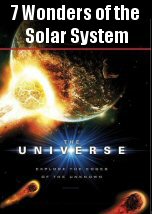
The Universe: 7 Wonders of the Solar System

   2010    Science    3D    HD
Take an exhilarating, unprecedented exploration of the seven most amazing wonders of our solar system. Our virtual tour begins with a trip to Enceladus, one of Saturn's outer moons, where icy geysers spout from its surface. Then venture to Saturn's famous rings, which contain mountain ranges that rival the Alps. Next dive into the eye of the biggest storm in the solar system--Jupiter's Great Red Spot. Soar through the Asteroid Belt, containing millions of leftover rocks from the formation of the solar system. Trek up Mount Olympus, the largest volcano, located on Mars. Have a close encounter with the searing surface of the Sun, and finish the journey by exploring our home planet Earth.
Series: The Universe

The Sun: God Star

   2021    Science
Professor Brian Cox journeys across the vastness of time and space revealing epic moments of sheer drama that changed the universe forever.
The series begins this epic exploration of the cosmos with a hymn to the great luminous bodies that bring light and warmth to the universe: the stars. It is estimated that there are two hundred trillion stars in the universe, each playing their part in an epic story of creation- a great saga that stretches from the dawn of time, with the arrival of the first star, through diverse generations until the arrival of our own star, the sun, and a civilization that has grown up in its light.
Series: Universe

Storm

   2018    Science
Space isn't vast and empty space but a dynamic, cosmic storm. It's a storm that could kill us, but without it we wouldn't be here at all. This is a story about the weird connections, the near misses, the lucky breaks that created this amazing world. For 4.5 billion years our planet has been battered and bruised and punched and pummeled but we're still standing. It's actually the battle that's built us and this is the tale of the tape.
Ever wonder how our planet got here? It was born in a cosmic storm. The violence could have destroyed us, but instead it made us.
Series: One Strange Rock

How Big How Far How Fast

   2012    Science
Push the limits of your imagination as astronomers attempt to grasp the mind-boggling extremes of size, distance and speed within our universe by bringing them down to earth. In this episode, our cast uses awesome analogies to bring the biggest objects, farthest distances and fastest speeds down to earth. To truly understand the scale of the cosmos, we jump behind the wheel of monster trucks, scale the Golden Gate Bridge, and race across the desert in a rocket-powered car.
Series: The Universe