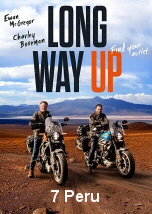
As the journey continues, there's beauty and danger in equal measure for Charley Boorman and Ewan McGrego. The duo ride their electric Harleys through the exotic and breathtaking Bolivian countryside in a tough ascent. The sixth episode showcases some of the challenges the hosts and the crew face when they scale the terrain. One of the Rivians runs into trouble while sandy roads and a heavy breeze sees Boorman take a tumble. Apart from all the accidents, the chapter also shows some quality work done by UNICEF when it comes to educating and working with the children in Bolivia. The altitude sickness hits Taylor, their logistics man real bad and McGregor starts feeling it as well. The episode ends with a doctor heading to his hotel room to check up on him.
Dr Hannah Fry travels down the fastest zip wire in the world to learn more about Newton's ideas on gravity. His discoveries revealed the movement of the planets was regular and predictable. James Clerk Maxwell unified the ideas of electricity and magnetism, and explained what light was. As if that wasn't enough, he also predicted the existence of radio waves. His tools of the trade were nothing more than pure mathematics. All strong evidence for maths being discovered. But in the 19th century, maths is turned on its head when new types of geometry are invented. No longer is the kind of geometry we learned in school the final say on the subject. If maths is more like a game, albeit a complicated one, where we can change the rules, surely this points to maths being something we invent - a product of the human mind. To try and answer this question, Hannah travels to Halle in Germany on the trail of perhaps one of the greatest mathematicians of the 20th century, Georg Cantor. He showed that infinity, far from being infinitely big, actually comes in different sizes, some bigger than others. This increasingly weird world is feeling more and more like something we've invented. But if that's the case, why is maths so uncannily good at predicting the world around us? Invented or discovered, this question just got a lot harder to answer.
It bursts from the Sun with the power of ten thousand nuclear weapons... and when it hits our planet, it could create the largest disaster in recorded history. A magnetic storm from the Sun could wipe out electrical power, television, radio, military communication, and nearly every piece of electronics in the Northern Hemisphere. It's a "Solar Katrina" -- a planet-wide "hurricane" of magnetic forces that scramble all 21st Century technology, possibly for good. What causes this magnetic superstorm? Why is magnetism so powerful -- and yet so poorly understood? And is there anything we can do to prevent the Magnetic Storm?
Electricity is not just something that creates heat and light, it connects the world through networks and broadcasting. After centuries of man's experiments with electricity, the final episode tells the story of how a new age of real understanding dawned - how we discovered electric fields and electromagnetic waves. Today we can hardly imagine life without electricity - it defines our era. As our understanding of it has increased so has our reliance upon it, and today we are on the brink of a new breakthrough, because if we can understand the secret of electrical superconductivity, we could once again transform the world.
The Internet promises us escape from reality. We can go places we never thought possible and express ourselves as never before. But as we sit in our homes surrounded by screens, are we free... and safe? In this episode meet a woman pulled into an online cult from the safety of her bedroom; a former pilot who suffers from Electromagnetic Hypersensitivity and can only find relief in the absence of electricity and wifi; plus, a quadriplegic who uses cutting-edge adaptive robotics and virtual reality to transcend his body's limitations.
As the journey continues, there's beauty and danger in equal measure. Charley and Ewan travel through the extraordinary Bolivian desert, but the sandy roads make all more difficult. The duo ride their electric bikes through the exotic and breathtaking countryside and all the way making a challenging ascent. The riders stay in a hotel made entirely out of salt before heading to La Paz. 'Bolivia' also shows some quality work done by UNICEF when it comes to educating and working with the children. McGregor and Boorman spend time with the kids before resuming their journey and ending with a ferry ride over lake Titicaca.







The altitude sickness hits Taylor, their logistics man real bad and McGregor starts feeling it as well. The episode ends with a doctor heading to his hotel room to check up on him.