The incredible story of how Pluto has been propelled from an unremarkable ball of ice on the edge of the solar system to a world of unimaginable complexity - where some form of alien life might exist. New discoveries from the edge of the solar system are transforming what is known about Pluto, thanks to the New Horizons space probe that took the first-ever close up images of the planet. Pluto was once thought to be geologically dead, but the pictures revealed it to be an active world of stunning complexity, with mountains carved from ice, a nitrogen glacier that appeared to be moving and a recently active volcano, with data sent back lead some scientists to speculate that there may even be life on Pluto today.
New planets are now being discovered outside our solar system on a regular basis, and these strange new worlds are forcing scientists to rewrite the history of our own solar system. Far from a simple story of stable orbits, the creation of our solar system is a tale of hellfire, chaos and planetary pinball. It's a miracle our Earth is here at all.
The magnificent ringed planet Saturn, along with its more than 80 moons, forms the most dynamic planetary system in our neighborhood. With underground oceans and protective magnetic fields, experts are exploring how this collective of satellites has the potential to rewrite the rules of the Solar System. The closer that we look, the more we see these extraordinary moons like worlds of their own -- so dynamic, so Earth-like. Almost a billion miles from the Sun, these icy worlds could be home for Life 2.0. The moons of Saturn offer possibly the best chance of finding extraterrestrial life in our solar system. With each new mission, we get closer to unraveling the mysteries of Saturn's moons.
This remarkable film offers a breathtaking, all-seeing perspective on one of the most eventful years in recent history. Captured through stunning satellite imagery, this documentary unveils hidden layers behind major global events, revealing the full scale of their impact as seen from space. From the mesmerizing path of a total solar eclipse to the relentless fury of extreme weather, the intense political landscape of the U.S. elections, and the awe-inspiring spectacle of powerful solar storms, the year 2024 was nothing short of extraordinary. The film also chronicles the devastating wildfires that scarred vast landscapes and the shocking collision of a cargo ship with a bridge in Baltimore—an event so destructive it was clearly visible from orbit. Through cutting-edge satellite technology, “2024: The Year from Space” not only documents history as it unfolded but also offers a rare and humbling reminder of how interconnected our world truly is.
Embark on an extraordinary journey across our cosmic neighborhood to witness the hidden wonders of planets, moons, and asteroids—each world more astonishing than the last. Cutting-edge imaging and breathtaking visuals unveil the solar system in ways never imagined, revealing alien landscapes, colossal storms, and secrets that challenge everything we know about our place in the universe. In the first episode, you can explore volcanic realms where otherworldly landscapes are sculpted by fire and ice. Discover planets and moons blanketed with enormous volcanoes, some erupting so violently that plumes rise into the darkness of space. From oceans of molten rock to frozen geysers launching towering jets of vapor, these spectacular worlds showcase the raw power and beauty of nature beyond Earth.
This documentary journeys with the scientists into the heart of a giant. Juno is the Nasa mission designed to peer through Jupiter's swirling clouds and reveal the wonders within. By projecting a 70-foot-wide, life-size Juno on a Houston rooftop, Scott Bolton, head of Juno, shows us how its fragile electronics are encased in 200kg of titanium. As Scott puts it, 'we had to build an armoured tank to go there.' Professor Andrew Ingersoll, Juno's space weatherman, reveals they have seen lightning inside Jupiter, perhaps a thousand times more powerful than Earth's lightning. This might be evidence for huge quantities of water inside Jupiter. Under the extreme conditions of Jupiter thousands of miles under the surface, hydrogen becomes a liquid metal. Juno is finding out how much liquid metallic hydrogen is inside Jupiter, and scientists hope to better understand how this flowing metal produces the most powerful aurora in the Solar System. But what is at Jupiter's heart? In Nice, Prof Tristan Guillot explains how Juno uses gravity to map the planet's centre. This can take scientists back to the earliest days of the solar system, because Jupiter is the oldest planet and it should contain clues to its own creation. By chalking out an outline of the Jupiter, Tristan reveals there is a huge rocky core - perhaps ten times the mass of Earth.


















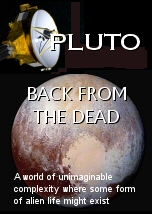










New discoveries from the edge of the solar system are transforming what is known about Pluto, thanks to the New Horizons space probe that took the first-ever close up images of the planet. Pluto was once thought to be geologically dead, but the pictures revealed it to be an active world of stunning complexity, with mountains carved from ice, a nitrogen glacier that appeared to be moving and a recently active volcano, with data sent back lead some scientists to speculate that there may even be life on Pluto today.