









Last Watched

"Song"  Sort by

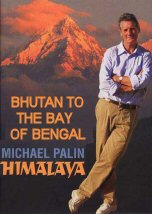
Bhutan to the Bay of Bengal

   2004    Culture
In Bhutan, Palin finds himself back in the land of yaks for a last look at the high Himalaya. Trekking to Chomolhari base camp he meets a nomad with a penchant for yak songs before heading down to Paro to witness the Buddhist festival or Tsechu. In a bar in Thimphu, he discusses reincarnation and the pursuit of happiness with Benji and Khendum, two of the king's cousins, and en route to Bangladesh is taken by Benji to see the rare black-neck cranes. On his journey south through Bangladesh, Michael visits the ship-breaking beaches of Chittagong and grid-locked Dhaka. He meets a man who made a fortune in Birmingham in the poultry business, and a woman who lends money only to women. On a 1920s paddle steamer he is serenaded with the words of Bengal's Shakespeare, and he completes his epic Himalayan journey aboard a fishing boat that carries him out into the Bay of Bengal and a westering sun.
Series: Himalaya with Michael Palin
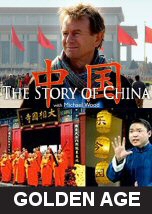

The Golden Age

   2016    History
This episode tells the tale of what's broadly considered China's most creative dynasty - the Song (960-1279). Michael Wood heads to the city of Kaifeng, the greatest city in the world before the 19th century. Here in Twin Dragon Alley, locals tell him the legend of the baby boys who became emperors.
He explores the ideas and inventions that made the Song one of greatest eras in world culture, helped by China's most famous work of art, the Kaifeng scroll, which shows the life of the city in around 1120. A chef makes Michael a recipe from a Song cookbook, while a guide to 'how to live happy, healthy lives for old people', published in 1085 and still in print, is discussed with local women doing their morning exercises. The Song was also a great era for scientific advance in China. Michael steers a huge working replica of an astronomical clock, made by China's Leonardo da Vinci.
Then at a crunch Chinese Premier League match, Michael tells us the Chinese invented football! The golden age of the northern Song ended in 1127, when invaders sacked Kaifeng, but they survived in the south. At their new capital, Hangzhou, Wood joins locals dancing by the West Lake, while in the countryside he meets Mr Xie with his records of 40 generations of ancestors. The final defeat of the Song took place in a naval battle in the estuary of the Pearl River in 1279. When all was lost, rather than surrender to the Mongols, a loyal minister jumped into the sea with the young boy emperor in his arms. 'So ended the glory of the Song', Wood concludes, 'but a new age would arise... as in China, it always has!'.
Series: The Story of China

Eagles The Farewell 1 Tour 2of3

   2005    Art
Thirty songs over two and a half hours, with fine performances, great sound, and good visual direction: it's all here on this series. At one point, the veteran band seemed unlikely to even make it to the new millennium, but here they are, mostly intact, with a string of hits dating back more than three decades. The majority of them are performed here, from the earliest ('Take It Easy,' 'Desperado,' 'Peaceful Easy Feeling') through 'Hotel California' and 'Life in the Fast Lane' and right up to 'Love Will Keep Us Alive'.
Series: Eagles The Farewell 1 Tour

Eagles The Farewell 1 Tour 3of3

   2005    Art
The live concert also contain hits from Glenn Frey, Don Henley, and Joe Walsh's solo careers, and a few new songs as well, including Walsh's 'One Day at a Time' and 'Hole in the World,' Frey and Henley's moving, almost gospel-tinged reaction to the events of 9/11/01.
As for the somewhat cheeky title, well, there's always been a certain smugness to the Eagles' sense of humor, and it's no different this time, as Frey doesn't even pretend that there won't be a Farewell 2 Tour in the future. And why not? These are good songs, played beautifully by the quartet (plus supplemental musicians) to audiences that love them.
Series: Eagles The Farewell 1 Tour

Over the Rainbow

   2013    Culture
With optional Hebrew subtitles. Simon Schama's history of the Jewish experience plunges into the lost world of the shtetl, the Jewish towns and villages sewn across the hinterlands of Eastern Europe which became the seedbed of a uniquely Jewish culture. Shtetl culture would make its mark on the modern world, from the revolutionary politics of the Soviet Union to the mass culture of Tin Pan Alley and Hollywood. It was also the birthplaces of Hasidism, the most visible, iconic and, arguably, most misunderstood expression of Jewish faith and fervour. This chapter of the story travels from the forests of Lithuania, where Simon's own family logged wood and fought wolves, to the streets of the Lower East Side where the sons of shtetl immigrants wrote the American songbook. With grim inevitability, the story returns to Eastern Europe in 1940 - where the genocidal mechanisms of the 'final solution' were beginning to grind the shtetl world into dust and ash.
Series: The Story of the Jews

Supertramp: Live In Paris

       Art
Supertramp's 'Breakfast in America' was the biggest selling album in the world in 1979. Following the album's release Supertramp embarked on a 10 month world tour which arrived in Paris at the end of November. Now, transferred and restored from the original 16mm film, this footage is available to Supertramp's legion of fans worldwide.
In July 2006, the original master tapes of the album 'Supertramp: Live In Paris' were rediscovered in the Northern California barn of the band's drummer Bob Siebenberg, along with video footage. The tapes were sent to Cups 'N Strings Studios in Woodland Hills, California, for digital remastering. The tapes were initially in bad technical shape, but were successfully transferred to a digital format.
The original idea was to feature heavily footage of Paris, adding a story in The Song Remains the Same. The sound was remixed by Peter Henderson and Supertramp's original sound engineer Russel Pope from the original multi-tracks.