












Last Watched

"Whales"  Sort by

Living with Predators. Conservation

   2015    Nature
The final episode of the series visits the frontline of the conflict with the world's top predators, meeting the scientists fighting to save them. Crossing five continents and combining landmark natural history footage with real-life human drama, it checks the pulse of the earth's iconic animals, including lions, tigers, polar bears and blue whales. With three-quarters of the planet's carnivores now in decline, can people find ways to live with predators before they disappear forever?
Series: The Hunt
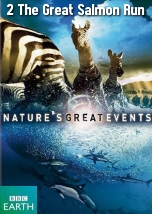
The Great Salmon Run

   2009    Nature
Every year grizzly bear families in North America depend for their survival on a spectacular natural event: the return of hundreds of millions of salmon from the Pacific Ocean to the mountain streams where they were born. The salmon travel thousands of miles to spawn and then die. The great run not only provides food for bears, but for killer whales, wolves, bald eagles, and even the forest itself. The question is: will the salmon return in time to keep hungry bears alive?
A mother grizzly and her cubs emerge from their den high in snowy Alaskan mountains. Filming from the air the team capture a TV first, following the bears as they negotiate a near vertical slope on their journey to the coast where they await the return of the salmon. Meanwhile, the salmon are making their way to the to river mouths where they must swim upstream and against the current. The programme reveals how they tackle the torrents and leap over waterfalls, a feat equivalent to a human jumping over a house. Dozens of hungry bears eagerly await the salmon that make it up river. In another TV first, underwater cameras record the ingenuity and fancy footwork they use to collect dead salmon from the bottom of deep pools.
Series: Nature Great Events

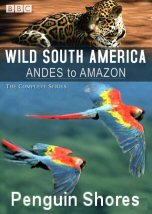
Penguin Shores

   2005    Nature
A dramatic journey along the coasts of South America, from the Falklands to the tropical Galapagos. The cold currents create rich fisheries, and support such diverse marine life as dolphins, killer whales, sea lions and albatross. But the most biquitous creatures are the penguins, which inhabit surprising locations - lush forest, arid desert and even equatorial areas.
Series: Wild South America

The Death of the Oceans

   2010    Nature
Sir David Attenborough reveals the findings of one of the most ambitious scientific studies of our time - an investigation into what is happening to our oceans. He looks at whether it is too late to save their remarkable biodiversity. Attenborough explores some of the ways in which we are affecting marine life - from over-fishing to the acidification of sea water. The film also uncovers the disturbing story of how shipping noise is deafening whales and dolphins, affecting their survival in the future.

Fathom

   2021    Nature
Fathom is a visual and aural wonder of a documentary that follows researchers working to finally decode the communication of humpback whales. Dr. Ellen Garland and Dr. Michelle Fournet embark on parallel journeys on opposite sides of the world, as they seek to better understand whale culture and communication. The film uniquely reveals a deep commitment and reverence to the scientific process and the universal human need to seek answers about the world around us.
From hypothesis to groundbreaking experiences in the field, 'Fathom' showcases the passion, curiosity, collaboration, perseverance and work it takes for leading scientists to make scientific discoveries.

Living Together

   2006    Nature
The documentary deals with the future of conservation. It begins by looking at previous efforts. The 'Save The Whales' campaign, which started in the 1960s, is seen to have had a limited effect, as whaling continues and fish stocks also decline. In the 1990s, as head of the Kenya Wildlife Service, Richard Leakey took on the poachers by employing armed units. Although it was successful in saving elephants, the policy was detrimental to the Maasai people, who were forced from their land. The need for "fortress" areas is questioned, and the recently highlighted Raja Ampat coral reef in Indonesia is an example. The more tourism it generates, the greater the potential for damage — and inevitable coastal construction. Sustainable development is viewed as controversial, and one contributor perceives it to currently be a "contradiction in terms". Trophy hunting is also contentious. Those that support it argue that it generates wealth for local economies, while its opponents point to the reducing numbers of species such as the markhor. Ecotourism is shown to be beneficial, as it is in the interests of its providers to protect their environments. However, in some areas, such as the Borneo rainforests, the great diversity of species is being replaced by monocultures. The role of both religion and the media in conservation is argued to be extremely important. Contributors to the programme admit a degree of worry about the future, but also optimism.
Alien Worlds

Alien Worlds

2020  Science
Earthflight

Earthflight

2012  Nature
Wonders Of The Universe

Wonders Of The Universe

2011  Science
Rome

Rome

  History
Universe

Universe

2021  Science