Mars is infested with robots, orbiting the planet and roaming the Martian surface on a mission to uncover its secrets; now, Perseverance joins this dedicated group of machines to uncover if there is, or was ever, life on the Red Planet. Our neighbor, Mars, fascinates us. It's a planet that is similar to Earth but with some big differences. Mars is rusty, dusty, frigid, and frozen. Past missions suggest that Mars was once a very different world. The Mars we see today has completely changed from the Mars of a few billion years ago. Without a time machine to explore ancient Mars, we employ a team of high-tech robot investigators, an entire fleet of robotic spacecraft exploring the planet. Working together, they dig into Mars's past to answer the ultimate question -- did Mars once have life?
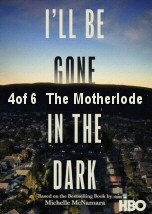
Michelle McNamara and her editors agree to push her book deadline after being granted access to the Orange County Sheriff's Department's East Area Rapist / Original Night Stalker room. After everybody realized the killer moved south, that story exploded. The hope was that by having greater public attention, the right person gave the right tip.
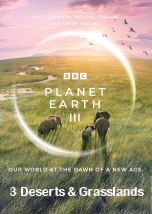
The third episode takes viewers on a riveting journey to some of the world's most extreme and breathtaking deserts and grasslands, where nature puts on its most dramatic show. It begins in the arid landscapes of Central Africa's Guelta d'Archei and the Namib Desert in Southwest Africa, places where water is scarce, and survival is a daily battle. The focus then shifts to the remarkable adaptability of creatures like ostriches, who brave the scorching heat and predators to raise their young and a handful of leopards who learned to hunt from trees on the African plains. In Australia, viewers witness the intricate courtship rituals of the spotted bowerbird, a species facing challenges due to climate change. The narrative then takes us to the vast Eurasian Steppe, home to the unique Saiga antelope, and to Brazil's Cerrado, a biodiverse grassland where the elusive maned wolf plays a crucial role in maintaining the ecosystem. The episode highlights not only the resilience and beauty of these creatures but also the fragility of their habitats, emphasizing the urgent need for conservation efforts.
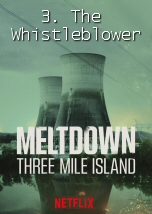
In the third episode, during cleanup at the plant, insiders claim that cost-cutting measures and intimidation tactics create a danger war force than the accident itself. Several state and federal government agencies mounted investigations into the crisis, the most prominent of which was the President's Commission on the Accident at Three Mile Island, headed by chairman John G. Kemeny. The investigation strongly criticized Babcock & Wilcox, Met Ed, Graphics processing unit, and the Nuclear Regulatory Commission for lapses in quality assurance and maintenance, inadequate operator training, lack of communication of important safety information, poor management, and complacency. Kemeny said that the procedures and that the control room were greatly inadequate for managing an accident.
Jean Hargadon Wehner discusses how she came to remember years later the sexual abuse she suffered at Archbishop Keough High School. She also talks about what happened when she reported the abuse to Church officials and how she realized she was connected to the death of Sister Cathy Cesnik. As the can of worms is opened on the hidden world in the high school and the people begin to talk about what happened behind closed doors. With the Jean’s accusations, Abbie Schaub, Gemma Hoskins, and Tom Nugent learn about a story of a graveyard and a source nicknamed 'Deep Throat' who could hold the key.
Rasputin is gone, but Nicholas II continues his catastrophic policies in war and at home. When Nicholas goes back to military headquarters, he is in fact leaving control of government, exactly when Russia needed to be held together by its Czar. The war by this time is deeply unpopular. It's not only unpopular, it's also arguably the engine that's causing enormous economic crisis, that's causing general unrest. Deprivation pushes the population from unrest to revolution.























Our neighbor, Mars, fascinates us. It's a planet that is similar to Earth but with some big differences. Mars is rusty, dusty, frigid, and frozen. Past missions suggest that Mars was once a very different world. The Mars we see today has completely changed from the Mars of a few billion years ago. Without a time machine to explore ancient Mars, we employ a team of high-tech robot investigators, an entire fleet of robotic spacecraft exploring the planet. Working together, they dig into Mars's past to answer the ultimate question -- did Mars once have life?