






Last Watched

"Man"  Sort by

Deeper, Deeper, Deeper Still

   2014    Science
This episodes the nature of the cosmos on the micro and atomic scales, using the Ship of the Imagination to explore these realms. Tyson describes some of the micro-organism that live within a dew drop, demonstrating parameciums and tardigrades. He proceeds to discuss how plants use photosynthesis via their chloroplasts to convert sunlight into chemical reactions that convert carbon dioxide and water into oxygen and energy-rich sugars. Tyson then discusses the nature of molecules and atoms and how they relate to the evolution of species. He uses the example set forth by Charles Darwin postulating the existence of the long-tongued Morgan's sphinx moth based on the nature of the comet orchid with pollen far within the flower. He further demonstrates that scents from flowers are used to trigger olfactory centers in the brain, stimulating the mind to threats as to aid in the survival of the species. Tyson narrates how Greek philosophers Thales and Democritus postulated that all matter was made up of combinations of atoms in a large number of configurations, and describes how carbon forms the basic building block for life on earth due to its unique chemical nature. Tyson explains on the basic atomic structure of protons, neutrons, and electrons, and the nature of nuclear fusion that occurs in most stars. He then discusses the existence of neutrinos that are created by these nuclear processes in stars, and that detecting such sub-atomic particles which normally pass through matter require subterranean facilities like the Super-Kamiokande that were used to detect neutrinos from the supernova SN 1987A in the Large Magellanic Cloud before light from the explosion were observed due to their ability to pass through matter of the dying sun. Tyson compares how neutrinos were postulated by Wolfgang Pauli to account for the conservation of energy from nuclear reactions in the same manner as Darwin's postulate on the long-tongued moth. Tyson concludes by noting that there are neutrinos from the Big Bang still existing in the universe but due to the nature of light, there is a "wall of infinity" that cannot be observed beyond.
Series: Cosmos: A Spacetime Odyssey
Edible Insects

   2021    Culture
From crunchy crickets to nutty fly grubs, the film takes a tasty look at insect foods and how they could benefit our health and our warming planet. From Thailand to Texas, insect farmers are showing how the tiny critters stack up as an environmentally friendly alternative to beef protein and can, pound for pound, deliver better nutritional value than the finest steak. But will western people overcome the 'ick' factor and share the appetite of many cultures around the world for insect feasts?

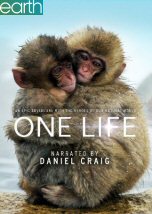
One Life

   2011    Nature    HD
Growing up. Finding food. Seeking shelter. Finding a soul mate. Raising children. These universal themes touch the hearts of audiences everywhere. Parents will do anything to give their kids the best start in life. Witness the epic journey of a tiny poison arrow frog, scaling impossibly high trees to feed her tadpoles in the canopy. As the young grow, they confront the life long search for food. Capuchin monkeys spend up to eight years teaching their young the complex process of preparing a palm nut meal.
For those creatures who successfully negotiated all the obstacles to adulthood, it’s time to face the ultimate test: to find a partner and to pass on their genes to the next generation. In what is one of the most spectacular and romantic courtship dances in the world, grebes step out across the surface of a lake in perfect unison. We see so much of ourselves in these different animals, and them in us – intelligence, strength, determination, courage, even love. The stories combine to reveal how every living thing on our planet shares the same desire – not just to live, but to foster new life. Relevant, engaging and above all, amazing. Narrated by Daniel Craig,

To End All War: Oppenheimer and the Atomic Bomb

   2023    Technology
The true story of physicist J. Robert Oppenheimer's journey from driven and ambitious scientist to remorseful and tormented man struck hard by the gravity of what he had done. For Oppenheimer, the successful detonation of the first atom bomb validates years of tireless work. But in this moment of seeming triumph, Oppenheimer sees before him a destructive power of almost supernatural magnitude.
The films explores how one man's brilliance, hubris and relentless drive changed the nature of war forever.

The Art of Germany: A Divided Land

   2010    Art
Andrew Graham-Dixon begins his exploration of German art by looking at the rich and often neglected art of the German middle ages and Renaissance. He visits the towering cathedral of Cologne, a place which encapsulates the varied and often contradictory character of German art. In Munch he gets to grips with the earliest paintings of the Northern Renaissance, the woodcuts of Albrecht Durer and the cosmic visions of the painter Albrecht Altdorfer. Andrew also embarks on a tour of the Bavarian countryside, discovering some of the little-known treasures of German limewood sculpture.
Series: The Art of Germany

Indestructible

   2020    Science
In this series, David Pogue explores the fantastic chemistry behind the everyday and sets out on a worldwide quest to find the key molecules and chemical reactions that have paved the way for human civilization, life, and even the universe as we know it.
In the first episode, glass so strong you can jump on it, rubber so tough it protects a clay pot dropped from 50 feet, endless varieties of plastic. Scientists and engineers have created virtually indestructible versions of common materials by manipulating the chains of interlocking atoms that give them strength—but have they made them too tough?
Series: Beyond the Elements
The Man with 1000 Kids

The Man with 1000 Kids

2024  Culture
Senna

Senna

2010  Culture
The Hunt

The Hunt

2015  Nature