In episodes 15 and 16, the war begins to close in on the Axis powers not only across battlefields, but inside the societies that created it. Germany and Japan face the turning tide in radically different ways: Hitler’s regime tries to preserve the illusion of normal life while driving production through propaganda, forced labor and terror, while Japan demands sacrifice, austerity and total obedience from its people as American submarines cut the lifelines of empire. As bombing raids, shortages and fear shatter the home front, the documentary reveals how nations built on conquest begin to feel the terrible cost of the war they unleashed. The story then moves into one of the most powerful chapters of resistance in occupied Europe. As Allied armies advance from Normandy and Soviet forces push from the east, ordinary people and underground fighters rise against Nazi rule in France, Poland and even inside the machinery of extermination itself. From coded BBC messages and the liberation of Paris to the doomed Warsaw Uprising and the desperate courage of prisoners documenting the horrors of Auschwitz, these episodes show war at its most human and devastating: A struggle not only between armies, but between tyranny and the refusal to be erased.
This compelling portrait explores the life and legacy of legendary filmmaker John Ford, tracing his journey from the silent era to becoming one of the most influential directors in cinema history. Through rare archival footage, interviews with collaborators and admirers, and scenes from his most iconic films, the documentary reveals how Ford shaped the visual language of Hollywood and redefined the American Western. It uncovers the man behind the myth—disciplined, private, and fiercely devoted to storytelling. Beyond the sweeping landscapes and unforgettable heroes, the film examines Ford’s complex personality and the contradictions that fueled his artistry. Featuring reflections from major actors and directors who worked with him, it becomes both a tribute and an intimate study of a filmmaker whose vision continues to echo through generations of cinema.
Dean Potter emerges as one of the most daring and controversial figures in modern adventure, a climber, highline walker and BASE jumper driven by an almost mystical need to move toward fear. Through breathtaking footage, personal reflections and the voices of those who knew him, this documentary explores how he turned cliffs, voids and impossible lines into places of freedom, beauty and danger. But behind the legendary ascents and world records lies a more fragile and divided man, struggling with relationships, identity, obsession and the heavy cost of living as if every boundary were meant to be broken. In the first two episodes, Dean finds escape and joy in extreme climbing, pushing himself through bold ascents, speed records and free-solo feats that make him both admired and misunderstood. As his rebellious image grows, so do the pressures around his personal life and the risks he is willing to take. He searches for peace in highlining, BASE jumping and the terrifying purity of climbing without a rope, while his “Dark Wizard” persona attracts devoted followers and fierce criticism. Then a new force enters the climbing world: Alex Honnold, whose arrival threatens Dean’s place at the edge of the sport and turns admiration, rivalry and fear into a powerful new chapter.
In the final three episodes of the series, the image of elite discipline surrounding the SS is stripped away to reveal a far darker and more disturbing reality. Behind the façade of military excellence lay poorly trained recruits driven not by honor, but by blind ideology and a complete absence of remorse. As their role expands from the battlefield to the brutal control of concentration camps, the narrative exposes how ordinary men became perpetrators of systematic violence, carrying out atrocities with chilling efficiency while maintaining the appearance of normal lives beyond their crimes. These episodes push further into the unsettling contrast between barbarity and everyday existence, showing how members of the SS could participate in unimaginable acts and then return to social settings as if nothing had happened. The story then draws a direct line to the present, confronting the uncomfortable truth that, despite overwhelming historical evidence, remnants of admiration and myth still persist in certain circles. It’s a gripping and unsettling conclusion that forces viewers to question how such distortion of memory can endure—and why it still matters today.
In these three episodes, we'll see how life on the farm becomes more ambitious, more expensive, and much more unpredictable. A major new arrival promises to transform the future of the business, while unexpected births bring fresh challenges and moments of joy among the animals. As the livestock move out to pasture and new technology is introduced to improve daily operations, every success seems to be matched by a new obstacle. What begins as a season of optimism soon becomes a race against time, budgets, and the realities of modern farming. Meanwhile, Jeremy takes a crucial step into the cattle trade and discovers that turning farm produce into a profitable venture is far more complicated than expected. His long search for a pub finally appears to be reaching a breakthrough, but expert advice reveals a daunting list of costs, regulations, and risks that threaten to derail the entire project. With major financial decisions looming and pressure mounting from every direction, the dream of building something bigger than a farm hangs in the balance.
In episodes 13 and 14, the war reaches a decisive new stage as the Allies prepare to launch Operation Overlord and open the long-awaited second front in Nazi-occupied France. Behind the invasion of Normandy lies an enormous gamble of planning, deception, weather, timing and nerve, with Dwight D. Eisenhower carrying the weight of one of the most dangerous military decisions in history. From the beaches of D-Day to the struggle to break through Hitler’s Atlantic Wall, the episode captures the fear, scale and sacrifice of the operation that begins the liberation of Western Europe. The story then moves to World War II’s often overlooked Asian theater, where Allied forces and Japan fight across jungles, mountains, plains and impossible supply routes. In Burma, India and China, commanders such as Joseph Stilwell, William Slim and Lord Mountbatten face a brutal war of disease, exhaustion, monsoon terrain and relentless Japanese resistance. From the Burma Road and the deadly airlift over the Hump to the fighting at Myitkyina, Imphal and Saipan, these episodes reveal a vast and punishing conflict far from Europe’s headlines, where survival itself becomes a battle and victory demands endurance on a staggering scale.


















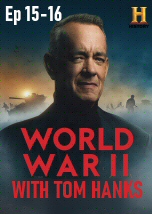





The story then moves into one of the most powerful chapters of resistance in occupied Europe. As Allied armies advance from Normandy and Soviet forces push from the east, ordinary people and underground fighters rise against Nazi rule in France, Poland and even inside the machinery of extermination itself. From coded BBC messages and the liberation of Paris to the doomed Warsaw Uprising and the desperate courage of prisoners documenting the horrors of Auschwitz, these episodes show war at its most human and devastating: A struggle not only between armies, but between tyranny and the refusal to be erased.