In the last two episodes of this series, you can see how coffee and corn open the door to stories far beyond what we consume every day. From the demanding journey of the coffee bean—shaped by history, craftsmanship and human effort—to the rise of corn from a sacred crop to a dominant force in global food systems, these episodes reveal how simple ingredients carry profound meaning. What begins as a look at familiar foods quickly becomes a deeper exploration of culture, industry and survival, uncovering the fragile balance behind what we eat and leaving a lasting sense of how much is at stake in the most ordinary things.
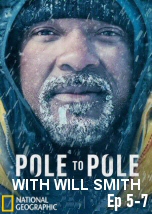
In the final three episodes, the journey deepens into a powerful exploration of culture, survival, and science at the planet’s edges. On a remote Pacific island threatened by rising seas, Will Smith joins Dr. Walworth and John Aini to document a dying language spoken by only five people, turning marine research into an intimate race against time to preserve human memory. The mission reveals how climate change erodes not just coastlines, but identities. The adventure then shifts to extremes of land and ice. In the Kalahari Desert, Will learns survival from the San people, confronting the limits of his endurance during a traditional hunt with guide Kane Motswana. The odyssey culminates beneath the ice of the North Pole, where, alongside polar ecologist Allison Fong, a daring dive to collect critical samples is jeopardized by a sudden storm and equipment failure. What follows is a gripping test of courage and teamwork that redefines heroism at the end of a 100-day quest.
In the final two episodes, the focus shifts to forests and humanity’s defining role in the planet’s future. Ancient woodlands emerge as powerful engines of climate balance, storing vast amounts of carbon while sustaining intricate webs of life. Through striking visuals and frontline science, the documentary reveals how the health of the world’s forests is inseparable from the stability of Earth’s climate—and how their decline accelerates global risk. The story then turns inward, asking what responsibility humans bear in shaping what comes next. From indigenous stewardship to bold restoration projects, these episodes explore how human choices can either deepen the crisis or unlock nature’s capacity to heal. It’s a compelling conclusion that reframes our relationship with the natural world, showing that the future of nature is, ultimately, the future of humanity itself.
From the first flicker of life billions of years ago to the extraordinary diversity of animals alive today, Chris Packham embarks on an epic journey through evolution. Combining cutting-edge science, spectacular wildlife and vivid reconstructions of long-vanished creatures, he reveals how countless generations of innovation, adaptation and chance transformed simple cells into bodies capable of movement, reproduction, flight, intelligence and astonishing complexity. Along the way, familiar animals become gateways into some of the greatest mysteries in the history of life. In the first two episodes, Packham traces two remarkable evolutionary stories. In Kenya, he asks how a microscopic cell could ultimately give rise to the enormous, intelligent and highly social elephant, uncovering the crucial breakthroughs that made complex bodies, lungs, limbs and giant size possible. Then, in South Africa, the ostrich and its extraordinary egg open the door to the evolution of reproduction itself: From the origins of sex to the appearance of eggs, feathers and flight. Together, these episodes reveal that some of nature’s most spectacular creatures are the result of billions of years of unlikely experiments, lucky accidents and relentless adaptation.
After seven years of sobriety, Charlie Sheen looks back with striking honesty on a life lived at full speed. This documentary traces his meteoric rise from rebellious ’80s heart-throb to global TV superstardom, and the excesses that fueled his fame before leading to a very public collapse. Through candid conversations and rare reflections, the film reveals the magnetic charm, chaos, and contradictions that defined an era of celebrity culture. Family members and close friends share untold stories, including former spouses Denise Richards and Brooke Mueller, exposing the personal cost of life in the spotlight. Viewers can watch both episodes together as a single, continuous story, following Sheen’s fall at the height of his hit series and his hard-earned path toward accountability and redemption. It is a raw portrait of fame, addiction, and the possibility of change when the cameras finally stop rolling.
In episodes 9 and 10 of this series, the war moves from the secrecy of codebreaking rooms to one of the most brutal battlefields in history. Far from the front lines, in the quiet English countryside, a hidden struggle unfolds at Bletchley Park, where brilliant mathematicians, linguists and intelligence officers race to crack Germany’s Enigma code. Every intercepted message could save ships, reveal enemy plans and alter the fate of entire campaigns, turning silence, patience and genius into weapons as powerful as tanks or bombers. The story then shifts to the Eastern Front, where Hitler launches Operation Blue in a desperate drive toward the Soviet oil fields and the city of Stalingrad. What begins as a strategic offensive becomes a nightmare of street-by-street combat, starvation, freezing conditions and unimaginable sacrifice. As German forces are pulled deeper into the ruins and Soviet resistance hardens, Stalingrad becomes more than a battle for a city; it becomes a turning point in World War II, where ambition, endurance and catastrophe collide on a scale that changed the course of the war.















What begins as a look at familiar foods quickly becomes a deeper exploration of culture, industry and survival, uncovering the fragile balance behind what we eat and leaving a lasting sense of how much is at stake in the most ordinary things.