







Last Watched

"Bird"  Sort by

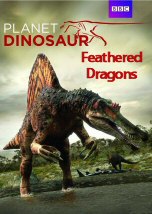
Feathered Dragons

   2011    Culture
In a late Jurassic forest in what is now China, an Epidexipteryx escapes from a juvenile Sinraptor by climbing a tree. It finds a beetle grub in the tree bark, being shown to use its elongated fingers in a similar way to a modern day aye-aye. However, its prey is stolen by another, larger Epidexipteryx, and after a brief bout of posturing, the smaller individual goes to find more food. It drops a second grub to the forest floor, where the other Epidexipteryx retrieves it, only to be killed by the juvenile Sinraptor. The episode then cuts to a desert in late Cretaceous Mongolia, where a Saurornithoides is shown brooding a nest of eggs. When it leaves the nest, an Oviraptor raids it, fleeing when the troodontid returns. The Saurornithoides is suddenly attacked and eaten by a Gigantoraptor, which then heads to compete in a breeding ritual for mates. The males use their feathers for display, a brief fight between two erupting at one point, allowing the females to choose the best suitor. The episode finally cuts to an early Cretaceous forest in China, where a Xianglong is being hunted by a Microraptor, which uses its feathers to pursue the gliding lizard in the air. A Sinornithosaurus attacks it, and after a brief chase the Microraptor manages a lucky escape. The Sinornithosaurus, alongside two other members of its species is then shown hunting a Jeholosaurus and its three young. The group brings down the parent, the narrator explaining that their possibly venomous bite allowed them to tackle animals much larger than themselves. A montage is then shown of the feathered dinosaurs featured in the programme, with the narrator saying that Microraptor not only hints at how flight might have developed, but also that dinosaurs still live amongst us today, as birds.
Series: Planet Dinosaur
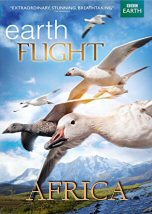
Earthflight Africa

   2012    Nature
Fly over Africa on the back of a vulture and see the most animal-packed continent with fresh eyes. Arrow-dive with cape gannets among sharks, dolphins and whales as they join the great sardine run. Soar with fish eagles as they discover an S-shaped living island comprised entirely of flamingos, and join them on a spectacular hunt. Fly with kelp gulls as they study the hunting behaviour of the greatest underwater predator of all: the great white shark. On the wings of eagles, fly through the mist-filled Victoria Falls and dive for fish in the mighty Zambezi. Circle with vultures high above the Serengeti as they watch the drama of the wildebeest migration below, and discover what happens when this canny scavenger suddenly becomes prey. Among toxic soda lakes, find out what it is like to be a flamingo, vulnerable to every predator on the continent, including baboons and hyenas. Join these flamingos as they take part in one of the most beautiful dances in the bird world. This is Africa as never seen before - from the wings of birds
Series: Earthflight

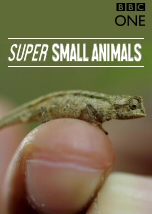
Super Small Animals

   2022    Nature
From a primate that’s no bigger than a mouse, to a chameleon that can fit on your fingertip, the natural world is full of fantastically small animals. Biologist Patrick Aryee explores the fascinating secrets behind these miniature marvels and shows that they’re not the underdogs you might think they are. Super Small Animals follows him as he meets the leading experts on these pint sized superstars, and finds out what makes them some of the most successful on the planet.
First up, he reveals the huge benefits that being small can bring. There’s the little lemur whose diminutive frame helps it to exploit a unique gap in the eco-system, the tiny hummingbird that uses its size to out-maneuver the competition, and the world’s smallest seahorse that never has to leave home. He also explores why small animals are proportionally the strongest in the world, and introduces a peanut-sized beetle that can pull over a thousand times its own weight.
Next he explores the challenges that animals face when they shrink in size, and the ingenious ways they overcome them. We find out how the smallest armadillo in the world manages to control its temperature in the searing desert sun, and the how the world’s smallest fish can survive in nothing more than a puddle, because it never really grows up. Patrick meets a secretive hippo that lives in the dense jungle, and looks like it’s been shrunk in the wash, and some of the world’s smallest snakes that give birth to enormous babies. He also meets a scientist that studies how really tiny spiders have a surprising trick that enables them to travel an incredible 40 miles per day, using almost no energy.
Then there are the animals that refuse to be pigeon holed as small, and manage to punch way above their weight. He puts some astonishing invertebrates to the test, to see how they work together to become much bigger than the sum of their parts and meets a pint-sized predator that takes on some of the largest and most dangerous creatures on the planet, getting hands on to discover how its build helps it to be brave. Finally he uncovers the incredible lengths that deep sea anglerfish go to in order to be big and small at the same time, and has an endearing encounter with a tiny carnivore that manages to be small in just one direction.
Whether their size helps them to hunt, hide or survive, all these remarkable animals prove that good things really do come in small packages.

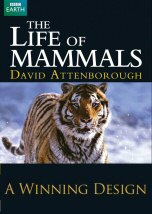
A Winning Design

   2002    Nature
A Winning Design clarifies what makes a mammal different from reptiles and birds. No, it isn't egg-laying: both the platypus and the echidna are egg-laying mammals; it's their ability to adapt. And it's this adaptability that becomes the crux of the remainder of the series. From the tiniest bat to the massive blue whale, all mammals share the ability to nurture their young on milk and regulate their own temperatures.
Series: The Life of Mammals

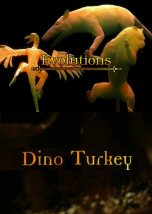
Dino Turkey

   2008    Science
From small viscous meat eaters to vegetarian giants, dinosaurs came in all shapes and sizes. Remarkable new evidence suggests that one dinosaur did not become extinct but evolved into a new animal species we all know today. Discover the missing link between the velociraptor and modern day birds.
Series: Evolutions

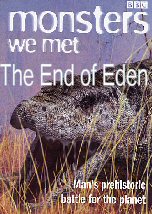
Monster we met: The End of Eden

   2006    Science
New Zealand - 850 years ago New Zealand was the last major land mass to be discovered and colonised by humans. A mere 850 years ago, Polynesian seafarers arrived in a land with no terrestrial mammals. New Zealand was a land of birds, and its avian rulers were giants: huge herbivorous moas were hunted by Haast's eagle - the largest eagle the world has ever seen. But within the space of only 100-400 years, the eagle, all the moas and over 20 other species of birds were gone. Had mankind become the monster?
The Last Dance

The Last Dance

2020  Culture
Galapagos

Galapagos

2006  Nature
The Hunt

The Hunt

2015  Nature
How to Grow a Planet

How to Grow a Planet

2012  Science
Life of a Universe

Life of a Universe

2017  Science
Power of Art

Power of Art

2006  Art