At 11 o'clock on New Year's Eve of the Cosmic Calendar, Homo erectus stood up for the first time, freeing its hands and earning the species its name. They began to move around, to explore, daring to risk everything to get to unknown places. Our Neanderthal relatives lived much as we did and did many of the things we consider to be 'human.' More restless than their cousins the Neanderthals and Denisovans, our Homo sapiens ancestors crossed seas and unforgiving landscapes, changing the land, ocean and atmosphere, leading to mass extinction. The scientific community gave our age a new name, 'Anthropocene.' Since the first civilizations we've wondered if there's something about human nature that contains the seeds of our destruction. Syukuro Manabe was born in rural Japan and took an intense interest in Earth's average global temperature. In the 1960's, he would assemble the evidence he needed to predict the increase of Earth's temperature due to greenhouse gases until it becomes an uninhabitable and toxic environment, leading to our extinction. 'This doesn't have to be,' says Neil deGrasse Tyson, 'it's not too late. There's another hallway, another future we can still have; we'll find a way.'
Master Chef judge Gregg Wallace and mathematician Dr Hannah Fry take over a restaurant and invite five special guests to enjoy a dinner party with a difference, where they will be scored on the carbon footprint of every dish they choose. Food accounts for a third of all greenhouse gas emissions, so making informed choices about what we eat is more important than ever. Gregg is with the kitchen team preparing delicious dishes and uncovering tips and tricks we can all use to cook more sustainably. Hannah is working with environmental scientists to reveal the carbon footprint of every single item on the menu and uncovering the latest research that can help us enjoy the food we love that doesn't cost the Earth.
Sir David Attenborough reveals how Mammals have conquered the Earth, uncovering the secrets to their success with their winning design, incredible adaptability, unrivalled intelligence, and unique sociability. 66 million years ago, when the reign of the dinosaurs came to an end, mammals were set free to exploit every corner of the planet. Mammals reveals the strategies, behaviours and traits that lie behind the astonishing success of this remarkable group of animals. Above all, the series celebrates the amazing intelligence that enables mammals to learn, remember, problem-solve, parent, and co-operate. Experience the complete six-episode series in a single video, showcasing how mammals have adapted to thrive in every major environment on Earth. They inhabit every ocean and continent, from frozen wildernesses and dense jungles to baking deserts, the dark depths of the ocean, and even the skies above our forests.
Pulls back the curtain on the world's top brands, exposing the hidden tactics and covert strategies used to keep all of us locked in an endless cycle of buying, no matter the cost. Few among us are immune to the thrills of a good buy. Whether you’re partial to designer handbags, mall brand clothing hauls, high-tech gadgets, or whatever’s on the shelves as you browse your favorite megastore, there’s always another item for sale that feels like it’s just right for you. And as it turns out, that’s all by design. In this film, the architects of our collective desire for endless consumption reveal how corporations are hell-bent on increasing profits, how they convince unsuspecting consumers time and time again to part with their money, and what happens when all of our discarded purchases make their way to landfills. Commentators who witnessed the inner workings of corporations from Amazon to Apple sit down to talk about the unsavory practices their former employers are still using. But while we’re all being encouraged to quench a bottomless thirst for more stuff, it’s the future generations and our environment that end up paying the price.
The centre of our galaxy is home to an invisible monster of unimaginable power – a supermassive black hole named Sagittarius A star, with four million times the mass of the Sun. Recent astronomical breakthroughs have confirmed not only that black holes like Sagittarius A star exist, but that these bizarre invisible objects may be the ultimate galactic protagonists. Stunning CGI takes us back to witness the fiery origins of our galaxy’s black hole 13.6 billion years ago, when the early universe was home to colossal blue stars, and when they ran out of fuel, they collapsed under their own enormous mass, crushing down into an object so small and so dense it punched a hole in the fabric of the universe. Over billions of years, Sagittarius A star feasted on nearby gas, stars, and through cataclysmic mergers with other black holes. A breakthrough discovery by Nasa’s Fermi gamma-ray telescope has shown that our black hole had the power to sculpt the entire galaxy, creating vast bubbles of gas above and below our galaxy and even protecting stars systems as ours. In a mind-bending conclusion, Brian Cox reveals how our modern understanding of black holes is challenging our concepts of reality to the breaking point. In trying to understand the fate of objects that fall into Sagittarius A star, scientists have come to a stunning conclusion: space and time, concepts so foundational to how we experience the world around us, are not as fundamental as we once thought.
In late Cretaceous Canada, in what will be known as Dinosaur Provincial Park, a Daspletosaurus stalks a Chasmosaurus in a forest, but loses the element of surprise and is forced to retreat. The Chasmosaurus comes across a younger Daspletosaurus, before being ambushed by a group of the tyrannosaurids. The episode then cuts to the high Arctic, where Edmontosaurus are hunted by a large species of Troodon. The theropods attack at night, separating a juvenile from the herd and severely wounding it, only to be driven away by an adult. In the morning, they return to eat the carcass of the juvenile, which died during the night. The episode returns to the Daspletosaurus, who chase and bring down the Chasmosaurus. The larger adults bully the youngsters off the carcass, forcing them to wait until they have finished. The episode then cuts to Madagascar, where a mother Majungasaurus (an Abelisaurid) and her two offspring chase a group of Rahonavis off a carcass. However, they are temporarily driven off themselves by a male Majungasaurus. But, after he steals some food from one of the young, the female attacks him, before she and her young cannibalise his body. The episode returns once again to North America, where the Daspletosaurus are waiting for the annual migration of Centrosaurus. They attack during a rainstorm, killing some of the ceratopsians. The Centrosaurus make it to a flooded river and begin to swim across, and although many make it to the other side, some are caught by giant crocodilians or are severely wounded by floating debris and thus drown, or drown for unseen reasons. In the morning, the carcasses attract scavengers, including the Daspletosaurus. A montage is then shown of Daspletosaurus and Majungasaurus, the narrator saying that together, the tyrannosaurids and abelisaurids were the last of the killer dinosaurs.







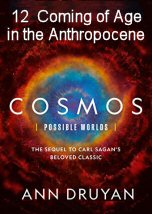









Since the first civilizations we've wondered if there's something about human nature that contains the seeds of our destruction. Syukuro Manabe was born in rural Japan and took an intense interest in Earth's average global temperature. In the 1960's, he would assemble the evidence he needed to predict the increase of Earth's temperature due to greenhouse gases until it becomes an uninhabitable and toxic environment, leading to our extinction. 'This doesn't have to be,' says Neil deGrasse Tyson, 'it's not too late. There's another hallway, another future we can still have; we'll find a way.'