

Last Watched

"Life "  Sort by

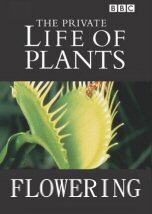
Flowering

   1995    Nature
The third episode is devoted to the ways in which plants reproduce. Pollen and a stigma are the two components needed for fertilisation. Most plants carry both these within their flowers and rely on animals to transport the pollen from one to the stigma of another. To do this, they attract their couriers with colour, scent and nectar. It isn't just birds that help pollination: some mammals and reptiles also do so. However, it is mostly insects that are recruited to carry out the task. To ensure that pollen is not wasted by being delivered to the wrong flower, some species of plant have developed exclusive relationships with their visitors, and the gentian and its attendant carpenter bees is one example. Since pollen can be expensive to produce in terms of calories, some plants, such as orchids, ration it by means of pollinia and a strategically placed landing platform. Other orchids offer no reward for pollination, but instead mislead their guests by mimicking their markings and aroma, thus enticing males to 'mate' with them (Pseudocopulation). The most extreme fertilisation method is one of imprisonment, and one plant that uses it is the dead horse arum. It is often found near gull colonies, and mimics the appearance and smell of rotting flesh. Blow-flies are attracted to it, and are forced to stay the night before being allowed to depart in the morning, laden with pollen. Finally, Attenborough introduces the world's largest inflorescence: that of the titan arum.
Series: The Private Life of Plants
Dragons of the Dry

   2008    Nature
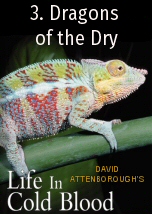
About 340 million years ago a brand new family of animals was evolving in the primeval swamps. They were to go one step further than the amphibians who had emerged onto dry and before them. For they would eventually completely cut their ties with water. They were the ancestors of todays lizards. They evolved scaly impermeable skins and moved up into the forests. They diversified into a multitude of different shapes and sizes. They developed signalling systems to communicate with one another. And they squabbled as animals do. For food they hunted insects that were already well established on the land in great numbers. And here without returning to water they produced their families. They powered their bodies not only with food but with the heat that they drew directly from the sun.
As they diversified so they spread into the harshest of the lands habitats. The baking waterless deserts which eventually they would come to dominate. Discover jacky lizards that wave, wrestling beaded lizards and the the world's smallest chameleon, which is no bigger than his thumbnail, and the biggest lizard in Australia.
Series: Life In Cold Blood

Volcano

   2007    Nature
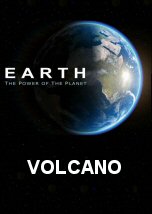
Volcanoes are one of nature’s most awesome and destructive forces, but they are also the life force and architect of our planet. They can raise up great mountains and create new land, or they can level cities and destroy entire civilizations. They provide a glimpse of the power of Earth’s internal heat source, without which it would have become a dead planet millions of years ago. In this episode, Iain takes us on a journey to some of the most dramatic places on Earth, starting in Ethiopia.
Series: Earth, The Power of the Planet

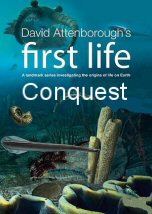
Conquest

   2010    Science
Attenborough's journey continues in Canada's Rocky Mountains, where fossils document an explosion in animal diversity never seen before or since. Travelling from there to North Africa, the rainforests of Australia and the east coast of Scotland, Attenborough discovers how animals evolved to conquer not only the oceans but also the land and air. These remote and fascinating creatures are brought to life as never before with the help of cutting-edge scientific technology and photorealistic visual effects. From the first large predators to the first legs on land, these were creatures that evolved the traits and tools that allow all animals, including ourselves, to survive to this day.
Series: First Life

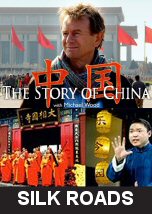
Silk Roads and China Ships

   2016    History
Michael Wood tells the tale of China's first great international age under the Tang Dynasty (618-907). From the picturesque old city of Luoyang, he travels along the Silk Road to the bazaars of central Asia and into India on the track of the Chinese monk who brought Buddhism back to China. This tale is still loved by the Chinese today and is brought to life by storytellers, films and shadow puppet plays. Then in the backstreets and markets of Xi'an, Michael meets descendants of the traders from central Asia and Persia who came into China on the Silk Road. He talks to Chinese Muslims in the Great Mosque and across town hears the amazing story of the first reception of Christianity in 635. Moving south, Michael sees the beginnings of China as an economic giant. On the Grand Canal, a lock built in 605 still handles 800 barges every day! The film tracks the rise of the silk industry and the world's favourite drink - tea. Michael looks too at the spread of Chinese script, language and culture across east Asia. 'China's influence on the East was as profound as Rome on the Latin West', he says, 'and still is today'. Finally, the film tells the intense drama of the fall of the Tang. Among the eyewitnesses were China's greatest poets. In a secondary school in a dusty village, where the Chinese Shakespeare - Du Fu - is buried in the grounds, the pupils take Michael through one famous poem about loss and longing as the dynasty falls. And in that ordinary classroom, there is a sense of the amazing drama and the deep-rooted continuities of Chinese culture.
Series: The Story of China

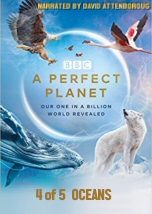
Oceans

   2021    Nature
Oceans are the largest ecosystem on earth, covering two thirds of our world’s surface and providing half the oxygen in our atmosphere. They are home to as much as 80 per cent of all life on earth, and nearly three billion people rely on them for their primary source of food.
But our planet’s oceans would be little more than stagnant wastelands, and life on planet earth would cease to exist, were it not for one simple factor: a global network of powerful ocean currents. Every drop of seawater on earth rides these currents, taking 1,000 years to complete a single circuit. Without the constant mixing of currents, tides and waves, our oceans would stop supporting life - and a healthy ocean is vital to a healthy planet.
Series: A Perfect Planet
All or Nothing: Arsenal

All or Nothing: Arsenal

2022  Culture
Untold

Untold

2021  Culture
Future of Work

Future of Work

2021  Technology
Generation Iron

Generation Iron

2018  History
Top Gear

Top Gear

2012  Technology
Leaving Neverland

Leaving Neverland

2019  Culture