


Last Watched

"Middle Age"  Sort by

Blood Of The Vikings: Invasion

   2001    History
In AD 856, a massive fleet of Viking ships appeared off the coast of East Anglia, heralding a change in Viking tactics - from raiding to invasion. Richards charts the years of attempted conquest that followed.
Series: Blood of the Vikings
Words on a Page

   2020    History
Writing itself is 5,000 years old, and for most of that time words were written by hand using a variety of tools. The Romans were able to run an empire thanks to documents written on papyrus. Scroll books could be made quite cheaply and, as a result, ancient Rome had a thriving written culture. With the fall of the Roman Empire, papyrus became more difficult to obtain. Europeans were forced to turn to a much more expensive surface on which to write: Parchment. Medieval handwritten books could cost as much as a house, they also represent a limitation on literacy and scholarship.
No such limitations were felt in China, where paper had been invented in the second century. Paper was the foundation of Chinese culture and power, and for centuries how to make it was kept secret. When the secret was out, paper mills soon sprang up across central Asia. The result was an intellectual flourishing known as the Islamic Golden Age. Muslim scholars made discoveries in biology, geology, astronomy and mathematics. By contrast, Europe was an intellectual backwater.
That changed with Gutenberg’s development of movable type printing. The letters of the Latin alphabet have very simple block-like shapes, which made it relatively simple to turn them into type pieces. When printers tried to use movable type to print Arabic texts, they found themselves hampered by the cursive nature of Arabic writing. The success of movable type printing in Europe led to a thousand-fold increase in the availability of information, which produced an explosion of ideas that led directly to the European Scientific Revolution and the Industrial Revolution that followed.
Series: The Secret History of Writing

Blood Of The Vikings: Last of the Vikings

   2001    History
In the last of the series, Julian Richards uncovers new information from the battle in 1066 between Viking warlord Harald Hardrada and King Harold of England that marked the end of the Viking age in Britain. Results from a nationwide genetic survey show where in Britain the Vikings left a measurable contribution.
Series: Blood of the Vikings
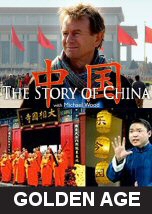
The Golden Age

   2016    History
This episode tells the tale of what's broadly considered China's most creative dynasty - the Song (960-1279). Michael Wood heads to the city of Kaifeng, the greatest city in the world before the 19th century. Here in Twin Dragon Alley, locals tell him the legend of the baby boys who became emperors.
He explores the ideas and inventions that made the Song one of greatest eras in world culture, helped by China's most famous work of art, the Kaifeng scroll, which shows the life of the city in around 1120. A chef makes Michael a recipe from a Song cookbook, while a guide to 'how to live happy, healthy lives for old people', published in 1085 and still in print, is discussed with local women doing their morning exercises. The Song was also a great era for scientific advance in China. Michael steers a huge working replica of an astronomical clock, made by China's Leonardo da Vinci.
Then at a crunch Chinese Premier League match, Michael tells us the Chinese invented football! The golden age of the northern Song ended in 1127, when invaders sacked Kaifeng, but they survived in the south. At their new capital, Hangzhou, Wood joins locals dancing by the West Lake, while in the countryside he meets Mr Xie with his records of 40 generations of ancestors. The final defeat of the Song took place in a naval battle in the estuary of the Pearl River in 1279. When all was lost, rather than surrender to the Mongols, a loyal minister jumped into the sea with the young boy emperor in his arms. 'So ended the glory of the Song', Wood concludes, 'but a new age would arise... as in China, it always has!'.
Series: The Story of China

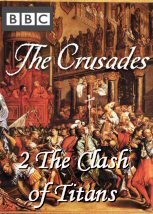
The Clash of Titans

   2012    History
The most famous – and perhaps most misunderstood – episodes in the epic history of the Holy Wars that are known to history as The Crusades – the clash between Richard the Lionheart and Saladin. In July 1192, Richard the Lionheart stood poised for a strike on Jerusalem, while Saladin – mighty sultan of Islam – readied his troops inside the city, preparing for the inevitable attack. During a year-long campaign across Palestine, these two legendary leaders had fought each other to a stand-still. Thousands had perished, appalling atrocities had been perpetrated on both sides. And now they faced each other in a battle for their sacred objective.
Series: The Crusades

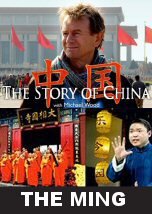
The Ming

   2016    History
The tale of one of China's most famous dynasties begins with the amazing story of Hongwu, a peasant rebel who founded one of greatest eras in Chinese history. The film takes us to his great capital Nanjing, with its 21 miles of walls, each brick stamped with the name of the village that made it. Following the trail, we go to the Bao family village and see the villagers act a Ming murder story.
Like many authoritarian states, the Ming were obsessive about architecture. We see the giant fortifications of the Great Wall, the ritual enclaves of the Forbidden City in Beijing and travel with bargeman Mr Hu down the Grand Canal, China's great artery of commerce right up to the present day. We then hear about Admiral Zheng He's voyages to Africa and the Gulf decades before Columbus, watch the construction of an ocean-going wooden boat 250ft long, and hitch a ride on a replica Ming junk in the South China Sea.
As state prosperity grew, so did a rising middle class. Wood looks at Ming culture in Suzhou, the 'Venice of China'. Staying in a merchant's house, he discovers the silk, ceramic and lacquer-making industries, and visits one of the most beautiful gardens in the city. Then on to Macao and the arrival of Jesuit missionary Matteo Ricci, who hoped to convert China to Christianity. In the cathedral in Beijing, we learn more about these fateful exchanges with the west. Finally in Shaoxing, we visit the house of the 'Ming Proust' and at grassroots the Zhao family in Fujian where the film ends in an elegiac mood with the fall of the Ming in 1644.
Series: The Story of China
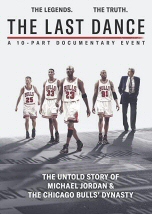
The Last Dance

The Last Dance

2020  Culture
Dangerous knowledge

Dangerous knowledge

2007  Science
Generation Iron

Generation Iron

2018  History
Ancient Greece

Ancient Greece

2013  History
Cooked

Cooked

2016  Culture
Zeitgeist

Zeitgeist

2007  Culture