This remarkable science-history series investigates the blistering pace of human endeavour in space exploration, computing, energy, resources, Earth science and our understanding of the evolution of life itself. Across the last 50 years, humans have set a blistering pace and scientific discovery. We've crossed the boundaries of our solar system, made machines that can learn harnessed the power of the sun and built life from scratch. It's a period like no other in history, where human endeavour is changing everything: this is The Great Acceleration. As we race toward the future, we must examine the journey. In the first episode, Dr Shalin Naik explores the ambitious space shuttle mission that began in the '70s plus the future colonization of Mars. Over the past 50 years, space has become central to everything, from communications to entertainment to climate modelling. And as private enterprise enters space exploration, our understanding of the universe will only continue to expand. We will know if we can survive on other objects - the moon, maybe Mars, maybe even some of the moons of Jupiter and Saturn. Deep space is the last and infinite frontier. That's what we do as human beings. We explore, we learn, we make discoveries, from the moment we're born to the moment we die.
This featured series is a gripping examination of the unsolved crimes of the Golden State Killer who terrorized California in the 1970's and 1980's. Sensitively handled at all turns, I’ll Be Gone in the Dark is different from your standard true crime series. Highly emotional in both a restorative cathartic, but also a genuinely upsetting way. In the first episode, the writer Michelle McNamara finds a new obsession in the 'East Area Rapist', who terrorized California in the 1970s and '80s, responsible for 50 home-invasion rapes and 12 murders.
Explore the latest science behind the headlines and the coolest scientific developments that impact our lives. Technology catapults to new heights in 2015, going faster and further than ever before. We have canvassed the world in search of the best and most fascinating science and tech stories of the year for 2015 YEAR IN SCI-TECH". This action-packed hour of fun and intrigue revisits the world’s first glimpse of Pluto and images of water on Mars while exploring what this all could mean for intelligent life in the universe – all while earthling’s inch closer to becoming actual space tourists. Throughout the hour, we revisit the year’s most amazing techological feats and scientific discoveries, including new and elusive animal species discovered deep under the ocean, as well as the hottest tech trends – from hover boards to driverless cars and trucks, and the newest advances in mind-blowing virtual reality.
Dr Hannah Fry travels down the fastest zip wire in the world to learn more about Newton's ideas on gravity. His discoveries revealed the movement of the planets was regular and predictable. James Clerk Maxwell unified the ideas of electricity and magnetism, and explained what light was. As if that wasn't enough, he also predicted the existence of radio waves. His tools of the trade were nothing more than pure mathematics. All strong evidence for maths being discovered. But in the 19th century, maths is turned on its head when new types of geometry are invented. No longer is the kind of geometry we learned in school the final say on the subject. If maths is more like a game, albeit a complicated one, where we can change the rules, surely this points to maths being something we invent - a product of the human mind. To try and answer this question, Hannah travels to Halle in Germany on the trail of perhaps one of the greatest mathematicians of the 20th century, Georg Cantor. He showed that infinity, far from being infinitely big, actually comes in different sizes, some bigger than others. This increasingly weird world is feeling more and more like something we've invented. But if that's the case, why is maths so uncannily good at predicting the world around us? Invented or discovered, this question just got a lot harder to answer.
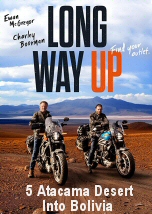
As the journey continues, there's beauty and danger in equal measure for Charley Boorman and Ewan McGrego. The duo ride their electric Harleys through the exotic and breathtaking Bolivian countryside in a tough ascent. The sixth episode showcases some of the challenges the hosts and the crew face when they scale the terrain. One of the Rivians runs into trouble while sandy roads and a heavy breeze sees Boorman take a tumble. Apart from all the accidents, the chapter also shows some quality work done by UNICEF when it comes to educating and working with the children in Bolivia. The altitude sickness hits Taylor, their logistics man real bad and McGregor starts feeling it as well. The episode ends with a doctor heading to his hotel room to check up on him.
After becoming the most powerful mob boss in the country, Al Capone now finds himself locked up in America's newest and harshest maximum security prison: Alcatraz. Prohibition has recently been repealed and one of the Outfit's most important sources of income dries up. With Capone cut off from all communication, his most trusted men, Frank Nitti, Tony Accardo and Paul Ricca, must keep his organization from collapsing. With Americans flocking to theaters by the thousands, the movie business is raking in millions of dollars a month. To take advantage of Hollywood, Nitti recruits Willy Bioff. Acardo breaks into a new racket in Chicago: slot machines. With help from Ricca, Accardo builds a network of slots in Chicago bars, earning up to $20,000 a year. By the end of 1939, the Outfit is bringing in more money than ever before... But new problems start to appear.








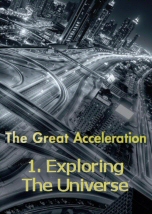







In the first episode, Dr Shalin Naik explores the ambitious space shuttle mission that began in the '70s plus the future colonization of Mars. Over the past 50 years, space has become central to everything, from communications to entertainment to climate modelling. And as private enterprise enters space exploration, our understanding of the universe will only continue to expand. We will know if we can survive on other objects - the moon, maybe Mars, maybe even some of the moons of Jupiter and Saturn. Deep space is the last and infinite frontier. That's what we do as human beings. We explore, we learn, we make discoveries, from the moment we're born to the moment we die.