








Last Watched

"cat"  Sort by

Are We Alone

   2011    Science
Aliens almost certainly do exist. So why haven't we yet met E.T.? It turns out we're only just developing instruments powerful enough to scan for them, and science sophisticated enough to know where to look. As a result, race is on to find the first intelligent aliens. But what would they look like, and how would they interact with us if we met? The answers may come to us sooner than we imagine, for one leading astronomer believes she may already have heard a hint of their first efforts to communicate
Series: Through the Wormhole
How Small is the Universe

   2012    Science
The biggest rabbit-hole in history: the search of the smallest thing in the Universe. It is a journey where things don't just become smaller but also a whole lot weirder. Scientists hope to catch a glimpse of miniature black holes, multiple dimensions and even parallel Universes. As they start to explore this wonderland, where nothing is quite what it seems, they may have to rewrite the fundamental laws of time and space.

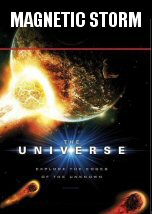
Magnetic Storm

   2010    Science
It bursts from the Sun with the power of ten thousand nuclear weapons... and when it hits our planet, it could create the largest disaster in recorded history. A magnetic storm from the Sun could wipe out electrical power, television, radio, military communication, and nearly every piece of electronics in the Northern Hemisphere. It's a "Solar Katrina" -- a planet-wide "hurricane" of magnetic forces that scramble all 21st Century technology, possibly for good. What causes this magnetic superstorm? Why is magnetism so powerful -- and yet so poorly understood? And is there anything we can do to prevent the Magnetic Storm?
Series: The Universe

Off the Scale

   2012    Science
The human eye can see extraordinary detail, but the eye of a needle held at arm's length is pretty much at the limit of our vision. Anything smaller is simply invisible, at least to the naked eye. But what if we could see this hidden world all around us in greater detail and magnification than ever before? How different would our familiar surroundings then seem? Richard Hammond explores the astonishing miniature universe all around us, revealing that small is not only beautiful, it can also be very, very powerful. From seeing the microscopic changes to ice crystals that can trigger an avalanche to watching in horror the invisible aftermath of a sneeze on a commuter train and learning how the surface of an ordinary-looking plant hides an astounding secret that will make walking on the moon safer, Richard harnesses cutting-edge technologies to transport the viewer into a spectacular micro realm.
Series: Invisible Worlds

Nebulas

   2008    Science
Take a tour through the Art Gallery of the Galaxy and view what are considered the "crown jewels" of the heavens. Nebulas are mysterious clouds of gas that aren't classified as stars, planets, moons or asteroids. Astronomers use the most sophisticated techniques to view them since they are practically invisible to the naked eye. Nothing less than stunning, nebulas glow, reflect or obscure the galaxy's light with amazing swirls of color. Nebulas mark the regions where the nothingness of space first coalesces, where stars are born and where stars die. Cutting-edge computer graphics are used to bring the universe down to earth.
Series: The Universe

The Red Sea

   2009    Nature
The Red Sea is one of the youngest oceans in the world and one of the warmest. The northern region, with its diverse array of marine life, is one of the most visited dive locations on earth while the southern end remains virtually unexplored. It's a global hotspot for marine biology and an important trade route throughout human history, linking the trade goods of India and the Far East with the markets of Egypt and Europe.
Series: Oceans