The series Warrior Graveyard uncovers some extraordinary warrior skeletons from history. Archaeologists and forensic scientists use remains to tell the story of famous warriors of the past and unleash the full force of modern forensics upon them: battle scars, bone deformations and recoverable scraps of DNA will all be tested and explored. CGI and drama will then bring them dramatically to life, revealing a revolutionary new picture of how these warriors lived - and died. An archaeological and forensic examination of six crusaders' bones brings to life the 1179 Battle of Jacob's Ford, revealing the wounds that killed the warriors in the Holy Land. With every sword slash comes an insight into an historic day. Excavations along the Israel/ Jordan border are unearthing skeletons and rewriting the history of the First Crusade. The site at Jacob's Ford is the only known Crusader battle site with complete skeletons. To secure the road between Akkon and Damascus, King Baldwin IV of Jerusalem had a mighty castle built at the Jacob's Ford of the Jordan River in October 1178. The fortress was a thorn in the side of Sultan Saladin, so he had it stormed a year later, before it was completed. Excavations have been taking place on the site of the legendary crusader castle since the early 1990s. Archaeologists and forensic experts have examined the remains of six fallen crusaders and uncovered fascinating details about the Battle of Chastellet. The programme has secured access to the excavation and remains of some of the 80 Crusader Knights and 750 foot soldiers stationed at the fort when it was attacked and its Crusaders massacred by Saladin's army in 1179, in the battle that changed the course of history in the Middle East.
Michael Wood charts the coming of Islam to the subcontinent and one of the greatest ages of world civilisation: the Mughals. He visits Sufi shrines in Old Delhi, desert fortresses in Rajasthan and the cities of Lahore and Agra, where he offers a new theory on the design of the Taj Mahal. He also looks at the life of Akbar, a Muslim emperor who decreed that no one religion could hold the ultimate truth, but whose dream of unity ended in civil war.
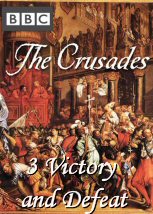
Dr. Thomas Asbridge explains how in the thirteenth century, after almost two hundred years of Holy Wars, the titanic conflict between Christianity and Islam, known to history as The Crusades, reached a decisive and shocking conclusion – a chapter that despite its drama has been virtually forgotten. He explains how, in the end, the fate of the Holy Land was decided not on the hallowed ground of Jerusalem, but in Egypt; and how the ultimate outcome of the Crusades was dictated not by Christians, but by the Mongol successors to Genghis Khan, and by a Muslim slave – a fearsome warrior whose story is now all but lost to western history.
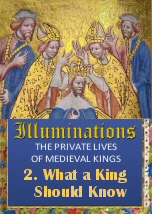
Dr Janina Ramirez shows how medieval manuscripts gave power to the king and united the kingdom in an age of plague, warfare and rebellion, discovers that Edward III used the manuscripts he read as a boy to prepare him for his great victory at the battle of Crecy and reveals how a vigorous new national identity bloomed during the 100 Years War with France. In the British Library's Royal Manuscripts collection Dr Ramirez finds out that magnificent manuscripts like the Bedford Hours, taken as war booty from the French royal family, were adapted for the education of English princes. She also explores how knowledge spread through a new form of book - the encyclopaedia.
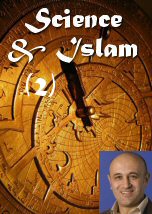
Al-Khalili travels to northern Syria to discover how, a thousand years ago, the great astronomer and mathematician Al-Biruni estimated the size of the earth to within a few hundred miles of the correct figure. He discovers how medieval Islamic scholars helped turn the magical and occult practice of alchemy into modern chemistry. In Cairo, he tells the story of the extraordinary physicist Ibn al-Haytham, who helped establish the modern science of optics and proved one of the most fundamental principles in physics - that light travels in straight lines. Prof Al-Khalili argues that these scholars are among the first people to insist that all scientific theories are backed up by careful experimental observation, bringing a rigour to science that didn't really exist before.
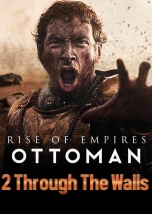
April 1453. Sultan Mehmed II unleashes an artillery attack on Constantinople unlike any the world has ever known. It's the largest concentration of cannons that the world had seen in one place. The monumental task of keeping the Ottomans out of Constantinople falls on the shoulders of Genoese soldier of fortune Giovanni Giustiniani. He and his men must defend 14 miles of city walls. Mehmed launches his ambitious plans to break through the walls of Constantinople, but Giustiniani's mercenaries manage to forestall the attacks.









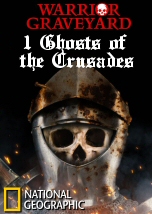






An archaeological and forensic examination of six crusaders' bones brings to life the 1179 Battle of Jacob's Ford, revealing the wounds that killed the warriors in the Holy Land. With every sword slash comes an insight into an historic day. Excavations along the Israel/ Jordan border are unearthing skeletons and rewriting the history of the First Crusade. The site at Jacob's Ford is the only known Crusader battle site with complete skeletons. To secure the road between Akkon and Damascus, King Baldwin IV of Jerusalem had a mighty castle built at the Jacob's Ford of the Jordan River in October 1178. The fortress was a thorn in the side of Sultan Saladin, so he had it stormed a year later, before it was completed.
Excavations have been taking place on the site of the legendary crusader castle since the early 1990s. Archaeologists and forensic experts have examined the remains of six fallen crusaders and uncovered fascinating details about the Battle of Chastellet. The programme has secured access to the excavation and remains of some of the 80 Crusader Knights and 750 foot soldiers stationed at the fort when it was attacked and its Crusaders massacred by Saladin's army in 1179, in the battle that changed the course of history in the Middle East.