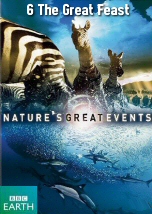
Every summer in the seas off Alaska humpback whales, sea lions and killer whales depend on an explosion of plant life, the plankton bloom. It transforms these seas into the richest on Earth. But will these animals survive to enjoy the great feast? The summer sun sparks the growth of phytoplankton, microscopic floating plants which can bloom in such vast numbers that they eclipse even the Amazon rainforest in sheer abundance of plant life. Remarkably, it is these minute plants that are the basis of all life here. But both whales and sea lions have obstacles to overcome before they can enjoy the feast. Humpback whales migrate 3,000 miles from Hawaii, and during their 3 month voyage lose a third of their body weight. In a heart-rending scene a mother sea lion loses her pup in a violent summer storm, while another dramatic sequence shows a group of killer whales working together to kill a huge male sea lion. In late summer the plankton bloom is at its height. Vast shoals of herring gather to feed on it, diving birds round the fish up into a bait ball and then a humpback whale roars in to scoop up the entire ball of herring in one huge mouthful. When a dozen whales work together they employ the ultimate method of co-operative fishing - bubble net feeding. One whale blows a ring of bubbles to engulf the fish and then they charge in as one. Filmed from the surface, underwater and, for the first time, from the air, we reveal how these giant hunters can catch a tonne of fish every day.
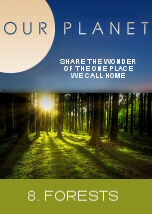
The last episode examines the fragile interdependence that exists between forests' wide variety of residents, including bald eagles, hunting dogs and Siberian tigers. Over half of all the world's trees, evergreen and deciduous, stand in great assemblies. For many of us, they are places of mystery and darkness. They are key to our climate, and home to countless unique species. The boreal forest contains 750 billion trees, and it stores over 40 percent of the world's carbon, making it a vital element in the fight against climate change. In the past, we have destroyed them without hesitation. Yet, forests do have an astonishing ability to recover. If we choose to give forests time and space, they could reclothe the earth with much of the rich and varied communities of animals and plants of which we have, so recently, robbed it. A future with more forests is key to the resilience of our planet.
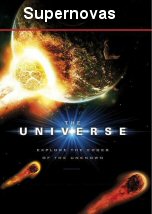
A stellar explosion, the supernova is the sensational death of a star. It can shine as bright as 100 billion Suns and radiate as much energy as the Sun would emit over 10 billion years. Jets of high-energy light and matter are propelled into space and can cause massive Gamma Ray Bursts and emit intense X-ray radiation for thousands of years. Astronomers believe that this process creates the very building blocks of planets, people and plants. Meet the world's leading Supernova hunters, and take a look at recorded supernovas throughout history.
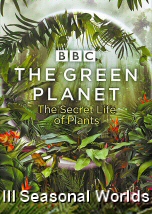
Will explore the strategy, deception and feats of engineering plants use to thrive in the changing weather of different seasons. In the face of conditions ranging from ice and snow to raging fires, survival is often a question of perfect timing - particularly when contending with intense competition and surprising predators. In this episode, David Attenborough travels to Finland to show one of the most extreme examples of seasonal plant life in the Arctic Circle. He also travels to California to see how climate change is affecting giant sequoias. These ancient trees like all other seasonal plants depend on the predictability of the seasons and our current changing climate threatens their survival.
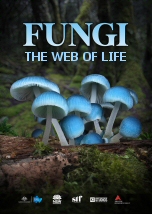
Acclaimed biologist Dr. Merlin Sheldrake seeks a rare blue mushroom in Tasmania's ancient Tarkine rainforest, revealing fungi's extraordinary abilities. Fungi may provide solutions to humanity's problems, with millions more species yet to be discovered. All life on Earth is connected by a great mystery we are only just beginning to unravel. Hidden between the world of plants and animals, another world exists… Fungi’s web of life. We’ll begin in the mysterious world of the forest floor, where fungi are the central players in nature’s story of birth, death, and rebirth to discover that life as we know it simply would not exist without them. Dr. Sheldrake will show us some the grandest and strangest organisms ever discovered, showcased through jaw-dropping time-lapse cinematography, in a landscape largely unchanged from the time of the dinosaurs. Fungi have important lessons to teach humanity about survival through cooperation. Indeed, these incredible lifeforms may hold the key to solving some of humanity’s most urgent problems. With millions more species to discover, our journey into the secret world of fungi has only just begun.
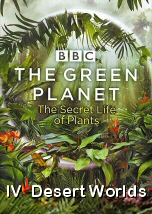
Plants that have developed to thrive in the desert, including cacti that grow in the shade of other trees and collect water in pleated trunks that expand and contract - but can also find themselves a host to other plants, like desert mistletoe. This programme also reveals how tobacco plants being eaten by caterpillars are able to summon the creatures' natural predators, and how tumbleweeds roll across the landscape, only unfurling and growing when they encounter rain.






















In late summer the plankton bloom is at its height. Vast shoals of herring gather to feed on it, diving birds round the fish up into a bait ball and then a humpback whale roars in to scoop up the entire ball of herring in one huge mouthful. When a dozen whales work together they employ the ultimate method of co-operative fishing - bubble net feeding. One whale blows a ring of bubbles to engulf the fish and then they charge in as one. Filmed from the surface, underwater and, for the first time, from the air, we reveal how these giant hunters can catch a tonne of fish every day.