Perhaps the most mysterious structure on Earth, Stonehenge has stood on a plain in Southern England for 5000 years. Its foundations predate the Great Pyramids. It is one of mankind's most ancient mysteries. Why is it here? Is it a temple? A burial ground? A place for sacrifice? Or could the mystery of Stonehenge be revealed in its builders' desire to explore the unknown heavens and touch the universe? Using the cutting-edge computer-generated imagery that takes us into deep space, we'll also go inside a virtual Stonehenge to see what the ancients saw and push this prehistoric marvel to give up its age-old secrets. In this episode we explore the possibility that this was a prehistoric astronomical observatory. Here ancient astronomer priests may have divined the complex movements of the Sun and Moon, recognizing patterns that would not be discovered elsewhere for thousands of years. The primitive Shamans may have also been the first astronomers to predict eclipses.
Once they were dreaded and thought to be dragons eating the sun--but modern science has dispelled mythology and we now look forward to total Solar Eclipses as one of the most spectacular phenomena in the heavens. Explore the complex movements of Earth, Moon and Sun that produce these unusual events and hear details why we may be the only intelligent beings in the known Universe to witness eclipses like we see on Earth. Man-made eclipses also figure into the science in the form of instruments called "coronagraphs." They blot out the sun and reveal its corona, uncovering secrets which, while enlightening, also warn of a disaster that could make our advanced technology crash and burn. Finally, travel into deep space, where the tiny eclipses caused by planets circling distant stars is now beginning to reveal hundreds more stars where "exoplanets" exist... perhaps even those in habitable zones like the Earth.
Over the last years, the world has experienced an energy revolution, driven by an urgent need to green the grid and save life on Earth as we know it. 50 years ago, a devastating oil crisis kicked off an energy revolution. The world set course to cut the costly habit of burning fossil fuels. With the urgent new threat of a changing climate, the drive to unleash the power of the sun, earth and wind has accelerated into a race for humanity's survival. Change is taken place but, is it happening fast enough to secure our future? Technologies are right here, right now, and they will enable the transition to 100% renewables, because winning the energy race means a win for the entire world.
The theory of Némesis, a star that orbits the Sun and causes catastrophic events is explored. Nemesis is a hypothetical red dwarf or brown dwarf, originally postulated in 1984 to be orbiting the Sun at a distance of about 95,000 AU (1.5 light-years) somewhat beyond the Oort cloud, to explain a perceived cycle of mass extinctions in the geological record, which seem to occur more often at intervals of 26 million years.
Recently, the Event Horizon Telescope project captured the first image ever of a black hole. Now, new discoveries might finally reveal how supermassive black holes are made, and using the latest technology, experts are on the verge of understanding how these monsters grow and how they affect life on our planet. Supermassive black holes: Gargantuan monsters that lurk at the center of galaxies. Right now you are travelling at half a million miles an hour around a giant black hole four million times the mass of the sun. But there's a mystery about these colossal beasts. We have no idea where they came from. How did they get so big so quickly?
As the drought drags on with the sun continuing to blaze down from a cloudless sky and harvest time gets closer, Jeremy Clarkson and his motley crew have a fearsome list of jobs to complete.















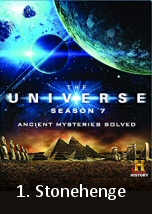








In this episode we explore the possibility that this was a prehistoric astronomical observatory. Here ancient astronomer priests may have divined the complex movements of the Sun and Moon, recognizing patterns that would not be discovered elsewhere for thousands of years. The primitive Shamans may have also been the first astronomers to predict eclipses.