




Last Watched

"Nature"  Sort by

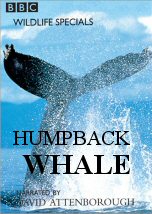
Humpback Whale

   2006    Nature
Few sounds are more beautiful or moving than the underwater songs of the humpback whale. Male whales compete with their songs, which often last for 10 minutes at a time, and can be repeated for hours on end. Whales separated by thousands of miles of sea will sing almost identical songs. Researchers have found that the songs change throughout the breeding months, following a mysterious pattern repeated across the waves. Whales also use sound to hunt. To catch herring, humpback whales release a stream of bubbles to form a shimmering, circular fishing net. Emitting a repetitive loud scream, they scare the fish into a tight ball, then lunge out of the water to swallow the shoal whole. Now it seems that the long-held image of the gentle giant must change to one of a ferocious and opportunistic hunter.
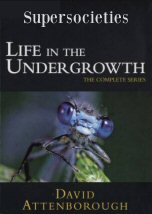
Supersocieties

   2005    Nature
Invertebrates don't always operate alone. True society was the last feature to evolve in invertebrates, as recently as the time of Tyrannosaurus. In the last programme see the tensions below the surface in some of the great social structures built by insects, and witness the carnage when an ant colony and a termite colony wage war.
Series: Life in the Undergrowth

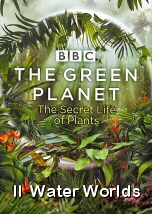
Water Worlds

   2022    Nature
Water plants create some of the most beautiful, bizarre and important habitats on earth. To hold on in torrents, plants use a kind of superglue. Some are armed with vicious weapons to fight titanic battles for space. Others form perfect spheres and escape from animal enemies by rolling. Where nutrients are washed away, plants turn into hunters of animals, laying traps and even counting to ensure their success.
In this episode we explore those watery worlds with David Attenborough, from Croatia to Brazil, from Colombia to Thailand, the brilliantly coloured flowers smother lakes, and in one magical river in Brazil, the water bubbles like champagne as plants create the atmosphere itself.
Series: The Green Planet

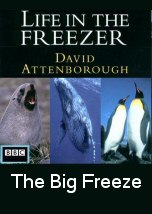
The Big Freeze

   1993    Nature
As almost all animal inhabitants of Antarctica are forced to migrate north, the sea underneath the frozen ice still provides a home to many specially adapted fish whose cells are protected from freezing through an 'antifreeze' liquid. Many of them feed on the faeces of other animals. The most notable larger animal that does not migrate north is perhaps the Weddell Seal, which can be found as close as 1300 kilometres to the pole. Groups of seals tear holes into the ice to dive for food and come up to breathe. The females come back to the ice to give birth. This episode also describes primitive plant life such as lichen, which can still be found on the continent in winter, even in the extremely dry and permanently frozen valleys conditions under which dead animals can lie frozen for many centuries without decomposing. It details the life of the Emperor Penguin, 'the only birds to lay their eggs directly on ice'. While other animals retreat, Emperors migrate not just to the ice, but into the Antarctic continent. The females lay eggs which are incubated by the males under the harshest conditions on Earth (huddling closely together for warmth), while the females return to the sea.
Series: Life in the Freezer

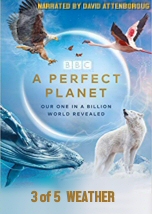
Weather

   2021    Nature
Weather controls the distribution of freshwater on Earth. David Attenborough narrates how this uneven distribution has given rise to an incredible diversity of species and habits, from the driest desert to the lushest tropical rainforest. Featuring a colony of ants banding together into a raft every time its home in the Amazon floods, a rain frog that manages to eke out an existence in one of the world's driest habitats on Earth, and the last wild camels that survive the Gobi Desert's bitter winters by eating snow that blows in from Siberia.
Series: A Perfect Planet

Food Water Waste

   2020    Nature
Across the world, rising demands for food, water and materials have pushed resources to the limit. Many parts of the world have major challenges over fresh water. A lot of soils have a lot of residual pesticides and herbicides. At the same time waste is piling higher. All this demands a new wave of innovation. The challenge is to make more of the things we need without the environmental cost.
Series: The Great Acceleration
Bible's Buried Secrets

Bible's Buried Secrets

2011  Culture
Wonders Of The Universe

Wonders Of The Universe

2011  Science
The Hunt

The Hunt

2015  Nature
Modern Masters

Modern Masters

2024  Art
Beckham

Beckham

2023  History
Ice Age Giants

Ice Age Giants

2013  Science