The incredible story of how Pluto has been propelled from an unremarkable ball of ice on the edge of the solar system to a world of unimaginable complexity - where some form of alien life might exist. New discoveries from the edge of the solar system are transforming what is known about Pluto, thanks to the New Horizons space probe that took the first-ever close up images of the planet. Pluto was once thought to be geologically dead, but the pictures revealed it to be an active world of stunning complexity, with mountains carved from ice, a nitrogen glacier that appeared to be moving and a recently active volcano, with data sent back lead some scientists to speculate that there may even be life on Pluto today.
Commander Stephen Hawking pilots his space ship the SS Hawking on the journey of a lifetime, zooming from black holes to the Big Bang, Saturn to Santa Barbara. After all, why should astronauts have all the fun?
Learn about what the moon is made and its formation; how it played a role in the evolution of life on Earth; and the future plans of NASA to establish a permanent base on the surface. Know more about moons on other planets.
New planets are now being discovered outside our solar system on a regular basis, and these strange new worlds are forcing scientists to rewrite the history of our own solar system. Far from a simple story of stable orbits, the creation of our solar system is a tale of hellfire, chaos and planetary pinball. It's a miracle our Earth is here at all.
The magnificent ringed planet Saturn, along with its more than 80 moons, forms the most dynamic planetary system in our neighborhood. With underground oceans and protective magnetic fields, experts are exploring how this collective of satellites has the potential to rewrite the rules of the Solar System. The closer that we look, the more we see these extraordinary moons like worlds of their own -- so dynamic, so Earth-like. Almost a billion miles from the Sun, these icy worlds could be home for Life 2.0. The moons of Saturn offer possibly the best chance of finding extraterrestrial life in our solar system. With each new mission, we get closer to unraveling the mysteries of Saturn's moons.
Tyson describes the discovery of cosmic rays by Victor Hess through high-altitude balloon trips. Swiss Astronomer Fritz Zwicky, in studying supernovae, postulated that these cosmic rays originated from these events instead of electromagnetic radiation. Also tells how Vera Rubin observed that the rotation of stars at the edges of observable galaxies did not follow expected rotational behavior leading to consider the existence of dark matter. This further led to the discovery of dark energy to account for the increasing rate of expansion of the universe. Tyson then describes the interstellar travel of the two Voyager probes. Tyson tells the Carl Sagan's role in the Voyager program, including creating the Voyager Golden Record to encapsulate humanity and Earth's position in the universe. Tyson concludes the series by emphasizing Sagan's message on the human condition in the vastness of the cosmos, and to encourage viewers to continue to explore and discover what else the universe has to offer.

















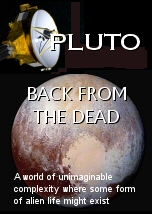



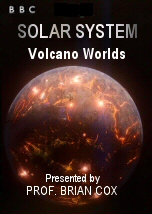


New discoveries from the edge of the solar system are transforming what is known about Pluto, thanks to the New Horizons space probe that took the first-ever close up images of the planet. Pluto was once thought to be geologically dead, but the pictures revealed it to be an active world of stunning complexity, with mountains carved from ice, a nitrogen glacier that appeared to be moving and a recently active volcano, with data sent back lead some scientists to speculate that there may even be life on Pluto today.