



Last Watched

"Extrem"  Sort by

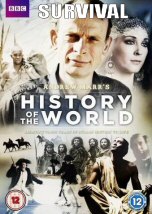
History of the World: Survival

   2012    History
Andrew Marr sets off on an epic journey through 70,000 years of human history. Using dramatic reconstructions, documentary filming around the world and cutting-edge computer graphics, he reveals the decisive moments that shaped the world we live in today, telling stories we thought we knew and others we were never told." Starting with our earliest beginnings in Africa, Marr traces the story of our nomadic ancestors as they spread out around the world and settled down to become the first farmers and townspeople. He uncovers extraordinary hand-prints left in European caves nearly 30,000 years ago and shows how human ingenuity led to inventions which are still with us today. He also discovers how the first civilisations were driven to extremes to try to overcome the forces of nature, adapting and surviving against the odds, and reveals how everyday life in ancient Egypt had more in common with today's soap operas than might be imagined.
Series: History of the World
Oklahoma City Bombing: American Terror

   2025    History
A haunting exploration of the deadliest act of domestic terrorism in American history, this gripping documentary unravels the chilling events behind the 1995 federal building bombing in Oklahoma City. Through rare footage, survivor testimonies, and never-before-heard accounts, it delves deep into the motives, execution, and aftermath of an attack that stunned the nation. More than just a recounting, it exposes the undercurrents of extremism and the scars left behind. Once you start watching, it’s impossible to look away.

Growing

   1994    Nature
The second episode is about how plants gain their sustenance. Sunlight is one of the essential requirements if a seed is to germinate, and Attenborough highlights the cheese plant as an example whose young shoots head for the nearest tree trunk and then climb to the top of the forest canopy, developing its leaves en route. Using sunshine, air, water and a few minerals, the leaves are, in effect, the "factories" that produce food. However, some, such as the begonia, can thrive without much light. To gain moisture, plants typically use their roots to probe underground. Trees pump water up pipes that run inside their trunks, and Attenborough observes that a sycamore can do this at the rate of 450 litres an hour — in total silence. Too much rainfall can clog up a leaf's pores, and many have specially designed 'gutters' to cope with it. However, their biggest threat is from animals, and some require extreme methods of defence, such as spines, camouflage, or poison. Some can move quickly to deter predators: the mimosa can fold its leaves instantly when touched, and the Venus flytrap eats insects by closing its leaves around its prey when triggered. Another carnivorous plant is the trumpet pitcher that snares insects when they fall into its tubular leaves. Attenborough visits Borneo to see the largest pitcher of them all, Nepenthes rajah, whose traps contain up to two litres of water and have been known to kill small rodents.
Series: The Private Life of Plants

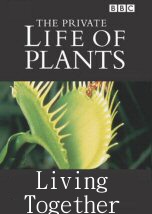
The Private Life of Plants Living Together

   1995    Nature
The fifth programme explores the alliances formed between the animal and plant worlds. Attenborough dives into Australia's Great Barrier Reef and contrasts the nocturnal feeding of coral, on microscopic creatures, with its daytime diet of algae. Some acacias are protected by ants, which will defend their refuge from any predator. Besides accommodation, the guards are rewarded with nectar and, from certain species, protein for their larvae as well. Fungi feed on plants but can also provide essential nutriment to saplings (Mycorrhiza). The connection is never broken throughout a tree's life and a quarter of the sugars and starches produced in its leaves is channelled back to its fungal partners. Meanwhile, fungi that feed on dead wood leave a hollow trunk, which also benefits the tree. Orchids enjoy a similar affiliation. Lichens are the product of a relationship between fungi and a photosynthetic associate, usually algae. They are extremely slow-growing, and a graveyard is the perfect location to discover their exact longevity. Mistletoe is a hemiparasite that obtains its moisture from a host tree, while using own leaves to manufacture food. Its seeds are deposited on another by the mistletoe tyrannulet, following digestion of the fruit. The dodder (Cuscuta) is also parasitic, generally favouring nettles, and siphons its nourishment through periodic 'plugs' along its stem. The rafflesia has no stem or leaves and only emerges from its host in order to bloom — and it produces the largest single flower: one metre across.
Series: The Private Life of Plants

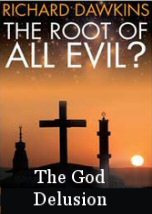
The God Delusion

   2006    Culture
Atheist and scientist Richard Dawkins visits England, America and Israel interveiwing prominant people of faith; Islamic, Hasidic Jews, and the new Christian sects popping up throughout the world, and expressing his view of the extent to which this fanaticism has degraded our civilisation, and will continue to degrade it. "The God Delusion" explores the unproven beliefs that are treated as factual by many religions and the extremes to which some followers have taken them. Dawkins opens the programme by describing the "would-be murderers ... who want to kill you and me, and themselves, because they're motivated by what they think is the highest ideal." Dawkins argues that "the process of non-thinking called faith" is not a way of understanding the world, but instead stands in fundamental opposition to modern science and the scientific method, and is divisive and dangerous.
Series: The Root of All Evil

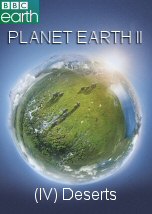
Planet Earth II Deserts

   2016    Nature    HD
The world's deserts are lands of extremes that force animals to come up with ingenious ways of coping with hostile conditions, giving rise to the most incredible survival stories on earth. A pride of desert lions are so hungry they risk hunting a giraffe several times their size, while male sandgrouse fly 120 miles each day to the nearest waterhole and dice with death to collect water for their chicks. Filmed for the first time, a tiny bat does battle with one of the world's deadliest scorpions, and in Madagascar, a locust swarm of biblical proportions is seen as never before.
Series: Planet Earth II
Formula 1 Season four

Formula 1 Season four

2022  Culture
Absolute Zero

Absolute Zero

2007  Technology
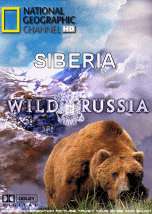
Wild Russia

Wild Russia

2009  Nature
Prehistoric Planet

Prehistoric Planet

2022  Science
Planet Earth

Planet Earth

2007  Nature
Life In Cold Blood

Life In Cold Blood

2008  Nature
Arnold

Arnold

2023  History