Step into the future with a groundbreaking documentary that unveils humanity's most critical turning point. This compelling film transports viewers to a world reshaped by technological revolutions, environmental struggles, and the relentless quest for survival. Combining stunning visuals with profound expert analysis, "2073" challenges us to reflect on the choices we make today and their lasting impact on the world of tomorrow. From the rise of AI-dominated cities to the battle for Earth's final resources, "2073" is an unmissable journey that will leave you questioning our future—and your role in it. A must-watch for anyone seeking to understand the challenges shaping the next chapter of human history.
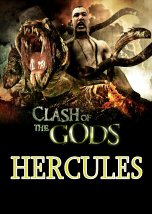
The tale of the strongest superhero in Greek mythology and his quest for redemption. To atone for committing a heinous crime, Hercules embarks on a series of impossible challenges known as the 12 Labors. Hercules endures as one of history's most influential demi-Gods, but recent archaeological discoveries suggest that mythology's strongest man may have been inspired by a real person.
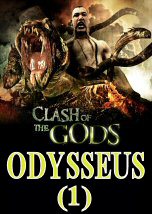
Homer's The Odyssey ranks amongst the most famous epics ever written. Follow its archetypal hero, Odysseus, as he sets sail on a twenty-year journey to return home from battle to reclaim his wife and kingdom. It's a timeless tale of adventure, filled with mythological beasts, vengeful gods, and enchanting seductresses. But could it have actually happened? Underwater divers have uncovered remains that date back thousands of years and may be a direct link to the story of Odysseus.
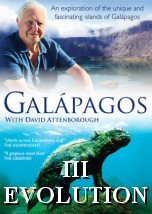
No two islands in the Galapagos are the same. The imperceptible drift of a continental plate keeps each island biologically isolated. David Attenborough explores this evolutionary crucible, encountering tortoises that weigh up to half a tonne, finches that use tools and lizards that communicate using press-ups; for Darwin, this was all evidence for his theory of evolution. We see the final footage of the world famous tortoise fondly known as Lonesome George, the last survivor of his species. David Attenborough was the last person to have ever filmed with him. Darwin’s famous visit had a downside – the arrival of man. David investigates the impact we’ve had in these islands, as our influence is a double-edged sword. We’ve disrupted the natural balance but he also believes Darwin would be thrilled with the advances we have made in science. We’re also now uncovering evidence that evolution is more rapid than Darwin could ever have imagined. Whatever wonders the Galapagos Islands hold today, they are only a hint of what awaits them in the future.
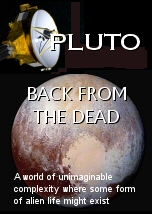
The incredible story of how Pluto has been propelled from an unremarkable ball of ice on the edge of the solar system to a world of unimaginable complexity - where some form of alien life might exist. New discoveries from the edge of the solar system are transforming what is known about Pluto, thanks to the New Horizons space probe that took the first-ever close up images of the planet. Pluto was once thought to be geologically dead, but the pictures revealed it to be an active world of stunning complexity, with mountains carved from ice, a nitrogen glacier that appeared to be moving and a recently active volcano, with data sent back lead some scientists to speculate that there may even be life on Pluto today.
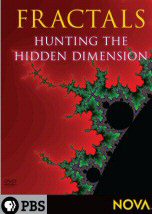
The ultimate adventure in scientific inquiry, this fascinating program follows the exploits of a small group of pioneering mathematicians who discovered a whole area of study that is revolutionizing all branches of understanding in the world: fractal geometry. Fractals are most recognized as a series of circular shapes with a border surrounded by jagged "tail-like" objects. The program, aimed at the average viewer does a fine job of explaining the background of fractals, first by beginning with the story of Pixar co-founder, Loren Carpenter's work at Boeing, developing 3D terrain from scratch using fractals. From there the program starts at the beginning with an introduction to Benoit Mandelbrot and his revolutionary work. The explanations are full of solid factual information but never talk above the level of a viewer who has some understanding of basic mathematical principles. Once the concept is presented the program spends the rest of the time showing how prevalent the fractal is in life. For a program about a mathematical concept, "Fractals" is very engaging, showing how the process was applied to special effects as far back as the Genesis planet from "Star Trek II" all the way to the spectacular finale on Mustafar in "Star Wars: Episode III." I found myself astonished at how fractals were the source of the lava in constant motion and action during the Obi-Wan/Anakin fight. What is more amazing is when the program delves into practical applications such as cell phone antennas, and eventually the human body. For the average person who enjoys watching science related programs, even on a sporadic basis, "Fractals" will prove to be a very worthwhile experience. The program is well produced, integrating talking head interviews (including some with Mandelbrot himself) with standard "in the field" footage. The structure of the program is very logical and never finds itself jumping around without direction. In simplest terms, this is a program as elegant as the designs it focuses on.












From the rise of AI-dominated cities to the battle for Earth's final resources, "2073" is an unmissable journey that will leave you questioning our future—and your role in it. A must-watch for anyone seeking to understand the challenges shaping the next chapter of human history.