




Last Watched

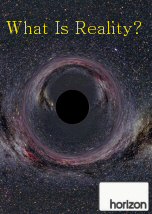
What Is Reality

   2011    Science
There is a strange and mysterious world that surrounds us, a world largely hidden from our senses. The quest to explain the true nature of reality is one of the great scientific detective stories. Clues have been pieced together from deep within the atom, from the event horizon of black holes, and from the far reaches of the cosmos. It may be that we are part of a cosmic hologram, projected from the edge of the universe. Or that we exist in an infinity of parallel worlds. Your reality may never look quite the same again.
20 Days in Mariupol

   2023    History
A team of Ukrainian journalists from The Associated Press trapped in the besieged city of Mariupol struggle to continue their work documenting atrocities of the Russian invasion. As the only international reporters who remain in the city, they capture what later become defining images of the war: dying children, mass graves, the bombing of a maternity hospital, and more.
Drawing on director Mstyslav Chernov's daily news dispatches and personal footage of his own country at war, the film is a vivid, harrowing account of civilians caught in the siege, as well as a window into what it's like to report from a conflict zone, and the impact of such journalism around the globe.

Black Code

   2017    Technology
Where big data meets big brother -- The story of how governments manipulate the internet to censor and monitor their citizens, and how those citizens are fighting back. This battle for control of cyberspace will challenge our ideas of privacy, citizenship and democracy to the very core. The film is a look at the global impact the internet has on free speech, privacy and activism.

Prehistoric Planet Freshwater

   2022    Science
In the third episode, a Velociraptor hunts pterosaurs on a cliffside by a waterfall. A battle-scarred Tyrannosaurus nurses his wounds and encounters a newcomer. With its feathered body and duck bill, the eight-ton Deinocheirus wades through an Asian wetland in search of relief from pesky biting flies.
A female Quetzalcoatlus builds and guards her nest. A mother Masiakasaurus and her family hunt crabs. Elasmosaurs enter an estuary in search of fish.
Series: Prehistoric Planet

Zappa

   2020    Art
An in-depth look into the life and work of the iconic artist and musician Frank Zappa. As a singer, songwriter, rock guitarist, classical composter, recording producer and even occasional film director, Frank Zappa was as difficult to describe as his eclectic music was throughout his 30-year career.
Zappa was without peer, a singular entity who branched out in countless directions, and in the process, became one of the most important and influential musical artists of the latter-20th century. With his most famous band, The Mothers of Invention, he blended rock, jazz, classical, doo-wop, R&B and avant-garde stylings with strange, sexually-tinged lyrics and absurd stage theatrics to create a wholly unique live experience, while in the studio producing outside-the-mainstream albums.

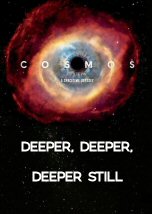
Deeper, Deeper, Deeper Still

   2014    Science
This episodes the nature of the cosmos on the micro and atomic scales, using the Ship of the Imagination to explore these realms. Tyson describes some of the micro-organism that live within a dew drop, demonstrating parameciums and tardigrades. He proceeds to discuss how plants use photosynthesis via their chloroplasts to convert sunlight into chemical reactions that convert carbon dioxide and water into oxygen and energy-rich sugars. Tyson then discusses the nature of molecules and atoms and how they relate to the evolution of species. He uses the example set forth by Charles Darwin postulating the existence of the long-tongued Morgan's sphinx moth based on the nature of the comet orchid with pollen far within the flower. He further demonstrates that scents from flowers are used to trigger olfactory centers in the brain, stimulating the mind to threats as to aid in the survival of the species. Tyson narrates how Greek philosophers Thales and Democritus postulated that all matter was made up of combinations of atoms in a large number of configurations, and describes how carbon forms the basic building block for life on earth due to its unique chemical nature. Tyson explains on the basic atomic structure of protons, neutrons, and electrons, and the nature of nuclear fusion that occurs in most stars. He then discusses the existence of neutrinos that are created by these nuclear processes in stars, and that detecting such sub-atomic particles which normally pass through matter require subterranean facilities like the Super-Kamiokande that were used to detect neutrinos from the supernova SN 1987A in the Large Magellanic Cloud before light from the explosion were observed due to their ability to pass through matter of the dying sun. Tyson compares how neutrinos were postulated by Wolfgang Pauli to account for the conservation of energy from nuclear reactions in the same manner as Darwin's postulate on the long-tongued moth. Tyson concludes by noting that there are neutrinos from the Big Bang still existing in the universe but due to the nature of light, there is a "wall of infinity" that cannot be observed beyond.
Series: Cosmos: A Spacetime Odyssey