











Last Watched

"Plant"  Sort by

Only the Dead

   2016    History
A war story unlike any ever seen. A story of what happens when one ordinary man, Time magazine war correspondent Michael Ware, transplanted into the Middle East by the reverberations of 9/11, butts into history. Ware handpicked and given a shattering video tape by the most feared, most hated terrorists on the planet to announce his arrival of the world stage sets out on an epic journey into the deepest recesses of the conflict as he seeks answers. Answers that he thinks will lead him to the Truth. The invasion of Iraq has ended, and the Americans are celebrating victory. The year is 2003. Alone and in secret one man, Abu Musab al Zarqawi is planning the real war. Step- by-step he lays out his plan in a letter to Osama bin Laden: the suicide truck bombings; the bloody horrors of the civil war; the televised beheadings. He carries out his grand design to transform the invasion into one of the most brutal conflicts our time and a catastrophe for the planet...and he does it all on camera. He gives the tape to Michael Ware. The tape sets our correspondent off on an epic voyage as he seeks answers. As he seeks what he thinks will be the Truth.


Boko Haram and Unnatural Selection

   2015    Culture
The terrorist group Boko Haram is responsible for thousands of deaths in Nigeria. Now, the government is determined to drive these militants from the country. But is the hunt for insurgents causing as much harm as it's preventing? Former Navy SEAL and new VICE correspondent Kaj Larsen travels to Nigeria to see what this cat-and-mouse game means for the people caught in the middle of the fight. 'Unnatural Selection': For centuries, scientists have been working to change the genetic traits of plants and animals. Now, the new gene-editing method CRISPR has made that process astonishingly simple - so simple it could easily be used on humans. Isobel Yeung reports from Brazil, Scotland, China and the U.S. on the technological advances that could reshape evolution as we know it.

Memory Hackers

   2016    Medicine
Memory is the glue that binds our mental lives. Without it, we’d be prisoners of the present, unable to use the lessons of the past to change our future. From our first kiss to where we put our keys, memory represents who we are and how we learn and navigate the world. But how does it work? Neuroscientists using cutting-edge techniques are exploring the precise molecular mechanisms of memory". By studying a range of individuals ranging —from an 11-year-old whiz-kid who remembers every detail of his life to a woman who had memories implanted— scientists have uncovered a provocative idea. For much of human history, memory has been seen as a tape recorder that faithfully registers information and replays intact. But now, researchers are discovering that memory is far more malleable, always being written and rewritten, not just by us but by others. We are discovering the precise mechanisms that can explain and even control our memories. The question is— are we ready?

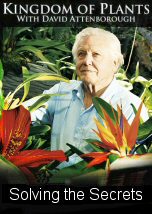
Solving the Secrets

   2012    Nature
Bladderwort utricularia is a pond-dweller that is among the fastest known, its traps snapping shut in less than a millisecond. As the seasons change, David demonstrates how plants operate on a different time scale to us; how they modify their lives according to the time of year. We discover insects’ hidden links with plants, both as pests and pollinators. UV-sensitive 3D cameras reveal the invisible alter-ego of plants and their flowers’ mesmerizing patterns; a parallel-dimension of strange colours and stunning patterns through which plants communicate with them. With the aid of visual effects, David steps among the swirling vortices of plant scent; communication signals with which plants are inextricably plugged in to the natural world. And using a tuning fork, he demonstrates how plants and insects can even communicate with music. As autumn envelopes the Gardens, fungi reveal themselves not as the enemies of plants but their vital allies. In Kew’s atmospheric Fungarium, David discovers a specimen that has the power of mind control and another that lives underground where it has grown to be so big it can be counted as the largest single organism on the planet. It is 6 times bigger than Kew Gardens itself.
Series: Kingdom of Plants

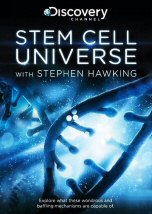
Stem Cell Universe with Stephen Hawking

   2014    Medicine
The use of embryonic stem cells has ignited fierce debate across the spiritual and political spectrum. But what if we could create manmade stem cells - or find super cells in adults that could forever replace embryonic cells and remove the controversy? Today, we are on the brink of a new era - an age where we may be able to cure our bodies of any illness. Stephen Hawking has spent his life exploring the mysteries of the cosmos, now there is another universe that fascinates him - the one hidden inside our bodies - our own personal galaxies of cells." Hawking takes us on a fascinating journey exploring what these wondrous and baffling mechanisms are capable of. He is joined by the scientists who are on the front lines of discovery in this field including Dr. Doris Taylor who is customizing a donor's heart with the recipient's stem cells - her goal is to revolutionize heart transplants, Dr. Paul Lu and Dr. Mark Tuszynski may have created a breakthrough that could cure paralysis, and Dr. Vincent Giampapa who believes that stem cells can be used to stem the tide of aging and create a fountain of youth.

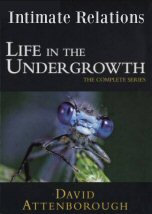
Intimate Relations

   2005    Nature
The world of invertebrates exists in a web of relationships with plants and other animals. Unique footage of the world's smallest insect (a fairy wasp only quarter of a millimetre long) shows it flying underwater to find the eggs of water beetles in which to lay its own brood. Some ants 'farm' the trees that give them shelter, creating areas known as 'Devil's gardens'. To make sure these grow without competition, they kill off other seedlings in the surrounding vegetation. The blister beetle's larvae huddle together on the end of a piece of grass and mimic a female bee. When a male bee tries to mate with the 'female', the larvae grab on to his belly. Confused, he flies away and searches for a real female. When he eventually finds her and mates with her, the beetle larvae hurriedly swap from his front on to her back, and hence get carried back to her nest where they eat her pollen supplies.
Series: Life in the Undergrowth
Sonic Highways

Sonic Highways

2014  Art
Asia

Asia

2024  Nature
Planet Earth

Planet Earth

2007  Nature
The Story of God

The Story of God

2016  Culture
Prehistoric Planet

Prehistoric Planet

2022  Science
The Making of the Mob

The Making of the Mob

2016  History
Rotten

Rotten

2018  Nature