





Last Watched

"Rat"  Sort by

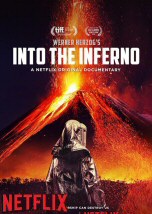
Into the Inferno

   2016    Nature
An exploration of active volcanoes in Indonesia, Iceland, North Korea and Ethiopia, Herzog follows volcanologist and co-director Clive Oppenheimer, who hopes to minimize the volcanoes’ destructive impact. What is the Herzog’s quest? To gain an image of our origins and nature as a species. He finds that the volcano—mysterious, violent, and rapturously beautiful—instructs us that, "there is no single one that is not connected to a belief system".

Unafraid of the Dark

   2014    Science
Tyson describes the discovery of cosmic rays by Victor Hess through high-altitude balloon trips. Swiss Astronomer Fritz Zwicky, in studying supernovae, postulated that these cosmic rays originated from these events instead of electromagnetic radiation. Also tells how Vera Rubin observed that the rotation of stars at the edges of observable galaxies did not follow expected rotational behavior leading to consider the existence of dark matter. This further led to the discovery of dark energy to account for the increasing rate of expansion of the universe. Tyson then describes the interstellar travel of the two Voyager probes. Tyson tells the Carl Sagan's role in the Voyager program, including creating the Voyager Golden Record to encapsulate humanity and Earth's position in the universe. Tyson concludes the series by emphasizing Sagan's message on the human condition in the vastness of the cosmos, and to encourage viewers to continue to explore and discover what else the universe has to offer.
Series: Cosmos: A Spacetime Odyssey

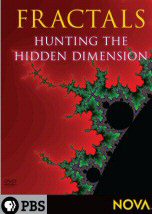
Fractals Hunting the Hidden Dimension

   2010    Science
The ultimate adventure in scientific inquiry, this fascinating program follows the exploits of a small group of pioneering mathematicians who discovered a whole area of study that is revolutionizing all branches of understanding in the world: fractal geometry. Fractals are most recognized as a series of circular shapes with a border surrounded by jagged "tail-like" objects. The program, aimed at the average viewer does a fine job of explaining the background of fractals, first by beginning with the story of Pixar co-founder, Loren Carpenter's work at Boeing, developing 3D terrain from scratch using fractals. From there the program starts at the beginning with an introduction to Benoit Mandelbrot and his revolutionary work. The explanations are full of solid factual information but never talk above the level of a viewer who has some understanding of basic mathematical principles. Once the concept is presented the program spends the rest of the time showing how prevalent the fractal is in life. For a program about a mathematical concept, "Fractals" is very engaging, showing how the process was applied to special effects as far back as the Genesis planet from "Star Trek II" all the way to the spectacular finale on Mustafar in "Star Wars: Episode III." I found myself astonished at how fractals were the source of the lava in constant motion and action during the Obi-Wan/Anakin fight. What is more amazing is when the program delves into practical applications such as cell phone antennas, and eventually the human body. For the average person who enjoys watching science related programs, even on a sporadic basis, "Fractals" will prove to be a very worthwhile experience. The program is well produced, integrating talking head interviews (including some with Mandelbrot himself) with standard "in the field" footage. The structure of the program is very logical and never finds itself jumping around without direction. In simplest terms, this is a program as elegant as the designs it focuses on.

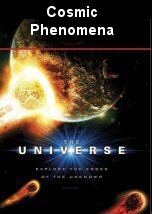
Cosmic Phenomena

   2009    Nature
A variety of cosmic events have both helpful and harmful effects on life on Earth. From the beauty of the Aurora Borealis and rainbows to the dangers of UV radiation and cosmic rays, from the miracle of photosynthesis to the thrill of a meteor shower, this episode explores how the effects generated by the sun and other extra-solar sources can literally get under our skin, scramble our technology, make life possible and threaten our existence all at the same time
Series: The Universe

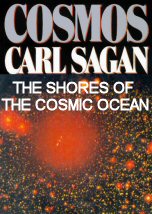
Cosmos Carl Sagan: The Shores of the Cosmic Ocean

   1980    Science
Carl Sagan opens the program with a description of the cosmos and the Spaceship of the Imagination. The ship journeys through the universe's hundred billion galaxies, the Local Group, the Andromeda Galaxy, the Milky Way, the Orion Nebula, our Solar System, and finally the planet Earth. Eratosthenes' successful calculation of the circumference of Earth leads to a description of the ancient Library of Alexandria. Finally, the Ages of Science are described, before pulling back to the full span of the Cosmic Calendar.
Series: Cosmos

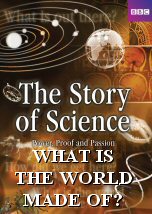
What is the World Made of

   2010    History
In this episode, Michael demonstrates how our society is built on our search to find the answer to what makes up everything in the material world. This is a story that moves from the secret labs of the alchemists and their search for gold by the stone of the philosophers to the creation of the world's first synthetic dye - Purple - and onto the invention of the transistor. This quest may seem abstract and highly theoretical. Yet it has delivered the greatest impact on humanity. By trying to answer this question, scientists have created theories from elements to atoms, and the strange concepts of quantum physics that underpin our modern, technological world.
Series: The Story of Science
Asia

Asia

2024  Nature
The Last Dance

The Last Dance

2020  Culture
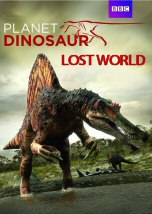
Planet Dinosaur

Planet Dinosaur

2011  Science
Top Gear

Top Gear

2012  Technology
Arnold

Arnold

2023  History
Natural World

Natural World

2009  Nature
How Earth Made Us

How Earth Made Us

2010  Science
Leaving Neverland

Leaving Neverland

2019  Culture