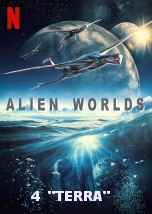
What sort of alien civilizations might exist in the vastness of space? Terra is the fictional world imagined in Episode 4, a planet nine billion years old, twice as old as Earth. Old enough that a truly advanced intelligence could evolve. It was once a fertile world, now it is barren. But life can still thrive here in artificial domes. Over time, they've evolved not to need their bodies. They exist only as neural tissue. They never age, they never die. They're monitored and maintained by robots. If alien civilizations are statistically so likely, why haven't astronomers found any sign of them? Where is everyone? Every time we look at an individual star, that's like dropping a bucket in the ocean. We're going to have to look at a lot of stars and to search through a lot of data until we find the clue that leads us to another civilization.
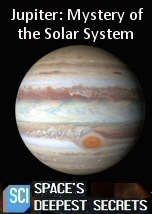
Jupiter is a turbulent world of monster magnetic fields and endless mega storms. Generations of astronomers have attempted to solve the mysteries of Jupiter, the most fierce and extreme planet in the Solar System. And now, NASA's Juno probe is revealing new evidence that could unlock the secrets of why this planet is so strange. With Juno, we're able to see Jupiter from the inside out and reach deep into its core to reveal how it grew.
The Blue Marble is an image of Earth taken on 1972, from a distance of about 18,000 miles from the planet's surface. It was taken by the crew of the Apollo 17 spacecraft on its way to the Moon. Before it was photographed from space, our perspective of Earth was fragmented and disconnected. Recent discoveries have revealed a dynamic and rapidly changing planet, above the crust and below.
This remarkable science-history series investigates the blistering pace of human endeavour in space exploration, computing, energy, resources, Earth science and our understanding of the evolution of life itself. Across the last 50 years, humans have set a blistering pace and scientific discovery. We've crossed the boundaries of our solar system, made machines that can learn harnessed the power of the sun and built life from scratch. It's a period like no other in history, where human endeavour is changing everything: this is The Great Acceleration. As we race toward the future, we must examine the journey. In the first episode, Dr Shalin Naik explores the ambitious space shuttle mission that began in the '70s plus the future colonization of Mars. Over the past 50 years, space has become central to everything, from communications to entertainment to climate modelling. And as private enterprise enters space exploration, our understanding of the universe will only continue to expand. We will know if we can survive on other objects - the moon, maybe Mars, maybe even some of the moons of Jupiter and Saturn. Deep space is the last and infinite frontier. That's what we do as human beings. We explore, we learn, we make discoveries, from the moment we're born to the moment we die.
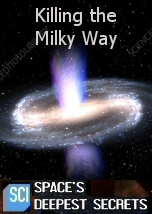
Across the universe, galaxies are going dark, and scientists don't know why the stars are losing their shine. Something is slowly drawing the curtains closed on the universe. Our milky way is under threat. Astronomers race against time to uncover the truth behind how galaxies are born and how they die before all of the lights go out.
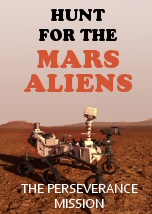
NASA's brand-new Mars rover is on the hunt for alien life, and with the help of cutting-edge engineering, scientists embark on a search for fossilized remains, which might prove the Red Planet was once home to a vast ocean and extraterrestrial life. Perseverance carries seven scientific instruments to study the Martian surface at Jezero crater. It carries several cameras and two microphones. The rover is accompanied by the helicopter Ingenuity, which will help Perseverance to scout for locations to study.























If alien civilizations are statistically so likely, why haven't astronomers found any sign of them? Where is everyone? Every time we look at an individual star, that's like dropping a bucket in the ocean. We're going to have to look at a lot of stars and to search through a lot of data until we find the clue that leads us to another civilization.