
Last Watched

"Pet"  Sort by

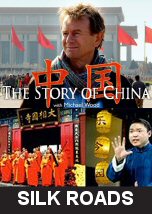
Silk Roads and China Ships

   2016    History
Michael Wood tells the tale of China's first great international age under the Tang Dynasty (618-907). From the picturesque old city of Luoyang, he travels along the Silk Road to the bazaars of central Asia and into India on the track of the Chinese monk who brought Buddhism back to China. This tale is still loved by the Chinese today and is brought to life by storytellers, films and shadow puppet plays. Then in the backstreets and markets of Xi'an, Michael meets descendants of the traders from central Asia and Persia who came into China on the Silk Road. He talks to Chinese Muslims in the Great Mosque and across town hears the amazing story of the first reception of Christianity in 635. Moving south, Michael sees the beginnings of China as an economic giant. On the Grand Canal, a lock built in 605 still handles 800 barges every day! The film tracks the rise of the silk industry and the world's favourite drink - tea. Michael looks too at the spread of Chinese script, language and culture across east Asia. 'China's influence on the East was as profound as Rome on the Latin West', he says, 'and still is today'. Finally, the film tells the intense drama of the fall of the Tang. Among the eyewitnesses were China's greatest poets. In a secondary school in a dusty village, where the Chinese Shakespeare - Du Fu - is buried in the grounds, the pupils take Michael through one famous poem about loss and longing as the dynasty falls. And in that ordinary classroom, there is a sense of the amazing drama and the deep-rooted continuities of Chinese culture.
Series: The Story of China
Bistro

   2017    Culture
A bistro is typically defined by its modesty – they are relatively small, affordable and humble. The bistro has become rather ubiquitous these days but despite its many incarnations, at its core, a bistro is a place where every man can eat, and eat well. With Petit Trois, Ludo Lefebvre has brought the spirit of the bistro to Los Angeles.
In this episode, Ludo brings us back to Paris to introduce us to some of the people and places that first inspired him to begin a culinary career.
Series: The Mind of a Chef

Strip Malls

   2017    Culture
Perhaps there is no architectural feature more distinctly Angeleno than a strip mall. The city is full of them with their busy facades and bright neon signage. Their wonderfully eclectic, multi-purpose tenants give shape and home to the multitudes of ethnic communities that make up LA’s diverse population.
Trois Mec and Petit Trois can be found side-by-side in a Hollywood strip mall, nestled between a dry cleaners and a Yum Yum donut. Ludo’s restaurants and the dishes he creates for them embody the cultural mash-up and high/low flair that is the strip mall philosophy.
Series: The Mind of a Chef

Fittest on Earth

   2017    Culture
The 2016 Reebok CrossFit Games were a gruelling five-day, 15-event test to find the fittest man and woman on Earth. The film follows the dramatic story of the top athletes who qualified and competed and offers an inside look at what it takes to be among the world's elite athletes, both in training and on the competition floor.
The CrossFit Games challenge competitors to perform intense physical tasks, but the hardest part is sometimes mental. Athletes often learn the details of the events only minutes before they begin, and everyone handles the pressure differently. Which of these fierce competitors will rise to the top and earn the title of Fittest on Earth?

AlphaGo

   2017    Technology
With more board configurations than there are atoms in the observable universe, the ancient Chinese game of 'Go' has long been considered a grand challenge for artificial intelligence. On March 9, 2016, the worlds of Go and AI collided in South Korea for an extraordinary best-of-five-game competition, coined the Google DeepMind Challenge Match. Hundreds of millions of people around the world watched as a legendary Go master took on an unproven AI challenger for the first time in history.
AlphaGo chronicles a journey from the halls of Cambridge, through the backstreets of Bordeaux, past the coding terminals of DeepMind in London, and, ultimately, to the seven-day tournament in Seoul. As the drama unfolds, more questions emerge: What can artificial intelligence reveal about a 3000-year-old game? What can it teach us about human mind?

Numbers as God

   2018    Science
Mathematician Dr Hannah Fry explores the mystery of maths. It underpins so much of our modern world that it's hard to imagine life without its technological advances, but where exactly does maths come from? Is it invented like a language or is it something discovered and part of the fabric of the universe? It's a question that some of the most eminent mathematical minds have been wrestling with. To investigate this question, Hannah goes head first down the fastest zip wire in the world to learn more about Newton's law of gravity, she paraglides to understand where the theory of maths and its practice application collide, and she travels to infinity and beyond to discover that some infinities are bigger than others.
In this episode, Hannah goes back to the time of the ancient Greeks to find out why they were so fascinated by the connection between beautiful music and maths. The patterns our ancestors found in music are all around us, from the way a sunflower stores its seeds to the number of petals in a flower. Even the shapes of some of the smallest structures in nature, such as viruses, seem to follow the rules of maths. All strong evidence for maths being discovered. But there are those who claim maths is all in our heads and something we invented. To find out if this is true, Hannah has her brain scanned. It turns out there is a place in all our brains where we do maths, but that doesn't prove its invented.
Experiments with infants, who have never had a maths lesson in their lives, suggests we all come hardwired to do maths. Far from being a creation of the human mind, this is evidence for maths being something we discover. Then along comes the invention of zero to help make counting more convenient and the creation of imaginary numbers, and the balance is tilted in the direction of maths being something we invented. The question of whether maths is invented or discovered just got a whole lot more difficult to answer
Series: Magic Numbers
Earth from Space

Earth from Space

2019  Nature
Long Way Up

Long Way Up

2020  Culture
Enemies of Reason

Enemies of Reason

  Medicine
How to Change Your Mind

How to Change Your Mind

2022  Medicine
Eden: Untamed Planet

Eden: Untamed Planet

2021  Nature
Trainwreck

Trainwreck

2025  Culture
Vice

Vice

2013  Culture