A mighty army of dolphins, sharks, whales, seals and gannets hunt down the billions of sardines along South Africa's east coast each winter. This is the Sardine Run: an underwater Armageddon, the greatest gathering of predators anywhere on the planet, and the most spectacular event in the world's oceans. From intimate moments of the creatures caught up in the run, to the dramatic finale of this spectacular event, The Great Tide is an action-packed feeding-frenzy, filmed underwater, on the ocean's surface, and in the air. However, in recent years the sardine run has become less predictable, perhaps due to the warming effects of climate change. If the sardine run does not happen, the lives of the animals caught up in the drama hang in the balance. Pioneering a unique boat stabilised camera mount for surface filming, Nature's Great Events crew capture all the high octane action as the predators compete for sardines, filmed with aerial, underwater and above water cameras. Super slow motion cameras also capture the very moment gannets plunge into the water, hitting it at sixty miles an hour. A violent winter storm is the trigger for the sardines to begin their desperate dash. They are followed by a super-pod of 5,000 dolphins and further up the coast more predators gather. A shoal of sardines 15 miles long is pushed into the shallows and aerial shots show thousands of sharks gathering to feed on them. The climax to the sardine run is a spectacular feeding frenzy as the dolphins round the sardines up into balls on which all the predators feast. Gannets rain down in their thousands, sharks pile in scattering the fish and a Bryde's whale lunges in taking great mouthfuls of sardines.
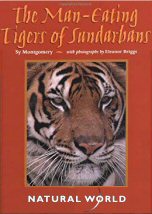
The Sundarbans mangrove forest, in Bangladesh near the Indian border, is a tidal jungle where Ganges and Brahmaputra enter the Indian Ocean. Its has some 400 Bengal tigers - the largest population in the world, and the only to be hardly scared of men. The downside is tigers kill up the 50 Bangladeshis a year, even from neighbouring villages, so keeping them inside the reserve is key to long-term survival. A recent project tries to train local mongrels, not pets but fiercely self-reliant dogs, to spot and even scare off tigers from villages. An individual tiger can turn into a man-eater in order to survive - this process may occur due to an injury or old age (and so cannot hunt agile prey) or even accidentally tasting human flesh.
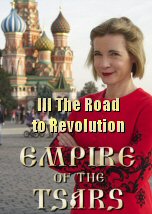
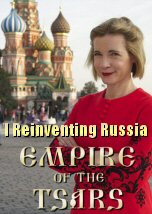
The years 1825-1918 were bloody and traumatic, a period when four tsars tried - and failed - to deal with the growing pressure for constitutional reform and revolution. In 1861, millions of enslaved serfs were freed by the Tsar-Liberator, Alexander II. But Alexander paid the ultimate penalty for opening the Pandora's box of reform when he was later blown up by terrorists on the streets of St Petersburg. Elsewhere, there was repression, denial, war and - in the case of the last tsar, Nicholas II - a fatalistic belief in the power of God, with Nicholas's faith in the notorious holy man Rasputin being a major part in his undoing. Lucy Worsley also details the chilling murder of Nicholas and his family in 1918, and asks whether all of this horror have been avoided.
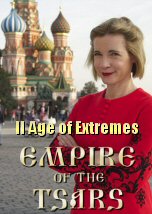
Lucy Worsley continues her journey through Russia in the footsteps of the Romanovs, the most powerful royal dynasty in modern European history. In this episode she examines the extraordinary reign of Catherine the Great, and the traumatic conflict with napoleonic France that provides the setting for the novel War and Peace. At the magnificent palace of Peterhof near St Petersburg, Lucy charts the meteoric rise of Catherine the Great, who seized the Russian throne from her husband Peter III in 1762 and became the most powerful woman in the world. Catherine was a woman of huge passions - for art, for her adopted country (she was German by birth) and for her many lovers. Catherine expanded her empire through military victories overseas, while at home she encouraged education and introduced smallpox inoculation to Russia. But Catherine struggled to introduce deeper reforms, and the institution of serfdom remained largely unchanged. Lucy explains how this injustice fuelled a violent rebellion. Nevertheless, Catherine left Russia more powerful on the world stage than ever. But all she had achieved looked set to be undone when Napoleon invaded Russia in 1812. Lucy relives the pivotal battle of Borodino, when the Russian army finally confronted the French forces; the traumatic destruction of Moscow; and, under Catherine's grandson Alexander, the eventual victory over the French that provided the Romanov dynasty with its most glorious hour.
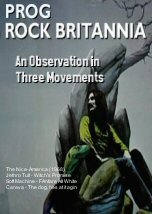
Documentary about progressive music and the generation of bands that were involved, from the international success stories of Yes, Genesis, ELP, King Crimson and Jethro Tull to the trials and tribulations of lesser-known bands such as Caravan and Egg. The film is structured in three parts, charting the birth, rise and decline of a movement famed for complex musical structures, weird time signatures, technical virtuosity and strange, and quintessentially English, literary influences. It looks at the psychedelic pop scene that gave birth to progressive rock in the late 1960s, the golden age of progressive music in the early 1970s, complete with drum solos and gatefold record sleeves, and the over-ambition, commercialisation and eventual fall from grace of this rarefied musical experiment at the hands of punk in 1977. Contributors include Robert Wyatt, Mike Oldfield, Pete Sinfield, Rick Wakeman, Phil Collins, Arthur Brown, Carl Palmer and Ian Anderson.
Lucy Worsley travels to Russia to tell the extraordinary story of the dynasty that ruled the country for more than three centuries. It's an epic tale that includes giant figures such as Peter the Great and Catherine the Great, the devastating struggle against Napoleon in 1812, and the political murders of Nicholas II and his family in 1918 which brought the dynasty to a brutal end. In this first episode, Lucy investigates the beginning of the Romanovs' 300-year reign in Russia. In 1613, when Russia was leaderless, 16-year-old Mikhail Romanov was plucked from obscurity and offered the crown of Russia. Lucy also charts the story of Peter the Great, the ruthless and ambitious tsar who was determined to modernise Russia at the end of the 17th century.







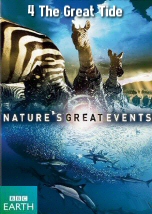




However, in recent years the sardine run has become less predictable, perhaps due to the warming effects of climate change. If the sardine run does not happen, the lives of the animals caught up in the drama hang in the balance. Pioneering a unique boat stabilised camera mount for surface filming, Nature's Great Events crew capture all the high octane action as the predators compete for sardines, filmed with aerial, underwater and above water cameras. Super slow motion cameras also capture the very moment gannets plunge into the water, hitting it at sixty miles an hour.
A violent winter storm is the trigger for the sardines to begin their desperate dash. They are followed by a super-pod of 5,000 dolphins and further up the coast more predators gather. A shoal of sardines 15 miles long is pushed into the shallows and aerial shots show thousands of sharks gathering to feed on them. The climax to the sardine run is a spectacular feeding frenzy as the dolphins round the sardines up into balls on which all the predators feast. Gannets rain down in their thousands, sharks pile in scattering the fish and a Bryde's whale lunges in taking great mouthfuls of sardines.