




Last Watched

"The Universe"  Sort by

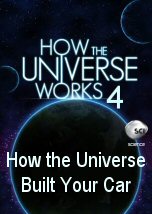
How the Universe Built Your Car

   2015    Science
See as never before in this series the inner workings of our world, and explore black holes, supernovae, neutron stars, dark energy, and all the titanic forces that make us. A users guide to the cosmos from the big bang to galaxies, stars, planets and moons. Where did it all come from and how does it all fit together. A primer for anyone who has ever looked up at the night sky and wondered". Beneath the hood of your car lies the history of the Universe. The iron in your chassis, the gold in your stereo and the copper in your electronics all owe their existence to violent cosmic events that took place billions of years ago.
Series: How the Universe Works Season 4
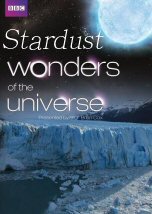
Stardust

   2011    Science
In the second stop in his exploration of the wonders of the universe, Professor Brian Cox goes in search of humanity's very essence to answer the biggest questions of all: what are we? And where do we come from? This film is the story of matter - the stuff of which we are all made. Brian reveals how our origins are entwined with the life cycle of the stars. But he begins his journey here on Earth. In Nepal, he observes a Hindu cremation. Hindu philosophy is based on an eternal cycle of creation and destruction, where the physical elements of the body are recycled on to the next stage. Brian draws a parallel with the life cycle of the stars that led to our own creation. Next, he explains how the Earth's resources have been recycled through the ages. How every atom that makes up everything we see, was at some time a part of something else. Our world is made up of just 92 elements, and these same 92 elements are found throughout the entire universe. We are part of the universe because we are made of the same stuff as the universe.
Series: Wonders of the Universe

Unafraid of the Dark

   2014    Science
Tyson describes the discovery of cosmic rays by Victor Hess through high-altitude balloon trips. Swiss Astronomer Fritz Zwicky, in studying supernovae, postulated that these cosmic rays originated from these events instead of electromagnetic radiation. Also tells how Vera Rubin observed that the rotation of stars at the edges of observable galaxies did not follow expected rotational behavior leading to consider the existence of dark matter. This further led to the discovery of dark energy to account for the increasing rate of expansion of the universe. Tyson then describes the interstellar travel of the two Voyager probes. Tyson tells the Carl Sagan's role in the Voyager program, including creating the Voyager Golden Record to encapsulate humanity and Earth's position in the universe. Tyson concludes the series by emphasizing Sagan's message on the human condition in the vastness of the cosmos, and to encourage viewers to continue to explore and discover what else the universe has to offer.
Series: Cosmos: A Spacetime Odyssey

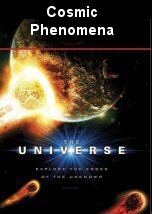
Cosmic Phenomena

   2009    Nature
A variety of cosmic events have both helpful and harmful effects on life on Earth. From the beauty of the Aurora Borealis and rainbows to the dangers of UV radiation and cosmic rays, from the miracle of photosynthesis to the thrill of a meteor shower, this episode explores how the effects generated by the sun and other extra-solar sources can literally get under our skin, scramble our technology, make life possible and threaten our existence all at the same time
Series: The Universe

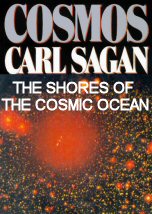
Cosmos Carl Sagan: The Shores of the Cosmic Ocean

   1980    Science
Carl Sagan opens the program with a description of the cosmos and the Spaceship of the Imagination. The ship journeys through the universe's hundred billion galaxies, the Local Group, the Andromeda Galaxy, the Milky Way, the Orion Nebula, our Solar System, and finally the planet Earth. Eratosthenes' successful calculation of the circumference of Earth leads to a description of the ancient Library of Alexandria. Finally, the Ages of Science are described, before pulling back to the full span of the Cosmic Calendar.
Series: Cosmos

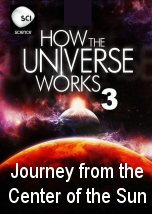
Journey from the Center of the Sun

   2014    Science
How does light escape from the sun? We take a journey from the center of the sun, following the path of light. We witness its fiery birth from in the core, its 430,000 mile battle against gravity and magnetism, and its escape from the solar surface.
Series: How the Universe Works
The Story of India

The Story of India

2007  History
The Big Think

The Big Think

2017  Technology
Myths and Heroes

Myths and Heroes

2005  History
Hiroshima

Hiroshima

2005  History
The Art Mysteries

The Art Mysteries

2020  Art
Leaving Neverland

Leaving Neverland

2019  Culture
The Life of Mammals

The Life of Mammals

2002  Nature