





Last Watched

" The Universe"  Sort by

The Hawking Paradox

   2005    Science
Stephen Hawking is the most famous scientist on the planet. But behind the public face lies an argument that has been raging for almost 30 years. Has he been wrong for the last 30 years? Hawking shot to fame in the world of physics when he provided a mathematical proof for the Big Bang theory. This theory showed that the entire universe exploded from a singularity, an infinitely small point with infinite density and infinite gravity. Hawking was able to come to his proof using mathematical techniques that had been developed by Roger Penrose. These techniques were however developed to deal not with the beginning of the Universe but with black holes". Science had long predicted that if a sufficiently large star collapsed at the end of its life, all the matter left in the star would be crushed into an infinitely small point with infinite gravity and infinite density – a singularity. Hawking realised that the Universe was, in effect, a black hole in reverse. Instead of matter being crushed into a singularity, the Universe began when a singularity expanded to form everything we see around us today, from stars to planets to people. Hawking realised that to come to a complete understanding of the Universe he would have to unravel the mysteries of the black hole and its paradoxes
Swallowed by a Black Hole

   2013    Science
The black hole at the centre of the Milky Way is getting ready to feast. A gas cloud three times the size of our planet has strayed within the gravitational reach of our nearest supermassive black hole. And across the globe, telescopes are being trained on the heart of our Milky Way galaxy, some 27,000 light years from Earth, in the expectation of observing this unique cosmic spectacle. For cosmic detectives across the Earth, it is a unique opportunity. For the first time in the history of science, they hope to observe in action the awesome spectacle of a feeding supermassive black hole.

The Story of Maths The Language of the Universe

   2008    Science
This four-part British television series outlines aspects of the history of mathematics. Written and presented by University of Oxford professor Marcus du Sautoy, it is a co-production between the Open University and the BBC. In the first episode, Marcus du Sautoy in Egypt uncovers use of a decimal system based on ten fingers of the hand and discovers that the way we tell the time is based on the Babylonian Base 60 number system. In Greece, he looks at the contributions of some of the giants of mathematics including Plato, Archimedes and Pythagoras, who is credited with beginning the transformation of mathematics from a counting tool into the analytical subject of today. A controversial figure, Pythagoras’ teachings were considered suspect and his followers seen as social outcasts and a little be strange and not in the norm. There is a legend going around that one of his followers, Hippasus, was drowned when he announced his discovery of irrational numbers. As well as his work on the properties of right angled triangles, Pythagoras developed another important theory after observing musical instruments. He discovered that the intervals between harmonious musical notes are always in whole number intervals.
Series: The Story of Maths

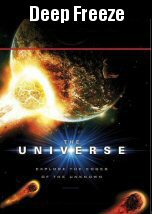
Deep Freeze

   2012    Science
There is an extraordinary range of temperatures in the universe. This program examines the extreme lower temperature range, the temperature we live in and below, explaining how cold is essential for the formation of habitats suitable for life. Explore icy planets and moons, discover the role of cold in the Universe, and learn about the importance of ice to the development of habitable worlds.
Series: The Universe

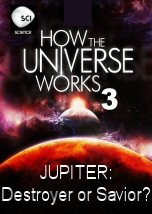
Jupiter: Destroyer or Savior

   2014    Science
Beneath Jupiter's swirling clouds lie our solar system's deepest secrets: from its violent youth, through the birth of life to the death of the sun. Now, scientists are unlocking these secrets and discovering that every living thing exists thanks to Jupiter.
Series: How the Universe Works

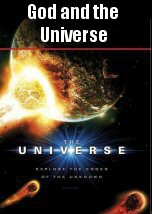
God and the Universe

   2011    Science    3D    HD
Since the dawn of civilization, humans have wondered who or what created the universe. Religion offers a spiritual answer, but do the latest discoveries in physics show evidence of a transcendent intelligence, or simply that the laws of physics by themselves could have led to the universe in which we live? This episode embarks on a mind-bending scientific search for God, asking physicists and theologians if the seemingly miraculous way the universe has been calibrated to support life is evidence of a creator...whether string theory will eventually be able to rule out the existence of God...why Stephen Hawking says the universe could have been created spontaneously...and how an advanced civilization in another universe could have conceivably created our own.
Series: The Universe
Long Way Up

Long Way Up

2020  Culture
Mammals

Mammals

2024  Nature
The Story of India

The Story of India

2007  History
Trainwreck

Trainwreck

2025  Culture
Out of the Cradle

Out of the Cradle

2019  History
Frozen Planet II

Frozen Planet II

2022  Nature
The Story of God

The Story of God

2016  Culture
Leaving Neverland

Leaving Neverland

2019  Culture