










Last Watched

"Lion"  Sort by

Land of Giants

       Science
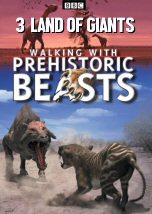
25 million years ago the biggest land mammals of all time, the indricotheres, stalked the Earth. Up to seven metres tall and weighing 15 tonnes, adults were too big to be eaten by any predator of the time. Only in the first few years of its life was indricotheres vulnerable. The programme follows the fate of a calf from his traumatic birth to see whether it can survive droughts, killer hogs and hyaenodon - a predator the size of a rhino with jaws that could crush a rock.
Series: Walking with Prehistoric Beast
Whale Killer

       Science
Moving on to the Late Eocene period 36 million years ago and mammals have prospered and are now the largest creatures on land and sea. This is an era of animals like andrewsarchus, the biggest mammal carnivore ever to walk on land, and the brontotheres, small-brained herbivores. It is in the sea, however, that the most monstrous mammals of all can be found. We follow the fate of a female basilosaurus, a huge serpent-like early whale, but nothing like the gentle filter feeding whales of the 21st century. Four times the length of the great white shark, with jaws to match, she is every inch a killer.
Series: Walking with Prehistoric Beast
New Dawn

       Science
The series takes place after the extinction of the dinosaurs 65 million years ago and recreates animals of the Cenozoic with computer-generated imagery and animatronics. The first episode starts 49 million years ago, when Earth has fully recovered from the dinosaur extinction and is covered in a mysterious forest. This is a time that the world has almost forgotten - Germany was a hot sweaty jungle, birds ruled the earth and preyed on miniature horses and whales walked on land.
Series: Walking with Prehistoric Beast

Triumph

   2015    Science    3D    HD
David Attenborough concludes his epic history of the evolution of flight with an exploration of the highly advanced fliers that dominate our skies today – the extraordinarily diverse skills of the birds, and the sonar-guided precision of the bats. He encounters some of our planet’s most remarkable fliers – from peregrine falcons dive-bombing starlings over Rome, to hummingbirds hovering in the cloud forests of Ecuador. In a spectacular finale, he visits Gomantong cave in Borneo to witness the mass exodus of a million bats.
Series: Conquest of the Skies

Rivals

   2015    Science    3D    HD
David Attenborough continues his search for the origins of flying animals, as he charts the rise of new, larger creatures – extinct reptiles that flew on wings of skin, dinosaurs that sprouted feathers to become the ancestors of birds, and gliding mammals that emerged from a life in the trees to dominate the night as bats. His journey spans the globe – from the rainforests of Borneo to see bizarre gliding animals, to China and its new discoveries of dinosaur fossils. Stunning CGI brings to life creatures that disappeared over 200 million years ago, and new filming techniques bring us closer than ever to the secrets of flight itself.
Series: Conquest of the Skies

Catholicism The unpredictable rise of Rome

   2011    Culture
Over one billion Christians look to Rome, more than half of all Christians on the planet. But how did a small Jewish sect from the backwoods of 1st-century Palestine, which preached humility and the virtue of poverty, become the established religion of western Europe - wealthy, powerful and expecting unfailing obedience from the faithful? Amongst the surprising revelations, Professor MacCulloch tells how confession was invented by monks on a remote island off the coast of Ireland, and how the Crusades gave Britain the university system. Above all, it is a story of what can be achieved when you have friends in high places.
Series: A History of Christianity