Led by Prince William, founder of The Earthshot Prize and featuring Sir David Attenborough and other members of the Earthshot Prize Council, the series looks past the problems we face and onto the solutions that promise to deliver us all a sustainable world in which both nature and humanity can thrive. In the first episode, David Attenborough introduces us to inspiring people with solutions to help restore nature, and reveals the three finalists of the first ever Earthshot Prize for Nature.
David Attenborough and the world-renowned scientist Johan Rockström examine Earth's biodiversity collapse. The film explains how humanity has pushed our planet beyond the boundaries that have kept it stable since the dawn of life, but also that this crisis can still be averted, thinking and acting with one unified purpose to ensure that Earth forever remains healthy and resilient.
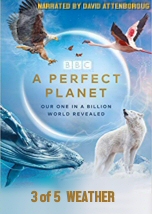
Weather controls the distribution of freshwater on Earth. David Attenborough narrates how this uneven distribution has given rise to an incredible diversity of species and habits, from the driest desert to the lushest tropical rainforest. Featuring a colony of ants banding together into a raft every time its home in the Amazon floods, a rain frog that manages to eke out an existence in one of the world's driest habitats on Earth, and the last wild camels that survive the Gobi Desert's bitter winters by eating snow that blows in from Siberia.
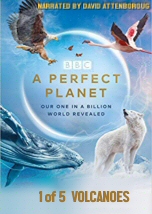
Our planet is one in a billion. How incredible, awe-inspiring life is driven by its natural forces - and how we can ensure humans become a force for good. David Attenborough narrates a series revealing how the forces of nature drive, shape and support the Earth's great diversity of life. The first edition examines volcanoes, which responsible for both for the planet's breathable atmosphere and the oceans, but are also the architects of the planet, with over 80% of the Earth's surface being the result of magma bursting up from the molten interior - providing a platform for life.
David Attenborough reveals the extraordinary ways that some animals use colour to hide and disappear into the background. New science reveals how the Bengal tiger in central India uses its orange-black stripes to hide from its colour-blind prey. In Kenya’s Masai Mara, the zebra’s black-and-white pattern confuses predators with an extraordinary effect called motion dazzle. And on the island of Cuba, a small snail uses colourful stripes in a surprising way to hide from its enemies. Other animals use colour to trick and to deceive. On Australia’s Great Barrier Reef, a blue-striped blenny uses colours to mimic other fish and launch a sudden attack. In the grasslands of Zambia, the chick of a pin-tailed whydah mimics the patterns of its nest mates to ensure that it is not detected as an imposter. And specialist cameras reveal how a tiny crab spider uses bright ultraviolet colours to lure in its victims.
The natural world is full of colours. For us, they are a source of beauty, but for animals they are a tool for survival. David Attenborough reveals the extraordinary ways in which animals use colour: to win a mate, to fight off rivals and to warn enemies. New camera technologies - some developed especially for this series – also allow us to see colours and patterns usually invisible to human eyes. Ultraviolet cameras reveal bright signals on a butterfly’s wings and facial markings on yellow damselfish that are used as secret communication channels. Some animals can also detect polarized light, and specialist cameras can now show us how fiddler crabs see the world, and how mantis shrimp have strange polarization patterns on their bodies to signal to a mate or rival.
















In the first episode, David Attenborough introduces us to inspiring people with solutions to help restore nature, and reveals the three finalists of the first ever Earthshot Prize for Nature.